

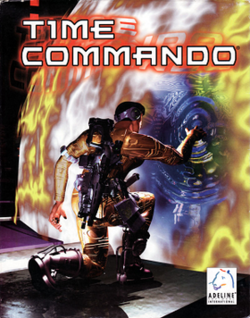

Time Commando arrives with the confidence of someone who has clearly read the marketing brief and immediately filed it under 'ambitious chaos'. You play Stanley Opar, a S.A.V.E. operative whose job description apparently includes walking into a time vortex to wrestle a computer virus. That virus, helpfully named the "Predator Virus," is doing what every good villain does in 1996: threatening to swallow the world unless you deposit enough chips in orb pools and punch your way through a parade of historically themed enemies. The game's premise is the sort of high concept that makes a decent party anecdote: military simulator, corporate sabotage, artificial vortex, time periods from caveman to future, and a final level inside the computer itself. It also smells faintly of a studio trying to deliver something flashy for the holidays after deciding their original idea needed at least one more year. Adeline Software set out to make a quick, small, simple game to tide over impatient players waiting for more Little Big Adventure. The result is neither entirely small nor entirely simple, but it is unavoidably interesting to watch when it trips over its own ideas. If you play the PlayStation port now, you'll be judging it twice: first as a 1996 action-adventure experiment that dared to stitch epochs together, and second as a time capsule that proves good ambition does not always equal good execution. The tone of Time Commando is earnest; its animations and controls are... enthusiastic. That combination makes for a game that is often more memorable for how it moves than for what it does, which is kind of impressive in its own way.
Time Commando is built around a single conceit: send one man into lots of different eras and let him collect era-appropriate weapons until the game feels complete. Each level is a self-contained time period-Prehistoric, Roman Empire, Feudal Japan, Medieval, Conquistador, Wild West, Modern Wars, Future, and finally Virus World-populated by enemies that match the wallpaper. Cavemen throw rocks. Romans fling sandals and spears, in spirit if not in animation. Cowboys attempt to be menacing. The modern and future levels work hard to look mean, and the final levels work even harder to look digital. Stanley has a small life bar and multiple lives. The life bar grows when you pick up health power-ups, which is the game's way of rewarding exploration and vaguely rewarding you for poking around. The more interesting mechanic is the time bar, a slowly filling meter that represents how quickly the Predator Virus is eating the level. This timer is not a polite countdown; it is a looming presence that encourages you to be productive. You slow down the encroaching doom by collecting computer chips strewn around each level and depositing them in orb pools that resemble the vortex that started the whole mess. Think of the orb pools as the game's version of doing your chores: deposit chips, delay apocalypse. Weapons are strictly era-appropriate, which is both entertaining and mechanically sensible: you won't be swinging a katana in the Roman arena unless the script allows it. The variety keeps combat flavorful. The problem is not the idea but the execution. The PlayStation version inherited the game's full-motion-video style backgrounds and prerendered camera angles, which makes combat feel like trying to land a plane while the controls occasionally decide to be impatient. Several reviewers at the time (and likely a few players now) noted that animations are stiff and that landing hits on enemies can feel like a polite suggestion rather than a guaranteed outcome. This is compounded by the FMV-style scrolling, which sometimes turns the camera into an enthusiastic but unhelpful participant. The game's engine was a reworked version of the one used in Little Big Adventure, rewritten to be faster and to have somewhat improved animations. That shows-Time Commando looks better than it had any right to on mid-'90s hardware. But improving the engine is not the same as designing tight, responsive controls. The combat has a clunky, weighty feel that can be enjoyable in short bursts and maddening in long runs. Some critics praised the concept and the weapon variety while dinging the hit detection and pacing. One contemporary reviewer described the animations as unintentionally humorous, which, if you are the sort of person who enjoys laughing at things that try very hard, is a feature not a bug. Pacing is a recurring issue. When not engaged in fights, Stanley moves with the kind of deliberate slowness that encourages you to admire the background art and question your life choices. GamePro summed it up well: the game is essentially good, but players will need an unusually high amount of patience to enjoy it. Which is fair. If you bring patience, a tolerance for occasional control hiccups, and a taste for thematic weapon sets, Time Commando will serve you an experience that is distinctive and occasionally brilliant. If you prefer your action games with crisp inputs and predictable physics, this will frustrate you. The PlayStation port specifically received mixed reviews: GameSpot gave it a reasonably positive nod for visuals and innovation while acknowledging control problems; Electronic Gaming Monthly liked the concept and weapons but criticized the animations and difficulty; Next Generation called it visually appealing but repetitive and twitchy. The design choices-shorter levels, an ever-present timer, and era-based arsenals-aim for variety and urgency. The result is a curious hybrid: some levels are tight and enjoyable, others feel padded or repetitive, and the timer can make exploration feel rushed even though the game itself sometimes moves at a leisurely clip. For modern players, the novelty is the hook. Time Commando is less about perfect combat loops and more about the pleasure of seeing a caveman, a legionary, and a cowboy in the same curriculum vitae. For nostalgia-seekers and those who enjoy the odd matchmaking of eras, there is a lot to like. For those who want exacting modern controls and frame-perfect collisions, prepare to grit your teeth and enjoy the music.
Visually, Time Commando is ambitious and mostly successful for its era. Adeline Software leaned into graphics when development began-partly because they were trying to produce a 'quick' game with visual punch-and the PlayStation port benefits from that focus. The 3D engine is a rewritten, faster iteration of the Little Big Adventure engine, which translates into smoother, more detailed environments and slightly improved animations. That improvement is visible: backgrounds and set pieces are often richly detailed, the eras are distinct, and the digital final levels lean into a nicely stylized 'computer world' aesthetic. The downside is where the visuals meet movement. Animations can be stiff or oddly choreographed; the result is sometimes unintentionally comic. Reviewers at the time noted this, with two EGM critics specifically finding amusement in how the characters moved when physics clearly had a different agenda. The FMV-style camera and prerendered backgrounds mean the game sometimes feels like a puppet show where the strings are inaccessible to the player. When combat clicks, the visuals make it feel dramatic. When it doesn't, the characters' lumbering animations make a close-quarter fight look like a slow, awkward dance. Soundtrack and audio are functional and occasionally stirring. Philippe Vachey composed the music, and the PC CD-ROM version contained a couple of audio tracks that most players will remember less than the main themes. The PlayStation audio complements the visuals without stealing scenes. The overall presentational package is that of a game that spent its budget on looking interesting, which mostly worked, and sometimes worked too hard. There is also charm in the visual mismatch: detailed environments with slightly off-kilter animations create a surreal atmosphere that is hard to replicate. It's the sort of visual memory that lodges in your head; not because it is perfect, but because it is distinct.
Time Commando is the kind of game that demonstrates how personality can cover for, or at least disguise, design quirks. It's ambitious in concept-send a single operative across history to fight a computer virus-and that ambition is visible in the era variety, weapon design, and visual flair. The game is earnest, occasionally brilliant, and occasionally infuriating. It wants you to be on your toes thanks to the time bar and orb pools, but it also moves like someone who has all the time in the world and enjoys scenic route combat. Critical reception at the time reflected that split personality. Some outlets praised the visuals and concept while docking points for control and animation issues. Sales were decent-over 500,000 units by 1999-so apparently enough players tolerated the pacing and quirks to recommend it to friends. The PlayStation port is a faithful and mostly attractive translation of the PC original, but it inherits the same twitchy control complaints and uneven animation work. If you play Time Commando now, treat it like a historical artifact with a working time machine: enjoy the eras, laugh politely at the animations, and prepare to be patient. If you're collecting retro oddities, or you like your action games with a strong personality and a hint of chaos, you will find value here. If you want buttery-smooth controls and modern responsiveness, this is not your rescue mission. Score: 6.5/10. Time Commando is interesting, occasionally lovely, and sometimes maddening-much like doing archaeology while the GPS constantly insists the site is somewhere else. That said, it is worth a try for anyone curious about mid-90s experimentation in action-adventure design, or anyone who finds joy in games that try a lot of things at once and occasionally trip over their own shoelaces.
 Time Crisis on PlayStation
 TimeShift on PS3
 Tintin: Destination Adventure on PlayStation
 One Piece Grand Adventure on PS2
 Taiko no Tatsujin: Dokodon! Mystery Adventure on Switch
 Onimusha: Dawn of Dreams on PS2












 Another SquareThought Site