

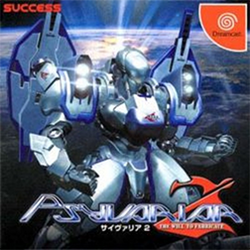

Psyvariar 2: Ultimate Final (released in arcades as Psyvariar 2: The Will to Fabricate) is the 2003/2004 follow-up from SKONEC that takes the vertically scrolling shooter template and leans into arcade pedigree. Originally built on Sega's NAOMI hardware and distributed by Success, the title later found its way to Dreamcast, Xbox and - the subject of this review - PlayStation 2. As a technical case study it's interesting: a coin-op designed for tight input response and high frame-rate expectations, ported to a sixth-generation console with very different hardware assumptions. If you care about how a shooter breathes on home hardware - frame pacing, input latency, and graphical fidelity versus performance tradeoffs - Psyvariar 2 is worth dissecting.
Psyvariar 2 is a single-player vertical shoot 'em up born in the arcade, which informs everything from its pacing to risk-reward systems. The source material emphasizes short, intense runs and dense on-screen action rather than sprawling level exploration, so the PS2 port's role is to preserve that arcade feel while translating coin-op constraints to a living-room session. From a technical gameplay standpoint the priorities are responsiveness and consistent collision detection. A shooter like this demands a tight input-to-action pipeline: button press, immediate sprite update, and an exact hitbox for both player and bullets. The NAOMI architecture - very similar to Dreamcast - handles those demands naturally with predictable timing. On PS2 the developers had to re-implement or emulate that timing layer without native NAOMI hardware. Control mapping on the DualShock 2 matters here. The original arcade layout is simple (movement and a couple of attack options), so the PS2's face buttons and shoulder buttons are sufficient, but subtle differences in deadzone handling and analog stick sampling can make a measurable difference in maneuver precision. Good ports normalize analog sampling to remove inconsistent input steps and match the arcade's discrete feeling movement. Where Psyvariar 2 succeeds is in preserving the vertical scrolling tempo: enemy waves come in tight patterns that demand micro-adjustments and split-second decisions. The PS2 build appears tuned to maintain the arcade's pace rather than artificially smoothing or throttling it for home play. Difficulty curve and scoring systems are inherently technical design elements. Arcade roots mean the scoring and enemy behaviors are designed to be learned and exploited; this results in emergent mechanical depth rather than purely bullet-dodging spectacle. Chain windows, enemy spawn timing and reward placement are all handled by deterministic timers and object pools - something that can break or feel different when CPU time is variable. SKONEC's approach in the PS2 version is to keep those deterministic behaviors consistent, which preserves high-level strategies that veteran players expect. That said, the lack of expansive options menus or modern QoL features like rollback-style input buffering or adjustable frame rates means you're committing to the original ruleset and its limitations. Where the port shows its age is in extras and presentation. Arcade-to-home conversions live or die on the little technical add-ons: continue-insertion behavior, difficulty toggles, leaderboard persistence, replays and attract-mode transfers to video. The PS2 release keeps things lean; the technical philosophy is fidelity over frills. If you want a port that tries to emulate the NAOMI experience as closely as possible on PS2 silicon, this is it. If you're expecting the era's usual buffet of remixed modes, widescreen options and rewind functions, the package is sparse.
Graphically Psyvariar 2 sits at the intersection of sprite-based design and modern GPU-assisted effects. The NAOMI hardware the game was authored on handled large sprite counts and fast scaling natively, so a faithful port must replicate heavy overdraw and alpha-blended particle systems on the PS2's Emotion Engine and Graphics Synthesizer pipeline. That becomes a question of draw call reorganization and shader-like tricks implemented via fixed-function blending rather than programmable shaders. On PS2 the result is competent but revealing: sprite art and enemy design maintain their crispness, but the console's notorious texture handling and limited VRAM mean developers must be careful with streaming and palette use. Expect occasional texture popping or simplified particle effects compared to the arcade, especially during boss encounters when multiple large sprites and background layers are active. The engine tries to prioritize frame-rate over visual fidelity - an appropriate decision for a shmup where hit recognition and readability are paramount - but this trade produces a slightly flatter look in the busiest moments. Transparency sorting and alpha blending can also highlight the PS2's limitations; when many semi-opaque bullet effects overlap, the console sometimes resorts to draw-order compromises that alter visual layering. It rarely impacts gameplay negatively, but enthusiasts who enjoy pixel-perfect sprite rendering might notice differences versus the Dreamcast or Xbox builds. Performance-wise the target is smooth vertical scrolling and stable 60Hz behaviour. The arcade original expects a high refresh rhythm for consistent timing, and the PS2 port generally adheres to that performance target. Where the hardware strain is greatest - large boss fights, extensive particle showers - you may see micro-stutters or frame pacing unevenness. These are not game-breakers but are measurable; they reflect the classic tension in porting: either cut cosmetic effects to guarantee sample-perfect timing, or preserve the look and accept small timing variances. SKONEC's PS2 build clearly opts for preserving the arcade's look to an extent, then leans toward performance preservation rather than lavish graphical enhancements exclusive to more powerful contemporary hardware like Xbox.
Psyvariar 2: Ultimate Final on PS2 is an interesting specimen for anyone who likes to look under the hood of arcade-to-console ports. The technical priorities shine through: maintain input responsiveness, preserve deterministic enemy and scoring behavior, and keep frame-rate high enough for precise play. The PS2 version doesn't try to be a content-packed remaster; it trades extra modes for fidelity to the original arcade intent. That decision makes the release feel authentic, though it also makes the package feel lean compared to other ports of its era. Fans of tightly tuned vertical shooters who can forgive the occasional graphical concession and the lack of modern comfort features will find a solid and satisfying shooter here. For those expecting a disc full of extras or a heavily upscaled visual overhaul, the PS2 port may come across as a faithful but modest translation. Overall, it's a technically respectable port and a good fit for players who value gameplay precision over bells-and-whistles - score: 7.5/10.
 Psyvariar Revision on PS2
 Psyvariar: Medium Unit on PS2
 PixelJunk Shooter 2 on PS3
 PixelJunk Shooter on PS3
 Plants vs. Zombies: Garden Warfare on PS3
 PixelJunk SideScroller on PS3












 Another SquareThought Site