

 Aug 2025
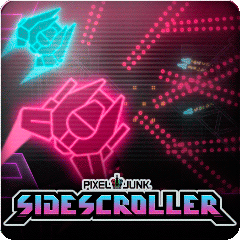

There is a small, stubborn corner of every gamer's skull where the coin-op cabinet still lives, its CRT glowing green, the joystick sticky with decades of endurance. PixelJunk SideScroller is the kind of downloadable experiment that reaches back to that corner, dusts off the coin slot and asks the player to deposit a virtual quarter. Developed by Q-Games and spun off from a bonus stage in PixelJunk Shooter 2, SideScroller is an arcade-minded scrolling shooter that wears its influences openly: vector-style lines, relentless pacing, and an emphasis on scoring and survival rather than sprawling narrative. If you are looking for a sprawling epic in the mold of contemporary triple-A campaigns, this is not that. If you want a compact testament to design economy - a little black-and-green arcade heart beating on your HD television - this is closer to the mark.
PixelJunk SideScroller cleaves to the simple, efficient DNA of classic side-scrolling shooters and then remixes it through a PixelJunk sensibility: tight controls, procedural flourish, and levels designed like a set of compact playgrounds for destruction. The game borrows its bones from the "Road to Dawn" bonus stage of PixelJunk Shooter 2, which explains both the familiarity and the confidence of the design. The player pilots a craft through neon-etched corridors, confronting waves of enemies and environmental hazards with an arsenal that feels deliberately modest. Weapon pick-ups and power-ups are less about bewildering variety and more about meaningful choices: do you grab the heavy-hitting, short-lived charge weapon, or conserve for the homing missile that lets you breathe around tricky geometry? The primary pleasure is rhythm. Enemies arrive in patterns that suggest careful choreography rather than random spawn points, and the game rewards recognition: once you learn a wave's cadence, you can thread through it with that peculiar satisfaction that only comes from executing a plan you memorized. There is an arcade logic at work, too, where score multipliers and survival forges a loop of escalating tension. Dying is rarely punitive in the modern sense - you restart from a reasonable checkpoint - but it does reset the score multiplier and the player's internal momentum, which is punishment enough when you feel the rhythm slipping away. SideScroller also includes cooperative multiplayer, which is presented as a welcome, old-fashioned feature rather than a bolt-on modern convenience. Playing with another person turns the game into a duet: there are moments of beautiful chaos where two ships dance around hazards, and moments of bitter comedy where both players rush the same power-up and explode each other's plans. The design scales decently for two players, though the screen real estate and enemy densities occasionally make it feel cramped; the chaos is part of the charm, but it can also be the source of frustration for those who prefer a solitary, surgical run. The controls deserve particular praise. Movement is responsive, shots fire with the reassuring snap of classic shooters, and even the game's physics - the way projectiles curve or how your ship recoils from impacts - feels deliberately tuned. Q-Games has entrusted the player with a toolkit that is forgiving enough to learn quickly but precise enough to exploit once mastered. This makes the game's higher difficulties genuinely rewarding: they demand pattern recognition, precise movement and split-second decision-making rather than better gear or higher-level stats. Where SideScroller falters is in its breadth. The title is intentionally compact, and after a few hours the level variations begin to repeat their motifs. There is an elegance here - a minimalist discipline - but also a feeling that the premise could have supported a richer lifecycle of content. Unlocks and leaderboards are present and work adequately, but the long-term hook relies heavily on the player's appetite for score-chasing and repeated runs. For arcade purists, that will be perfect. For players who need evolving mechanics and narrative payoff, the game might feel like an excellent amuse-bouche without a main course.
The visual presentation is both a selling point and a cheeky thesis statement. PixelJunk SideScroller deliberately emulates an arcade vector monitor aesthetic while sitting on an HD console. The result is a striking, minimalist palette of neon lines and geometric shapes rendered with modern crispness. The game never apologizes for being spare - there is little texture work, few realistic effects, and no photorealism - but what it does present is coherent and instantly readable. Enemies are silhouettes and glyphs that communicate intent at a glance; hazards are drawn with clarity so that the player can make split-second evasions without visual confusion. This vector motif also does a lot of stylistic heavy lifting. Explosions are rendered as expanding linework rather than particulate fire; backgrounds are composed of layered line art that suggests depth without requiring elaborate geometry. On a technical level, the PS3 handles the aesthetic without strain, giving the game a steady frame rate and immediate input feel. It is an aesthetic gamble that pays off because the game's mechanics are intimate; clarity matters more than lavish spectacle, and Q-Games understands that. Some players will miss the lush, textural graphics prevalent in other 2011 releases, and the game's deliberate retro stylings will read as ascetic to those who equate production value with shader count. The sound design, however, complements the visuals nicely: pulsing electronic rhythms and tight, percussive effects heighten the arcade atmosphere and push the action forward. The combined audiovisual package is cohesive and purposeful, a compact art direction that reinforces the game's identity rather than obscuring it.
PixelJunk SideScroller is an intelligent little shooter with an old-school heart and a modern temper. It is concise by design, favoring distilled mechanics and a vector-based aesthetic rather than excess. The controls are excellent, the level design is taut, and the cooperative mode brings a welcome communal angle that can turn an evening into a sequence of laughing curses and triumphant replays. Critical response was broadly positive - reflected in a respectable Metacritic score - but the game's briefness and repetitive motifs prevented it from attaining universal acclaim. As a downloadable title on the PlayStation 3 in 2011, SideScroller sits comfortably alongside other boutique experiments that asked players to appreciate craft over scale. For anyone nostalgic for the honest, merciless pleasures of the arcade cabinet, or for players who enjoy rhythm-driven shooters and score-chasing, this is a small gem. Those who expect an expansive campaign, extensive unlock trees, or narrative indulgence will find their expectations mismatched. In the end, PixelJunk SideScroller is best judged by what it set out to do: recreate the satisfying snap of a classic arcade shooter with a modern polish. In that mission it largely succeeds, and it does so with a smile that remembers the coin-operated past while refusing to smell like it.
 PixelJunk Shooter on PS3
 PixelJunk Racers on PS3
 PixelJunk Shooter 2 on PS3
 Plants vs. Zombies: Garden Warfare on PS3
 PixelJunk Racers 2nd Lap on PS3
 PixelJunk 4am on PS3










 Another SquareThought Site