

 Aug 2025
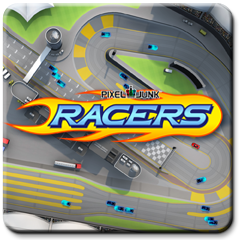

PixelJunk Racers launched in 2007 as the first PixelJunk title for PlayStation 3, a compact racer with an unapologetically constrained design: a fixed overhead camera, five discrete lanes, and a tiny command set (change lane, throttle, honk). On paper it reads like an engineering exercise in 'how little can you give the player and still call it a racing game,' and in practice it delivers a tightly focused experience that alternates between satisfyingly precise and maddeningly brittle. The game shipped in full HD at 1080p and offered 16 core game types (expanding to 32 when you factor in difficulty tiers) across ten tracks. Q-Games later issued PixelJunk Racers: 2nd Lap in 2010 as an enhanced, free upgrade for owners, adding new modes, trophies, and a Ghost Attack feature that leans on recorded online ghost data. This review zeroes in on the technical architecture of that tight design-controls, AI patterns, level structure, rendering choices and multiplayer plumbing-so you can decide if the mechanical rigor is a feature or a punishment.
The first thing to lock into your head about PixelJunk Racers is its structural constraint: all movement happens inside one of five lanes, like a slot-car system where the player is only allowed lateral moves and throttle modulation. That constraint is the game's primary design axis and it influences everything from AI behavior to input timing to perceived fairness. Input and responsiveness are deliberately minimal. You have a throttle (presumably analog), a lane-change input, and a horn. The lane-change mechanic is the star of the show technically because it is the only evasive action you can take. The responsiveness of that input is crucial: lane-change latency, whether the game implements some form of lane-change buffering, and how collisions are resolved when two cars try to occupy the same lane are all the invisible systems that determine whether a race feels precise or sloppy. Reviewers at the time noted instances where enemy cars would occupy all five lanes, creating impassable walls-this is not merely a design annoyance, it's a consequence of spawning/AI pathing and collision policy. If the AI scheduling floods every lane and the physics/collision resolution doesn't gracefully resolve stack-ups, the player experiences an unavoidable failure state. That was observed in contemporary coverage as 'controller-hurlingly frustrating' behavior, which speaks to a fragile edge-case in the car-placement and lane-occupancy algorithms. The AI itself is patterned around lane management rather than complex steering. Enemy cars behave primarily as timing obstacles: they accelerate and decelerate according to difficulty tiers (Normal, Turbo, Master), change lanes according to internal heuristics, and cluster depending on mode parameters. Because of the five-lane model, AI complexity is concentrated in lane-choice heuristics and throttle modulation rather than in path-finding or racing lines. This keeps CPU load light and lets the entire race be simulated within a compact deterministic environment, but it also means depth must come from the design of modes and rule permutations rather than emergent driving simulation. Modes provide that intended depth. The base package contains 16 core racing modes and, with the three-tiered difficulty levels in many of them, yields 32 playable variants across ten tracks. Modes vary the win conditions, scoring, and sometimes lane-availability or hazards. Score Attack hooks into PlayStation Network leaderboards: your runs are recorded and ranked online. Technical care was taken here to record and transmit compact score metadata rather than full replays (until 2nd Lap's Ghost Attack feature). The Ghost Attack addition in 2nd Lap expands the technical side of online interaction: instead of just score tables, it transmits ghost data so you can race against a recorded representation of another player, which is a lightweight approach to asynchronous multiplayer that avoids the latency and synchronization problems of real-time netcode. Multiplayer is deliberately offline-only for real-time play. Up to seven players can share the same console, which is an intriguing engineering tradeoff: local multiplayer avoids network latency entirely and simplifies synchronization because every client is a local controller event queue. The tradeoff is obviously practicality-arranging seven humans in one room is rare-and it limits the game's longevity in a world that was already heading online. The only online component originally was leaderboard comparison; 2nd Lap's ghost racing is the most significant online feature added because it scales well and doesn't require complex server-authoritative simulation. Difficulty tuning is a recurring theme. The three-tier difficulty system (Normal, Turbo, Master) mainly adjusts the speed variables and sometimes the aggressiveness of AI lane-changes. Speed scaling affects not just reflex challenge but also input window tolerance: higher speeds compress the timing window for lane changes, magnifying any input latency or collision resolution oddities. Reviewers found the difficulty curve uneven and occasionally unfair; technically, when speed increase is the primary lever for difficulty, any underlying small mechanical inconsistencies become large sources of player frustration. That is exactly what critics pointed out: diverse modes are interesting on paper, but if the underlying mechanics are too brittle the variety can't save the experience. Level design is compact and holistic: the camera is fixed above the entire circuit, so the race is about macro-timing rather than local steering. Ten tracks serve as templates for the different mode rules, and Q-Games claimed 'richly detailed courses' even within the minimalist lane framework. Rendering the entire track at once in 1080p was a sensible technical choice because it reduces the need for streaming geometry or camera-dependent level-of-detail systems. It also means the engine could focus on keeping all objects in memory and simulating everything deterministically, which is ideal for local multiplayer and for accurate Score Attack replays. In practice, the game's meat is in mode permutations and leaderboard competition. The experience can be very punchy when lane-change timing and AI spacing behave predictably. Conversely, when the lane-occupancy edge cases manifest-enemy cars simultaneously blocking lanes, inconsistent collision pushes, or sudden AI saturation-the core mechanic feels unfair. That polarity is what defines the gameplay: elegant, controlled design on good runs; brittle, rage-inducing edge cases on bad ones.
PixelJunk Racers doesn't try to hide that its priorities are mechanical clarity and HUD legibility. The fixed top-down camera and the promise of Full HD 1080p allow Q-Games to render the entire track crisply, so lane markers, opponent positions, and UI elements remain visible even with multiple players. The documentation from SCEA mentions 'speed through 10 richly detailed courses'-technically that translates to dense, compact level art rather than sprawling worlds: there's nowhere to hide, so detail is concentrated in the immediate visual read of each lane and its hazards. That's a deliberate rendering decision to prioritize information density over photorealism. From an engine perspective, rendering the entire circuit at once simplifies frame coherence: no camera-dependent occlusion culling complexity, no LOD drops, and no streaming seams. The trade-off is that you must fit all visible geometry and effects in a single framebuffer budget for 1080p, which on PS3 hardware meant careful shader and polygon budgeting. The PixelJunk series is known for efficient, stylized visuals, and Racers follows that ethos: crisp vectors, readable contrasts, and minimal post-processing. Those choices aid gameplay because at high speeds the player must be able to read lanes and opponents instantly. HUD and UI design are intrinsically functional: scoreboard, lap/timer, and lane position are given priority. Online leaderboards (Score Attack) are integrated at a metadata level, and 2nd Lap's ghost recordings imply an additional data serialization pipeline for saving and transmitting ghost path data. Trophies in 2nd Lap indicate some additional telemetry hooks in the codebase to detect and flag achievement events.
PixelJunk Racers is a study in constrained design: its five-lane, overhead framework and three-button control scheme force the game to derive depth from mode diversity, timing precision, and leaderboard competition. Technically, the decisions make sense-full-track rendering at 1080p, deterministic local simulation for up to seven players, and a lightweight approach to online interaction (leaderboards and later ghost data) are all smart engineering choices for a PS3 downloadable title. Where the technical design falters is in edge-case robustness and difficulty tuning. When enemy car scheduling or collision resolution lets opponents form impenetrable barriers, that reveals a brittle spot in an otherwise tidy system. Increasing speed to raise difficulty amplifies the impact of any small latency or collision oddity, which is why some reviewers found the experience aggravating despite the wealth of modes. The lack of online multiplayer for synchronous races was a missed opportunity at launch, though 2nd Lap's Ghost Attack improved the asynchronous play model in an efficient, technically clean way. If you worship mechanical purity and enjoy minmaxing score runs against leaderboards, PixelJunk Racers rewards attention and repetition. If you need graceful error states, forgiving difficulty curves, or online couch-to-couch matchmaking, the game will feel like a clever prototype that didn't entirely cross the finish line. On a technical level it's an admirable piece of engineering with clear trade-offs-efficient rendering, deterministic local simulation, and tight mode design-held back by a few brittle implementation details and a multiplayer strategy that put a lot of faith in people gathering in the same living room. For curious PS3 owners who like high-skill, high-risk arcade scoring, it's worth a lap; for someone expecting a modern, networked party racer, it's likely to feel like a half-finished race day pitstop.
 PixelJunk Shooter on PS3
 PixelJunk SideScroller on PS3
 Roary the Racing Car on DS
 Team Sonic Racing on Switch
 Garfield Kart: Furious Racing on Switch
 Ben 10: Galactic Racing on PS3
 PixelJunk Shooter 2 on PS3
 PixelJunk Racers 2nd Lap on PS3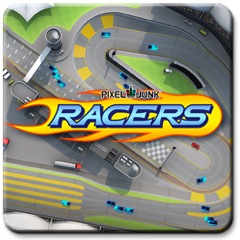










 Another SquareThought Site