


 Dec 2004


If you've ever wanted to make your own RPG but were put off by coding languages or by the grim reality that true creative power usually carries a PhD in spreadsheet warfare, RPG Maker 3 for the PS2 will flirt with your ambitions and then hand you a very hefty to-do list. This is not just a toy version of game-making; it's a console-sized engineering kit that asks you for patience, planning, and a willingness to think like both a director and a systems designer. The game is packed with features - fully 3D maps, a chunky event/trigger system, a catalog of character and enemy models, and an actual music library - but those features arrive with the attitude of a strict teacher: they expect you to train. The reward is the freedom to design towns, dungeons, and encounters that feel like real RPGs, provided you survive the learning curve and the resource limits.
RPG Maker 3 is less a single game and more a toolbox with rules. The core challenge isn't beating a preset story but learning the editor so thoroughly that you can choreograph your own. The event system is where the real tests lie. Events employ an advanced trigger mechanism: you select units, buildings, or objects, assign triggers, and build an event chain. Up to fifty events can be chained on a single object, which sounds insanely generous until you try coordinating dialogue, cutscenes, item rewards, boss spawns, and map changes without accidentally creating a logic loop that makes your NPCs speak in ancient riddles forever. This is where several distinct skills come in. Logical sequencing and flow control are essential - you need to think like a coder even though you aren't typing code. Conditional events exist, letting you check variables and player states, but using them requires careful mapping of cause and effect. If you can mentally trace an if/then/else tree and foresee how a player might approach a puzzle, you're already ahead. The editor's improvement over the predecessor - allowing script creation while placing events rather than in separate steps - speeds iteration, but it also tempts you to make complex chains on the fly. The good design practice here is to plan event flows on paper or a notepad first. The editor will reward forethought and punish frantic click-and-hope sessions. Resource management and optimization form another layer of challenge. RPG Maker 3 stores data in a database-style structure and caps the number of placeable objects in an area. That means every lamp post, chest, and invisible trigger is a budget line item. Creative restraint becomes a design skill; you must balance visual detail against functional necessity. Problems emerge quickly when you want a crowded market square full of NPCs, vendors, and interactive stalls: you either simplify the scene or break your object limit and start pruning. This constraint forces you to learn to prioritize the player's experience and to use clever event-driven tricks to simulate busyness (for instance, swapping visible units in and out rather than placing them all simultaneously). Combat and encounter design are interesting little puzzles too. The system lets you spawn monster parties on field maps, assign them to terrain types, and configure who shows up where. Crafting satisfying difficulty curves requires a grasp of balance: tweaking enemy stats, adjusting party composition, and deciding where to place powerful foes so they feel earned rather than arbitrary. The dungeon builder is a test of spatial logic: dungeons follow a twenty-floor system oddly described with 'the tenth floor as the highest and floor B10 the lowest,' which translates in practice into a long vertical ladder of design choices. Trap placement, stairways, secret passages, and a single secret door per floor mean you must design flow, pacing, and reward carefully. Good dungeon design in RPG Maker 3 feels like solving multiple simultaneous mazes - one for navigation, another for difficulty, and a third for narrative beats. Item categories (Items, Treasures, Weapons, Armors) and their configurability present another design skill to master. Assigning the right effect to an item, choosing which character can equip a weapon, or creating a treasure that unlocks a key event all tie back into your event logic. You have to think across systems: if a treasure opens a door, how does that interact with your conditional events? If a weapon significantly boosts a character, do encounters remain challenging? Testing and iteration are required - trial runs, balance tweaks, and playtesting will be your closest friends. A player who enjoys systems design, balancing stats, and iterative problem solving will get the most mileage from this editor. Finally, time investment is the unglamorous boss fight here. The manual-ish learning curve demands hours to become fluent. But if you relish puzzles where rules are the fun part, the ultimate victory is that feeling when scripted events and battle layouts click together into a stable, entertaining experience.
RPG Maker 3's graphics are fully 3D, which gives your homebrew RPG a respectable coat of polish on the PlayStation 2. The assets are generous: more than 20 character models and around 50 enemy models, multiple terrain types, and a decent selection of building and layout presets for towns and dungeons. The visual tools are straightforward enough that you can mock up a believable town or dungeon without having to import custom art. The flip side is the same database and object-limit system that complicates gameplay design. Because the program restricts how many objects you can place, you can't rely solely on graphical abundance to carry your scene. That forces a certain aesthetic minimalism or clever use of prefab layouts to keep maps lively without breaching limits. The character and enemy models are serviceable rather than show-stopping; they communicate the necessary fantasy motifs and make event choreography readable, but expect stiff animations and a few repetitions if you try to push variety beyond the library's size. Music is included in the package: roughly forty to fifty tracks, eight main themes, nature sounds, and several battle themes. They were later remastered into a Music Pack for PC RPG Maker users. For the console experience, the music options provide enough variety to set mood without overwhelming you with choices. Choosing the right tracks and placing them effectively is a small composition puzzle that reinforces the game's central thesis: design is about choice within limits.
RPG Maker 3 for PS2 is a sandbox for people who enjoy rule-based puzzles as much as they enjoy storytelling. Its biggest challenge isn't technical incapability but the opposite: the tools are powerful, and they demand structure. You'll need logical thinking to chain events cleanly, spatial reasoning to build dungeons that feel fair and fun, and balancing chops to avoid encounters that are either trivial or ridiculous. Throw in patience and a willingness to iterate, and you can create compact RPGs with surprising depth. If you want a quick plug-and-play toy to make a handful of cutscenes and be done, this isn't it. If you want a console-friendly editor that respects your ambition and forces you to level up as a designer, then RPG Maker 3 will teach you, frustrate you, and ultimately reward you. Consider the score a nudge: it's an earnest, capable product hamstrung by some limits and a steep learning curve, but for the right person - the one who thinks like a problem-solver and enjoys designing with constraints - it provides hours of satisfying, brain-bending creation.
 Taiko no Tatsujin: Dokodon! Mystery Adventure on Switch
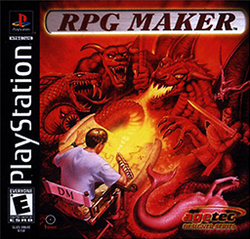
 RPG Maker on PlayStation
 Combat Elite: WWII Paratroopers on PS2
 Rainbow Moon on PS4










 Another SquareThought Site