

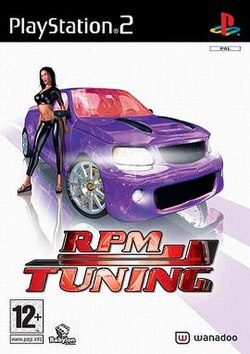

RPM Tuning arrives with a title that promises grease-splattered nights, souped-up engines and an intimate relationship with a torque wrench. What you actually get is a modestly voiced B-movie about a guy named Vince, a collection of blandly named cars and a handful of underground races that mostly want you to forget the last thirty minutes of your life. Developed by Babylon Software and running on RenderWare, the PS2 release hit Europe in November 2004 and then quietly avoided North America entirely on that platform, which is an efficient way of telling you what reviewers already did: lower your expectations. The game is part of the Top Gear series and was published under several banners across platforms (Wanadoo on PS2 in the EU; Kemco and Valusoft handled other formats and regions). Critics were not thrilled-Metacritic aggregates the Xbox outing at 45/100, and the consensus from outlets that bothered to score it ranges from mildly disappointed to actively hostile. If you are tuning in because you like unique, polished arcade racers, this is not the hot hatch for you. If you like a story about car swaps, briefcases full of plot, and someone getting shot with dramatic timing, there is at least a plot to follow while you wait for the racing to be interesting.
Gameplay greets you like an overeager mechanic who only has three cars to offer. Vince starts by choosing between a Hatchback si, a Pick up 150 and a 322 ci. This is not the emotional crescendo of modern driving sims, but it is functional. The story mode is the main course: Vince wants a GTSR, which is apparently the pinnacle of automotive fantasy in this universe, and the campaign shuffles you through underground races, exchanges, and the sort of interpersonal drama that reads like a synopsis you would loudly judge on a bus. Characters include Rick, an underground racer with questionable ethics, his henchmen Mac and Dante, Carmen the mechanic's daughter (who starts off with classical heroine disdain and ends as a dramatic figure with a gun), and a supporting cast of mechanics and rival drivers. The plot moves by way of car exchanges-win races, swap into faster vehicles, find briefcases, and occasionally get involved in shady sales with policemen named McCullen. At one point Carmen shoots Rick, which is the game's way of saying 'this is the climax' and also 'we ran out of budget for a big finale.' It's gloriously inelegant in a mostly charming way. Racing itself is straightforward. The modes include single-player campaign and multiplayer, so you can either suffer through Vince's soap opera alone or bring a friend so they can suffer with you. The races are serviceable: you drive around tracks, compete against AI, and progress by winning. There is a sense that the 'tuning' in the title is more aspirational than realized-what you mostly do is swap cars you find or earn, rather than perform deep, satisfying mechanical overhauls. If you came looking for a menu of bolt-on upgrades, dyno runs and a meaningful difference between three different suspensions, prepare for disappointment. The engine swaps and vehicle progression exist, but they are streamlined and occasionally baffling in how little they affect the feel of the cars. Controls are competent without being inspired. Steering is predictable, the physics lean toward arcade simplicity, and collisions are functional rather than spectacular. The AI will sometimes follow a path and sometimes do inexplicably human things, like hugging a wall for moral support. Multiplayer is present as a consolation prize for the PS2 era: you can race a mate, argue about who brake-checked whom, and then return to the campaign to pretend you didn't just spend an hour yelling at a pixel. The game's pacing is weirdly episodic because story beats are shoehorned between races. If you are the sort of person who enjoys narrative wrappers for gameplay, the plot gives you enough to nod along while you drive. If you prefer seamless transitions and coherent level design, you will notice seams. This imbalance is the central paradox: the story sometimes outshines the racing, because the racing rarely insists on being noticed.
On the PS2, RPM Tuning looks like a mid-2000s game that took RenderWare's suggestions and politely declined any follow-through. Models are solid enough to read as cars, color palettes are serviceable, and lighting does the job without theatrical intent. Texture detail is modest, pop-in happens at times, and the environments look like deserted industrial districts that someone forgot to populate. Animations are functional; NPCs move with the emotional range of parked cars. For the era and the hardware, it is not offensively ugly. It is the sort of visual package that allows you to focus on the game if you are not trying to evaluate it in pixel-perfect closeups. If you boot it up today, nostalgia will either be kind or cruel depending on how fondly you remember PS2-era grain and polygon edges. The character portraits and cutscenes-where the game leans into its soap opera-have the awkward charm of half-serious voice acting and slightly stilted motion. All told, the graphics neither rescue nor doom the experience; they merely exist, which sums up the aesthetic philosophy of the whole package.
RPM Tuning is the videogame equivalent of a late-night diner: some warm, mediocre food, a dramatic argument at the counter, and enough charm to make you tell the story later with selective memory. It has a plot with a clear throughline-Vince wants a GTSR, finds briefcases, and suffers relationship drama-and that framework gives the title an identity that many racers of the time lacked. Unfortunately, the racing undercooks the ambition: tuning is more in the name than in the implementation, and the driving never quite delivers the mechanical satisfaction you'd expect from a game promising underground street cred. Critics agreed that the game was a mixed bag. Metacritic places the Xbox version at 45/100, GameSpot scored it 4.9/10, Game Informer landed at 5/10, and some outlets were markedly harsher. Those scores feel right. If you find a cheap copy and are curious about an odd slice of Top Gear's franchise history, RPM Tuning can be entertaining in spurts-especially if you enjoy cheesy plot twists and earnest incompetence. If you wanted a polished, tunable, pulse-raising racer, you're better off looking elsewhere. Think of RPM Tuning as a car you buy for laughs at a yard sale: it will start, it will sometimes get you where you want to go, and it will give you a story to tell while you wait for something better to arrive.
 Option Tuning Car Battle 2 on PlayStation
 Option Tuning Car Battle Spec-R on PlayStation
 Roary the Racing Car on DS
 Tony Stewart's All-American Racing on PS4
 Team Sonic Racing on Switch
 Chocobo Racing on PlayStation












 Another SquareThought Site