

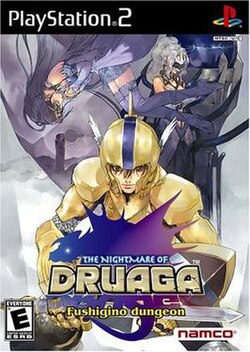

If you grew up reading thick monthly magazines with glossy covers and letters pages full of complaints about 'kids these days,' this is the sort of game that would have inspired a long, woolly editorial. The Nightmare of Druaga is not designed to win a popularity contest on a showroom floor; it is explicitly bred for the hard-bitten dungeon spelunker who misses the days when progress could be taken away by a single, avoidable misstep. Developed by Arika with involvement from Matrix Software and Chunsoft and released on the PlayStation 2 in 2004, this is a Mystery Dungeon entry wearing the skin of Namco's ancient Babylonian fantasies. It dresses itself in classical myths, shuffles you into grid-based levels and then gleefully slaps your save file if you make the wrong turn. The game markets itself as a sequel to the Tower of Druaga saga and the eighth installment of the Mystery Dungeon lineage, which is to say it belongs to a small family of games that value procedural cruelty, strategic equipment choices, and the kind of looped narrative that rewards persistence. For players raised on sprawling console RPGs with permanent progression and forgiving save mechanics, Nightmare sits at the polar opposite end of the design spectrum. For roguelike devotees, it is a respectable, occasionally inspired, and frequently unforgiving addition - one that will appeal to those who enjoy being put through the wringer for the sake of a satisfying rescue mission and the pleasure of mastering systemic depth.
At its heart the game is a binary: town and dungeon. Towns serve as the civilized half of the experience - merchants to haggle with, craftsmen to tinker with your inventory, NPCs to hand out side-quests and occasionally the sort of exposition that nods knowingly at the Tower of Druaga mythos. It is in these moments, walking between shops and quest boards, that the game lets you breathe. The dungeons are where the breath gets knocked out of you. Dungeons operate on the Mystery Dungeon liturgy: move once, enemies move once. Grid-based, turn-driven exploration gives the title its cerebral rhythm; there is no twitching your way past danger, only the cold arithmetic of spatial positioning and resource management. Levels are randomly generated, and the early objective is basic and unforgiving - locate the key and reach the exit before the darkness, the monsters, or your own hubris undo you. Gil, the game's protagonist (Gilgamesh in a trimmed-down package), fights through caves, temples, forests and sewers beneath Ishtar's temple with equipment that changes not just damage output but Gil's relative speed and attack range. This gives gear a tactical flavor unusual in console dungeon-crawlers: a heavier mace might make you slower than a nimble dagger, while a certain helmet could mellow the light radius that reveals foes. Light itself is a resource. Gil's armor emits illumination that defines your visible world; without it you feel your way like an actual spelunker who forgot the headlamp. To maintain this brightness the player must make offerings to Ishtar, which ties exploration to the game's narrative and its risk economy. Items and monsters are randomized, and while you will find powerful magic items and elemental imbuements that let you tailor weapon properties, the true weight of the design is the death penalty. When you die you lose almost everything: the bulk of your inventory, half your money, and a bruised pride. A small fraction of items can be sanctified at Ishtar's temple so they survive death, a concession to fairness, but the sting remains real. The title refuses to be gamified into comfort. An auto-save feature exists that will shame you if you try to power off to sidestep consequences; the game notices and forces a conversation with Ishtar that reads like a stern letter from a magazine editor who has had it with soft saves. Boss encounters are milestones and sometimes brick walls; like the classic Tower of Druaga some foes are intentionally out of your reach until you've learned the right dance. Items can be combined in town to produce hybrid equipment, a welcome craft system that rewards experimentation. Rare area-of-effect spells and elementally imbued items let the tactical palette expand, but mastery is earned the hard way, and the game keeps you honest by making errors costly. Narratively the game is a surprisingly layered mess of time loops and mythic explainers. It starts as a fairly straightforward rescue quest-the fiancée Ki is stolen by Skulld and spirited off to the Tower of Druaga-then unfolds into a meditation on time, divine interference and repetition. Skulld's true identity, the role of Ishtar and Anu, the Dark/Blue Crystal Rod duplicity and the notion of characters trapped in recursive timelines give the otherwise procedural slog a mythic backbone. This is a rare roguelike that insists the mechanics and the plot be in conversation: the time-loop conceit mirrors dungeon repetition, and the revelations at the sanctuary are satisfyingly baroque for people who read game manuals and footnotes for fun. If there is a fundamental objection, it is the game's appetite for punishment. The save and death systems are deliberate, and contemporary reviewers were split: some hailed the eerie lighting and interface polish, others called the experience plodding and needlessly retro. This is not a game that compromises for casuals. It offers the pleasures of emergent strategy, and will reward careful players generously, but it is emphatically not inviting to those who approach consoles expecting a comfortably padded progression curve.
Graphically the game is one of its oddest arguments. In an era when the PlayStation 2 could throw polygons at your screen with abandon, Nightmare of Druaga decides to take a more restrained aesthetic. The presentation is not about polygonal bravura; it is about mood. The dungeons are lit in a way that some critics described as an 'eerily beautiful interplay of light and shadow,' and that assessment is fair. The light radius mechanics are not only gameplay-critical, they are used to sculpt atmosphere: torchlit corridors, moody temple interiors and the lurid gleam of boss rooms all benefit from this framed, low-key approach. Character art, whether in cutscenes or in promotional material, leans toward classical heroism; Gil's gold armor and the various demonic set-pieces nod to the Babylonian backdrop with a designer's affection. Technical fidelity is mixed. Up close, some textures and models show the PS2's budget, and GameSpot's criticism of 'poor graphics' had a grain of truth if you judged the title against contemporary blockbusters. Against its own goals, however, the visuals are coherent and serve the game's needs without needless ornament. The interface earns praise for clarity - an important detail in a game where inventory and status management are never incidental. The music finds allies among reviewers: ambient and sometimes melodic tracks complement the dungeon atmosphere rather than competing for attention. It is not a soundtrack that demands to be played on its own terms, but it supports the mood in ways that help you settle into the long, methodical climbs and repeated returns.
The Nightmare of Druaga is an act of intentional anachronism: modern console hardware hosting a roguelike that prefers calculated, often cruel systems over mass-market comfort. Its appeal is precise and limited. For players steeped in Mystery Dungeon conventions, and those who enjoy slow-burning strategy wrapped in mythic storytelling, this is a worthwhile and occasionally brilliant detour. For anyone who expects the consolized comforts of permanent leveling, liberal save points and a forgiving difficulty arc, the title will feel archaic in all the wrong ways. As a reviewer who learned to describe games in the brassy tones of the 1990s, I admire Nightmare's nerve. It does not pretend to be for everyone, and it stakes its claim honestly: a game about repetition, consequence and piecing together meaning from procedural rubble. The saving grace is that beneath its punishing systems there is craft - an interface that respects the player, lighting and sound that build ambience, and a plot that rewards patient attention. That combination earns it a respectable score: 7.0 out of 10. Not a classic for the masses, but a memorable trophy for the patient and the stubborn, the sort of cartridge you would have argued for in a mailbox column about 'real games' back when magazines still decided reputations.
 Dungeon Hunter: Alliance on PS3
 Boyfriend Dungeon on PS5
 Combat Elite: WWII Paratroopers on PS2
 The Banner Saga 2 on PS4
 Arcania: The Complete Tale on PS3
 Predecessor on PS4












 Another SquareThought Site