

 Oct 2010
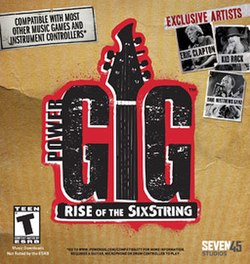

Power Gig arrived in late 2010 like that kid in school who insists he can shred because he bought a guitar once - earnest, loud, and badly in need of lessons. Its selling point was novel: ship a game with a real six-string electric (allegedly useful for both playing the game and not embarrassing yourself at open mic night), and market the whole thing as a more "authentic" alternative to Guitar Hero and Rock Band. The universe the developers built around that guitar - a fantasy world called Ohm, ruled by the smug tyrant Martin Rothchild, the self-styled 'Headliner' - promised weighty stakes: music is forbidden, and three rebel clans must "Unite the Clans" to bring sound back into the world. Critics, buyers, and anyone with functional tastebuds collectively shrugged. Aggregate scores landed in the 30s out of 100, and the game has since been remembered mostly for its missteps. But if you're here for character analysis, strap in: the story's teeth are small, but there are a few interesting jagged edges to examine.
Power Gig plays like the music-game blueprint you've seen a dozen times: colored lanes, notes to match, riffs to miss dramatically while your friends judge you. The difference on paper - and in the advertising copy - was that your hands were on a real six-string, not a toy. In practice the difference is more conceptual than experiential. The guitar shipped with the game is a 2/3 scale electric that physically detects strings and fret positions, yet the software treated it like a glorified controller: the game's basic mode asks you to hold strings within colored fret areas and strum in time; the "Power Chord" mode replaces the standard colored notes with numbers 1-6 to correspond to strings, nudging the title toward chordal play. The hardware can sense much, but the game only asks for small things: mostly two-note chord intervals and timing-based strums. It's like being handed a Swiss Army knife and asked to tighten screws with the toothpick. Now the story: Unite the Clans sets up a premise that feels like someone tried to mash together Dungeons & Dragons and VH1's Behind the Music. Ohm is an oppressive land where Martin Rothchild - the Headliner - bans public performances. Opposing him are three distinct clans, each carrying a specific philosophical riff. The RiffRiders exist for the jam, the Rise chafe against tradition and spark rebellion, and the Zehn are transcendental, busy pondering the self-as-sound. Each playable character aligns to one of these clans and comes equipped with a "Mojo Power" (Power Gig's version of Star Power) which alters score behavior in some unique way. An arc analysis: on paper the clans promise interesting conflict. The RiffRiders are archetypal carefree musicians - imagine teenagers discovering distortion for the first time. Their arc, ideally, would move from casual joy to hard-won responsibility: learning that jamming can change a culture, not just your own dopamine levels. The Rise, being the upstarts, are set up for a classic innovation arc: break the rules, develop new techniques, and ask uncomfortable questions about whether tradition is always worth keeping. The Zehn, spiritual and inward, should provide the game's emotional spine: their path ought to be about mastery of craft as a path to personal revelation, a contrast to the RiffRiders' extroverted chaos. In execution, the arcs are paper-thin. The story mode lurches through exposition, and characters act like living rock clichés rather than evolving people. Critics singled out the campaign for being "corny and self-serious in equal measures," and it's hard to disagree: the game spends more time telling you how important music is than showing you why we should care about any individual character. Martin Rothchild is a fine villain name - suitably pompous - but he's less a tyrant than a concept: 'bad for music.' There's little to no emotional payoff, and Mojo Powers end up being gameplay trinkets rather than catalysts for character development. A deeply ironic outcome: a game that claims to bring authenticity to guitar playing treats the human stories around music as cheap set dressing. How the character setup interfaces with mechanics is another area where Power Gig promises more than it delivers. Each character's Mojo Power affects score, but it doesn't unlock deeper lessons about the instrument or provide progressive training that would map an emotional arc (practice, failure, breakthrough) onto the player's learning. Compared to Rock Band 3's Pro mode, which attempted to close that gap by teaching real technique, Power Gig's 'real guitar' is mostly cosmetic from a gameplay perspective. So you can play as the introspective Zehn lead who 'finds himself' but the game will never make you earn that self-discovery with a meaningful learning curve. The result is a dressed-up narrative shell with the mechanical complexity of a pop song's chorus: catchy, repetitive, and ultimately forgettable. The AirStrike drum controller - a floor array of sensors for 'air drumming' - is a bold hardware idea that collapses under real-world use. Motion-sensor drums promise realism and quietness; what you get in many reviewers' hands is poor hit detection, weird latency, and the loss of tactile feedback that makes drumming satisfying. The game also bizarrely excludes bass as a playable instrument, trimming the band's anatomy down to guitar, drum, and vocals. For a title selling the myth of musical authenticity, leaving out the bass is like launching a burger joint and declaring 'no buns, but we're authentic.' Soundtrack-wise, Power Gig isn't stingy. It boasts a setlist comparable in size to its competitors and includes master recordings from higher-profile artists who'd largely stayed away from rhythm games: Eric Clapton, Dave Matthews Band, and Kid Rock among them. That exclusivity was part of Seven45's pitch: bring real artists who respect the guitar back to the genre, and maybe teach players something. Yet despite a respectable roster, critics called parts of the tracklist 'leftovers' - good songs, but not always the standout or challenging charts you'd expect to anchor a narrative of musical growth. Some DLC appeared post-launch, though availability has been spotty since.
Power Gig's visual presentation is utilitarian by intention and clumsy by choice. User interface decisions such as the flat, vertical tablature-like note display - rather than the angled 'highway' used by Guitar Hero - aim for clarity and a perhaps-too-literal musicality, but the result was criticized for being less intuitive and less exciting. The UI's flatness mirrors the narrative flatness: exposition text and cutscenes lean heavily on telling rather than showing, with character models and environments that rarely do the world's lore justice. Critics described the story sequences as exposition-heavy and 'deliberately befuddling' at times, a phrase that captures the mismatch between concept and execution. Visually, the game doesn't offend on a technical level: textures, models, and stage lighting are competent for a 2010 rhythm game, but they never reach a level of personality that makes you care about the clans' differences. The 'Ohm' backdrops are stagey and theatrical, which is thematically consistent, but the cinematics and pacing turn what could be danceable myth-making into MTV-meets-training-video territory. In short, Power Gig looks like a game that wanted to be earnest and mysterious, but arrived wearing someone else's emo jacket. Hardware aesthetics deserve mention: the bundled six-string guitar is the physical linchpin of the game's claim to authenticity. It looks like a real instrument - which is impressive in the box - but multiple reviewers found its build and playability lacking. A dampener is included to stop strings from ringing during gameplay, which is practical, and the guitar can be converted into a standalone instrument. In practice, however, the guitar's feel and tuning stability were criticized, and as a playing experience it compared poorly to even budget guitars. The AirStrike kit's lack of visible pads and reliance on motion also created a visual disconnect: invisible hits look stranger and less satisfying than the thwack of drumheads and the flourish of a physical cymbal tilt.
Power Gig sells itself as a rock-reformation kit: a real guitar, a mythic storyline, and musician-friendly marketing with Clapton and Dave Matthews nodding along. The problem is that the game splits its soul between hardware stunts and a ham-fisted narrative, and neither gets the attention needed to matter. The real six-string is an intriguing piece of hardware, but the game seldom uses it to teach, challenge, or meaningfully evolve the player's relationship with music. Characters and clans are sketched with broad, promising strokes - the RiffRiders' joie de vivre, the Rise's rebellious energy, the Zehn's quest for transcendence - but these arcs are delivered as bullet-point flavor text rather than earned journeys. Martin Rothchild's role as the Headliner is memorable as a name, forgettable as a foe. For players who only care about setlists and familiar songs, there is enjoyment to be had: the soundtrack has quality masters and some unique additions. For anyone hoping for a real bridge to playing an instrument, or for a story mode with emotional payoff, Power Gig will feel like an expensive false start. Critics were not kind: Metacritic sits in the mid-30s, GameRankings barely clears 40%, and Giant Bomb infamously tagged it the worst game of 2010. If you want to study Power Gig for its character ambitions, it's a fascinating case study in ambition over follow-through - a game that wanted to mature the rhythm genre but treated its characters like props. If you're buying the box for the guitar under the false impression that you'll magically learn to shred, maybe save the cash for lessons or a better starter guitar and watch someone else try to unite the clans.
 Power Pro Kun Pocket 14 on DS
 Nobunaga's Ambition: Rise to Power on PS2
 Rhythm Heaven on DS
 Super Crazy Rhythm Castle on Xbox Series X/S
 Rhythm Heaven Groove on Switch
 Taiko no Tatsujin: Dokodon! Mystery Adventure on Switch










 Another SquareThought Site