

 Aug 2025
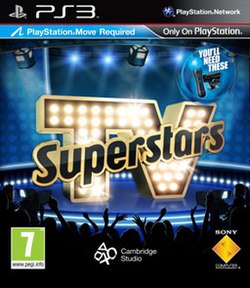

TV Superstars is a party game that exists to answer one pressing question: what would happen if reality television vomited a host of mini-games onto the PlayStation 3? The result is a nicely polished, mildly caffeinated collection of TV-show shaped distractions that rely on PlayStation Move and the PlayStation Eye to turn you into an in-game celebrity. You supply the face via camera, the Move wand stands in for your limbs and dignity, and the game provides the faux-glam, faux-stakes and faux-fame. The pitch is as obvious as it is sincere: you are a contestant on a fake reality show, moving through a series of themed challenges designed to boost your avatar's popularity. The game trades on the sort of broad, ridiculous humour those television producers use when real people are paid to run into soft obstacles and scream for ratings. It's light, sometimes clever, occasionally repetitive, and best enjoyed with friends who will appreciate being launched into a chalk-outline-shaped applause line.
TV Superstars is built from small, bright bits of gameplay stitched together by the idea of 'becoming famous'. That central conceit is the most interesting thing about the game: instead of high scores or endless unlock trees, progression is measured by your avatar's popularity. Winning games gets you tabloids, billboards and endorsements - the digital equivalent of being photographed holding a brand's product and pretending you like it. Your likeness is captured by the PlayStation Eye and slapped onto a cartoony avatar. The intent is obvious: the game wants you to feel like you, only more glamorous and with better lighting. The Move controller is the tool of choice for interaction, and most minigames are gestures, swings, presses and theatrical poses given meaning by the game. The minigames are the meat of TV Superstars, and they arrive in themed chunks that parody real television formats. Frock Star is a runway challenge where you strut and model bizarre outfits - the objective is to look fashionable and flamboyant enough to please a fictional panel of judges. There's an element of timing and rhythm to the walk, and you also dab at virtual makeup, which turns the runway into a bizarre cross between a rhythm game and a dress-up app. Let's Get Physical is the show's answer to American Gladiators married to a Japanese variety show and given too much sugar. It's a montage of obstacle-strewn feats: run on a giant spinning wheel while avoiding hazards, launch your avatar through the air to align with a chalk outline on a wall, and complete other slapstick athletic tests. The Move sensor registers your movements and translates them into in-game momentum; it's not always pixel-perfect, but when it works the physical comedy of flinging yourself toward a target is genuinely satisfying in the same way watching someone miss a trampoline can be. Big Beat Kitchen pairs cooking with rap, and will probably ruin your perception of omelettes forever. You time actions to the beat while completing cooking tasks, and the outcomes are judged for both culinary and lyrical flair. DIY Raw is a home-makeover segment where you hammer and place objects to prevent the house from self-destructing - imagine a home-improvement show where the house is actively trying to retire the contestants early. STAA (Superstars Television Acting Agency) has players film commercials; the more convincing your poses and gestures, the better the in-game ad sells. Most games follow the same basic structure: pick up a Move command, perform it in rhythm or with appropriate timing, and the game grades you. Success brings media attention in the form of tabloid write-ups and billboard ads that increase your popularity. That popularity is the meta-currency: it unlocks sponsorships and more gameplay variety. The idea of fame-as-progress is a neat bit of satire, even if the execution sometimes feels shallow. Multiplayer is present and useful. Most of the fun ramps up when people are playing in the same room, yelling at each other because one of you misunderstood a flamboyant runway cue or the physics of being launched through the air. Single-player is perfectly serviceable, but party games live or die with social chaos, and TV Superstars is no exception. The controls are generally approachable. Move tracking is decent for the era, although certain motions require exaggerated gestures that make the game feel more like interpretative dance than precise control. The game isn't long on depth. The minigames are amusing in small doses but tend to repeat systems: timing, motion detection, and quick reaction. After a few hours you'll probably have seen most of what it offers. That isn't necessarily a fatal flaw for a party title; longevity is bought by friends, not features. If you're hosting a gathering for people who enjoy mocking each other into stardom and have a Move controller already, TV Superstars does what it promises. If you wanted a robust single-player experience with narrative twists and mechanical surprises, you will likely be disappointed. There's also a subtle, semi-clever commentary on celebrity culture running through the progression system. You're rewarded more for media appearances and brand deals than for the noble pursuit of skill, which is a quietly accurate reflection of the world it's parodying. The game never digs particularly deep into satire, but it doesn't need to: a few tabloid cutaways and billboard unlocks are plenty of low-effort social commentary for a party title that mainly aims to make you laugh while waving a glowing wand.
Visually, TV Superstars looks like a polished mid-generation PS3 party title: clean, colourful and intentionally cartoonish. The game uses your PlayStation Eye photo to create a caricatured avatar, and the effect is about as uncanny as a cardboard cutout wearing your hair. It's amusing rather than unsettling; the avatars sit somewhere between 'recognisable you' and 'celebrity impersonator you would find in a casino lobby'. Backgrounds are glossy sets that mimic television stages - neon, confetti, giant logos and enthusiastic virtual audiences who clap on cue. Because the aesthetic leans into kitsch, the relatively simple models and textures mostly work. There are no photorealistic ambitions here, which helps when the Move tracking is only intermittently precise. Animations are deliberately exaggerated to sell jokes and spectacle. Lighting is theatrical and flat in all the right ways: everything looks lit by stage lights so your virtual forehead will gleam with the sheen of manufactured success. From a technical point of view the game is clean but not ambitious. Frame rates are stable, loading times are reasonable, and the camera-based avatar creation is handled without fuss. If you remember the Move era fondly, the visuals will feel familiar and comforting. If you prefer your games to simulate the real world down to individual eyebrow hairs, TV Superstars will seem a little plain.
TV Superstars is a party game with a single-minded mission: to make you and your friends look ridiculous for the sake of ludicrous applause. It isn't trying to be a masterpiece, and it doesn't pretend to be. Its strengths are accessibility, a handful of genuinely funny minigames, and a surprisingly neat framing device that turns fame into progression. Its weaknesses are repetition, limited depth for solo players and occasional wonkiness from the Move tracking. Critical reception at the time reflected that middle ground. Aggregate scores landed in the mid-range, and reviewers were split between those who enjoyed the light-hearted silliness and those who expected more from a retail PS3 release. The game is also notable as the last project from Cambridge Studio before it was folded into the larger Guerrilla Games family - which makes TV Superstars a sort of farewell party, complete with confetti and the option to put on ridiculous hats. If you own a PlayStation Move and want a casual party title that captures the laugh-at-yourself spirit of reality TV without offering too many moral lessons, TV Superstars is worth a rental or a light purchase. It's not essential, but it is pleasant, intermittently witty and best played in a living room with people who are easily embarrassed. Ultimately, TV Superstars is like a one-night celebrity: loud, a little shallow, fun for a short time, and gone when the next show starts.
 Sonic Superstars on Xbox Series X/S
 Circuit Superstars on Switch
 Super Mario Party Jamboree – Nintendo Switch 2 Edition + Jamboree TV on Switch 2
 Trivial Pursuit on PS3
 Rabbids: Party of Legends on Switch
 The Jackbox Party Starter on Switch










 Another SquareThought Site