

 Aug 2025
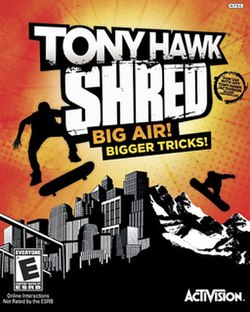

Tony Hawk: Shred arrived in 2010 carrying the familiar Tony Hawk name, a bulky plastic skateboard peripheral, and the promise of letting players 'go big' without risking torn ACLs. On PS3 it's Robomodo's attempt to translate skate and snowboarding into motion-controlled chaos, a spiritual sequel to the equally divisive Ride. If you're evaluating whether to dust off your balance board fantasies or retreat to the warm embrace of thumbsticks, the single most important thing to understand about Shred is this: it's less about replicating precision trick timing and more about negotiating a bargain with an imperfect plastic plank. Shred is a motion-based sports party game at heart - you stand over a peripheral and use your weight shifts and twists to pop, carve and grind your way through levels. The introduction of a snowboarding mode gives the package a frosty twist and is probably the game's best attempt at variety. The game was sold both as a pricey bundle and as a standalone title, but poor sales (around 3,000 copies in its first US week) and mixed reviews (Metacritic hovered in the mid-50s for the PS3) meant the franchise pressed pause after Shred. For the person who loves a challenge, though, Shred offers a very particular kind: the challenge of learning a temperamental control device and shaping real-world patience into in-game competence.
Learning curve and first impressions The very first challenge Shred throws at you is hardware. The skateboard peripheral transforms your living room into a makeshift skate park, which is awesome in theory and mildly terrifying in execution. Your early sessions consist of calibrating, re-calibrating, and learning how much your weight really matters. Unlike a controller where a stick moves something predictably, Shred asks for minute weight shifts, confident stomps, and a little faith that the board will understand you. The result is a learning curve that feels less like climbing and more like convincing a stubborn goat to model Tony Hawk's signature 540. Core skills required Balance and body awareness: This is obvious but worth repeating. The peripheral is a physical object that demands you move like you mean it. Subtlety goes a long way; exaggerated inputs often overshoot. You'll need to develop a sense of how much lean equals a carve, how a knee bend transforms into an in-air trick, and how to distribute weight for grinds. Timing and rhythm: Tricks in Shred still reward timing. To link combos you must commit to sequences, landings and pop timings. Because the system interprets motion rather than button presses, there's often a tactile rhythm to learning a trick string - a dance between you and the board. Spatial awareness and planning: Levels are laid out with gaps, rails and ramps that demand forethought. Successful runs focus on reading surfaces, planning a combo route and making minimal course corrections. Memorization of lines - that satisfying internal map of where the next grind sits - becomes crucial. Muscle memory and patience: Expect repetition. The peripheral's oddities mean you'll fail a lot early on. If patience is not your virtue, this is the part of Shred that becomes a grueling test. Repetition builds muscle memory, and muscle memory equals more reliable inputs. Adapting to imprecision: Perhaps the biggest skill Shred demands is forgiveness. Motion controls are imprecise compared to analog sticks. To excel you learn to aim for "good enough" inputs that produce consistent outcomes rather than perfect imitation of pro moves. This is a mindset shift from console precision to physical compromise. Game modes and challenge types Shred isn't just a trick showcase; it mixes single-player goals with multiplayer party gambits. Single-player challenges push you to string combos, beat time trials and nail score targets - all while coaxing the peripheral into listening. Multiplayer parties, intended to be the game's bread and butter, trade high-skill mastery for spectacle. They create opportunities for short, punchy competitions where raw control mastery translates into sweet bragging rights. Snowboarding mode The snowboarding addition changes the dynamic. Carving down slopes requires smooth weight transitions and an eye for momentum - you can't just spam the same motion and hope for a score spike. Success relies on rhythm and flow more than frantic micromovements. The snowboarding events offer a different flavor of challenge: sustaining speed, chaining tricks while maintaining balance, and timing jumps off natural terrain. Surfing was intended as a mode but was scrapped, so snowboarding remains the main 'new' discipline. Difficulty spikes and design quirks The main friction comes when the game demands minute control inputs for advanced tricks and the peripheral occasionally underdelivers. Difficulty spikes feel less like level design and more like the hardware saying, 'Now do it with one less percent precision.' That doesn't mean the challenge is unfair - it just means the player's skill set must expand beyond pure technique into adaptation, experimentation, and a budget for frustration. How to practice and get better Start small. Spend sessions in training and simple objectives to get a baseline for your board's sensitivity. Record your lines mentally - repetition helps internalize how your body translates into in-game movement. Use the simpler party modes as controlled laboratories: short, repeatable tasks let you isolate issues and build reliable inputs. And above all, adopt a forgiving mindset: ignore the urge to blame the plastic and treat it like a living, low-budget mentor who occasionally nods in approval.
On PS3 Shred looks like a mid-generation sports title that's more concerned with stylized presentation than photorealism. The environments are colorful and functional, designed to showcase tricks rather than seduce you with texture porn. Animations are the important bit here - the game does a decent job translating broad body motions into on-screen flairs, especially during snowboard runs where flow is prioritized. That said, the camera occasionally struggles to keep up with wild combos, and the visual feedback you rely on for split-second corrections can be fuzzy. The art direction keeps things lively and accessible, which helps the game's party aesthetic. If you're buying it for visuals alone, you're not getting a technical showcase, but you are getting clear cues when things go right - and when they spectacularly do not.
Tony Hawk: Shred is a curious beast: inventive in concept, sincere in reward, but hampered by the reality of motion peripherals and the steep patience tax they demand. For players who love a tactile, physical learning experience - someone who finds zen in repetition and the satisfaction of forcing a balky peripheral to obey - Shred can be oddly rewarding. Nailing a long combo and feeling your body produce the trick sequence will elicit genuine, surprisingly animal joy. If your idea of gaming skill is twitch-precise thumb action and glass-smooth responsiveness, Shred will be frustrating. The PS3 version sits in the middle ground: competent presentation, reasonable ambition, and a challenge profile that skews toward adaptation and endurance rather than strict virtuosity. The mixed critical reception and weak sales reflect that it didn't land for a broad audience, but for the niche of players willing to wrestle with the hardware, there's a distinct, if imperfect, payoff. Final verdict: treat Shred as a party experiment and a physical puzzle rather than a traditional Tony Hawk sim. It's not the triumphant evolution of the franchise, but it's a teachable, occasionally glorious mess that rewards patience, rhythm, and a willingness to move. If you can find a cheap bundle and enjoy the idea of learning to talk to a plastic skateboard, you'll find enough here to tinker and triumph - and a few moments that actually feel like flying.
 Tony Hawk: Ride on PS3
 Tony Hawk's Pro Skater 5 on PS3
 Accolade Sports Collection on Xbox Series X/S
 Deca Sports DS on DS
 Alan Hansen's Sports Challenge on PS2
 EA Sports MMA on PS3










 Another SquareThought Site