

 Oct 2007
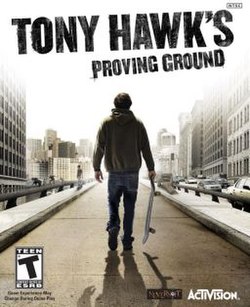

Tony Hawk's Proving Ground arrives like a confident skateboarder who still remembers how to ollie over your expectations. It's Neversoft's swan song for the series on the major consoles, and the PS3 version tries to blend the old-school Pro Skater sprint-and-score loop with newer toys like Nail-the-Manual and Nail-the-Grab. If you're approaching Proving Ground with dreams of stylish lines, ridiculous combos and a soundtrack that slaps, you'll find a game that rewards skillful play - even if it sometimes trips over its own ambition. The PS3 release gives you one open-world city to roam - a mash-up of Baltimore, Philadelphia and Washington, D.C. - and nine levels' worth of spots to learn, master and exploit. This review zeroes in on what matters most to the player who likes being challenged: how the game's goals are structured, what mechanical chops it demands, and the ways it pushes you to refine timing, balance, planning and creativity. If you want the short answer: this is a game that will make you better at thinking in lines, timing tricks and accepting the occasional faceplant as a lesson rather than a crime.
Proving Ground's gameplay sits squarely between a sprint to beat objectives and a chess match of combo planning. The PS3 version brings back elements of classic Tony Hawk fare - high-scoring runs, broken objectives scattered around dense urban playgrounds - but it also layers in Nail-the-Trick-style challenges with two new variants: Nail-The-Grab and Nail-The-Manual. These modes force you to pause the usual flow, focus on a segment, and execute near-perfect micro-actions. If you've ever tried to thread a needle while doing a kickflip in your head, you'll understand the kind of concentration Nail modes demand. On a mechanical level, the challenge profile is multi-tiered. First: timing. Tricks are less about mashing buttons and more about knowing the rhythm of the animation, when to pop the stick for a revert, when to edge into a manual and how long to hold a grab without losing momentum. The Nail-The-Manual mode especially trains you to treat manuals like a second language: leaning into two-inch miracles where balance checks, minute joystick nudges and situational awareness determine whether your combo balloons into a scoreboard-busting run or collapses into a painfully short wipeout. Second: spatial planning and route memory. The single open world on PS3 is dense with grind lines, transition ramps, bowls and secret launchpads. The nine levels across the East Coast neighbourhoods fold into one continuous playground that rewards players who can see sequences several tricks ahead. Good runs require planning - where to start, which gap to hit for extra airtime, how to chain a grind into a launch, and how to end on a high-value trick so you can cash in with a Nail mode. This is a game where learning the map is as critical as learning the stick inputs. Third: combo hygiene. Proving Ground resurrects the combo-focused approach of earlier games: you must piece together manuals, grinds, airs and grabs to inflate your multiplier. The Nail modes exist to help you cement tricky bits, but they also punish sloppy linking. Combos demand clean transitions; landing a trick is not enough if you can't immediately connect it to the next move. This forces players to develop a kind of rhythm-game precision - muscle memory for successive flicks, button holds, and thumbstick flows. Fourth: adaptability and risk management. The game's objective types (Rigger, Career and Hardcore goals) nudge you toward different playstyles. Rigger tasks often require using objects in the environment - hooking yourself to a chain of rigs, basically treating the city like a skatepark-slashed-puzzle - while Hardcore goals will make you chase longer, riskier lines for higher payoff. Career objectives are the standard smoke-and-mirrors of score-chasing and item-finding. Each class of goal forces you to weigh risk versus reward: do you go for the spectacular manual across a crumbling rail for mega points, or play it safe and slowly chip away at objectives? Good players learn to mix both strategies. Fifth: multiplayer and user-generated challenge design. The PS3 version's online features via PlayStation Network introduce up to four-player parties that can free-roam. This alters the skill set: you must now read other players, contest lines, and react quickly to opportunistic attacks on your best combos. The Skate Lounge feature is a deceptively powerful addition: a customizable warehouse where you can place ramps, rails and challenges. Building a trick-heavy course is itself a meta-skill - you need to understand what elements create flow, how to force a player into a high-risk link, and how to design challenges that are hard but not soul-crushing. Where Proving Ground stumbles is in its inconsistency across platforms and the occasional looseness in its execution. The PS3/X360 versions get the open-world and the full suite of mechanics; PS2 and Wii miss features like Nail-The-Manual and bowl skating. The AI and some physics moments don't always reward precision the way you'd expect - sometimes the game feels like it judges you; other times it rewards you for daring. Still, most of the challenges in the PS3 version are deliberate and fair: they teach you to keep trying, refine your rhythm and get creative with the environment. If you're training to be a Proving Ground virtuoso, focus on three practice pillars: repetition for muscle memory (especially for Nail modes), map recon (memorize routes and escape paths), and combo chaining (practice transitions between airs, grinds and manuals until they feel instinctive). This game is not kind to lazy inputs, but it is generous to persistence.
The PS3 version looks like a late-2000s console game that learned its street cred from reality TV. It isn't trying to be photorealism's greatest hit, but the urban textures, convincing ramps and the scale of the open world do a competent job of selling the idea that you're shredding on East Coast concrete. Lighting and reflections are decent for the era, and the camera generally does its job during big airs and vert runs to make you feel the height. Where visuals tie into challenge is important: clear sightlines and readable geometry help you judge gaps and lines. Proving Ground mostly succeeds here - rails, ledges and launch points are easy to read, which makes precision tricks less about guessing and more about skill. Occasionally, draw distance or texture pop-in can sabotage a planned run, but these are annoyances rather than deal-breakers. The PS3 presentation overall is functional and focused: it supports the gameplay challenges rather than distract from them.
Tony Hawk's Proving Ground on PS3 is not a revolution, but it's a solid study in how to craft skateboarding challenges that make you better by making you try. The game promotes a skill set built around timing, balance, spatial planning, combo-linking and creative course thinking. Nail-The-Manual and Nail-The-Grab give you the micro-level exercises to polish those skills, while the open world, diverse objectives and Skate Lounge provide macro-level arenas to apply them. If you're the type who enjoys learning a map like it's a rhythm map and emerging from repeated, small failures into long, clean combos, Proving Ground will reward your patience. If you want perfect physics and a flawless arcade experience, you'll find spots that disappoint. For players who love being challenged, though - who like feeling their thumbs and reflexes improve session by session - this is a PS3 Tony Hawk game that still knows how to teach, tease and test. And for what it's worth, it's a fitting final Neversoft hurrah: a title that appreciates the craft of skating games and the stubborn joy of getting one more combo than you did yesterday.
 Metal Gear Solid V: Ground Zeroes on PS4
 Air Conflicts: Vietnam on PS3
 Accolade Sports Collection on Xbox Series X/S
 Deca Sports DS on DS
 Alan Hansen's Sports Challenge on PS2
 EA Sports MMA on PS3
 Band Hero on DS
 Band Hero on PS3
 Apocalypse on PlayStation










 Another SquareThought Site