

 Aug 2025
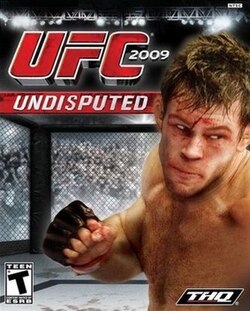

UFC 2009 Undisputed arrived in 2009 as the octagon-sized reboot fans had been waiting for, bringing official Ultimate Fighting Championship licenses and a roster of real fighters to PlayStation 3 and Xbox 360. Built by Yuke's and published by THQ, this was the first fully licensed UFC title since 2004 and it carried heavier technical ambitions than the typical sports reskin. The end result is a clear-headed attempt to model mixed martial arts as a system of interacting mechanical layers: standup striking, clinch, takedowns, and a surprisingly intricate ground game. Reviewers rewarded its ambition, and the numbers followed: respectable critical scores and strong sales that pushed the franchise forward. This review focuses on how the game's systems hold up when you stop watching the dramatic slow-mo and start poking at its guts with the kind of clinical curiosity that makes designers nervous.
UFC 2009 Undisputed is built around a relatively small but mechanically dense set of choices. Yuke's organizes fighter archetypes into two orthogonal axes: standup and grappling. The standup pool contains Boxing, Kickboxing, and Muay Thai; the grappling pool contains Brazilian Jiu-Jitsu, Judo, and Wrestling. Every fighter gets one style from each category, which immediately constrains their toolset and tells you what to expect during a match. This binary classification is simple on paper but produces emergent depth in execution. For example, Georges St. Pierre is modeled with Kickboxing and Wrestling, which gives him both range and takedown proficiency. That combination matters in the interplay between distance management and transition timing. Mechanically the game divides combat into layers that must be read and manipulated together. Striking involves range control, feinting, and timed counters. Clinch exchanges introduce a mini-game of pummeling and posture control, and takedown attempts open up position-specific transitions. The ground game is the most technically ambitious element: once a takedown lands, control shifts to a positional subsystem where momentum, bodyweight, and submission mechanics interact in ways that reward incremental advantages rather than single-button instant wins. This is the part that critics who called the game 'deep' and 'intricate' were referring to. It rewards players who invest time into understanding how to chain moves, maintain base, and pressure for submissions without exposing themselves to reversals. Controls and learning curve are where the game shows its teeth. Reviewers consistently noted a steep learning curve; this is not a button-masher. Inputs are mapped to context-sensitive behaviors, so the same stick motion yields different outcomes depending on clinch state, body positioning, and stamina. That adds a frictional learning cost, but it also means the inputs more faithfully simulate the decision bandwidth of MMA. The Career mode and Create-A-Fighter (CAF) systems let you experiment with builds, but that flexibility initially introduced exploits. Notably, an exploit in the CAF system allowed players to artificially inflate ability meters, which Yuke's later patched. The patch also introduced measures to track players who disconnected from online matches to avoid losses and to improve matchmaking by grouping players with similar connection speeds. Online play was a mixed bag at launch. The underlying netcode needed to reconcile local deterministic simulation with the unpredictable reality of home network latency, and reviewers reported lag in some matches. The initial system did not penalize disconnections, creating a meta-problem where players could dodge losses with a network flap. Patches attempted to fix both the CAF exploits and the disconnect abuse, and they added heuristics to match players by connection quality. Even with those fixes, competitive matches still suffered occasional hiccups if one player's network quality differed significantly from the other's. The takeaway for players interested in high-level play is that a stable connection and an understanding of the game's timing windows are non-negotiable. A few other design choices are worth calling out from a technical authenticity perspective. The game excludes southpaw stances due to clipping issues-an engine-level collision concern-with the result that fighters who actually fight southpaw in real life are forced into orthodox stance models in-game. The developers also faced clipping problems with character hair that reportedly excluded at least one real fighter from the initial roster. These are small but meaningful fidelity compromises that reveal the limitations of the collision and animation pipelines used during development. From a systems point of view, the game is balanced around pacing and stamina more than unrealistically spiky damage. Review outlets praised the balance between striking and the ground game: the latter is neither overwhelming nor trivialized. Ground control and submissions require sustained pressure and correct positioning rather than pure statistical advantage. That design choice makes the title a rewarding study in incremental advantage: secure a takedown, improve position, and then methodically work for a finish. For players who want immediate gratification, that can feel slow. For players who enjoy optimizing sequences and timing transitions, it pays dividends. The career and unlock systems provide long-term goals without being purely cosmetic. TapouT crew members and a handful of unlockable characters add value for completionists. DLC paths and the inclusion of contest winners through network distribution-such as the season 8 Ultimate Fighter winners made available post-launch-extend the game's lifecycle and create additional data points for balancing and matchmaking.
Presentation is where the engine both shines and exposes its seams. Character models and arena presentation are competent for the era and generally convey the televised look of UFC events, with broadcast-style camera framing and crowd reactions that sell the spectacle. Animations are responsive and the transition blending between standing, clinch, and ground positions feels purposeful; Yuke's used animation layering to maintain continuity across radically different combat states. The Achilles heel on the visual side was collision detection and clipping. THQ and Yuke's openly discussed clipping problems during development, and those issues had practical consequences: some character features, like long hair, created unacceptable geometry intersections during grappling and ground transitions, and the developers chose to omit certain fighters as a workaround. The lack of southpaw stances was also a direct casualty of clipping constraints, as the engine struggled to reconcile mirrored animations and hitboxes without visual and mechanical artifacts. That trade-off demonstrates a fundamental engineering limitation-either spend more production time to remodel assets and refine the cloth and collision systems or restrict content to keep transitions stable. Yuke's picked the latter for the initial release. There were also smaller technical touches that mattered. The CAF system originally allowed players to manipulate attribute meters in unintended ways, which pointed to gaps in validation code for player-generated content. That kind of engine-side oversight is common in sports titles that expose attributes to user modification, and the subsequent patch shows that the team took a post-release, telemetry-driven approach to fixing exploits and improving online fairness. On the rendering front, texture resolution, lighting, and arena detail are all in line with contemporary PS3 releases: passable and stylistically consistent but not groundbreaking. The important thing is that the visuals serve clarity; when you're nine seconds into a ground exchange the camera and animation must communicate position and escape windows, and on the whole they do that effectively.
UFC 2009 Undisputed is a technically ambitious, system-first fighting game that rewards players who like to learn rules rather than muscle through them. Its most notable strengths are the depth of the ground game, the coherent layering of standup and grappling archetypes, and the care taken to balance those systems so that player skill and tactical timing matter. The weaknesses are mostly engineering trade-offs: clipping and collision constraints that forced concessions like the exclusion of southpaw stances and the omission of certain character features, plus teething problems in online play that produced lag and disconnect exploits before patches arrived. If you are a player who revels in the technical side of fighting games-studying position, threading transitions, and optimizing stamina management-this title will feel like a toolbox. If you prefer immediate, pick-up-and-play arcade thrills, expect to invest time climbing the learning curve. Yuke's and THQ shipped a solid foundation that not only revived the UFC license but also set a technical baseline that its sequel could build on. Given strong critical reception, robust sales, and awards recognition, the game's practical engineering decisions paid off in the marketplace even if a few fidelity compromises left purists grumbling. Final verdict: a must-try for serious MMA game fans and system-minded players, with an 8.5 out of 10 score reflecting its smart design, a few rough edges in implementation, and a real sense of potential that would be fully realized in later entries.
 UFC Undisputed 2010 on PS3
 Undisputed on Xbox Series X/S
 Accolade Sports Collection on Xbox Series X/S
 Deca Sports DS on DS
 EA Sports MMA on PS3
 ACA Neo Geo: Art of Fighting 2 on Xbox One
 Online Pro Wrestling on PS2
 AEW Fight Forever on Xbox Series X/S
 Earth Defense Force: Iron Rain on PS4










 Another SquareThought Site