

 Nov 2010
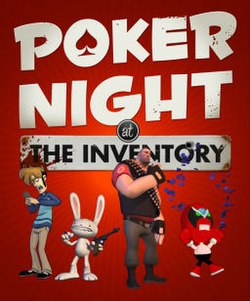

Poker Night at the Inventory is less a conventional video game and more a cozy, occasionally toxic dinner party that happens to be played with poker chips. Telltale's 2010 oddball crossover gathered four very different personalities - Tycho from Penny Arcade, Max from Sam & Max, the Heavy from Team Fortress 2, and Strong Bad from Homestar Runner - and put them in a subterranean clubhouse to verbally tango while counting cards. On PS4 via the 2026 remaster by Skunkape, the experience still hinges on two things: a deceptively simple game of Texas Hold 'Em and an enormous amount of character writing. If you're buying this for the poker, congratulations, you're getting a card game. If you're buying it for the chatter, congratulations, you're in the right basement.
At its core Poker Night is pure, no-frills Texas Hold 'Em: you get two cards, there's a community flop-turn-river, no-limit betting, and the increasing burden of blinds. Everyone buys in for $10,000 and the table runs until everyone's broke or one legend remains. The twist - and the real engine of the game - is the dialogue system. Telltale intentionally traded flashy mechanics for character interactions. Each NPC has voice, tells, and a catalog of reactions that change depending on bets, bluffs, and who just lost their life savings to a three-card straight. The gameplay loop cleverly ties stakes to personality. Random events let a character pawn an item as collateral if they can't front a blind; that item becomes a Team Fortress 2 unlock if you bust them out. It turns an abstract chip pile into something personal: beat the Heavy and you might walk away with a virtual hat; beat Strong Bad and you're not just richer, you're smug. The table becomes an arena for interpersonal arcs, even if the arc is a single hand of poker. Tycho's arc is the closest thing to a slow burn. He arrived as a curmudgeonly observer in the webcomic, and at the table he is the acidic intellect: condescending, dry, and delighted to point out when someone is playing like they gave up their spine in a trade. Telltale's decision to finally give Tycho a voice (Andrew "Kid Beyond" Chaikin) pays off because the model is less about shouting and more about a sustained, wry commentary that occasionally softens into reluctant camaraderie - especially with Max. Watching Tycho go from aloof skeptic to the player's conspiratorial co-combatant over a few hands is oddly satisfying and reads like a miniature pride-to-respect arc. Max is the wildcard with a sitcom résumé of slapstick and existential menace. He rarely gives away his internal monologue, and his arc is intentionally ambiguous: is he amused, bored, or plotting to replace your chips with a rubber chicken? The beauty of Max is that he acts as the audience proxy who refuses to explain himself. His presence invites others to react, bromance to bloom (or die), and reveals more about the other players than it does about him - a clever writing choice that turns silence into character-building punctuation. The Heavy is comic-heroic and quietly touching. He carries the weight of a videogame tank mentality: literally respawning as a gameplay fact in his own mythology, which he describes as a series of dreams. That obliviousness is both the joke and the heart; he's warm, occasionally philosophical about food and destruction, and treats Strong Bad like a bright, annoying insect. The Heavy's arc runs from blithely unbeatable to humanized when he loses - his frustration is blunt and sincere, and the table reacts with genuine concern and mockery. It's a one-scene tragedy-comedy that manages pathos with a furrowed brow and a love of sandwiches. Strong Bad is the cartoon loudmouth with a gratitude-free toolbox of jabs. He is fully complicit in his own meta-awareness, often acknowledging the absurdity of being a character in a game. His arc is antagonism turned begrudging respect. He antagonizes Tycho, the table, and you, then occasionally delivers a backhanded compliment that reads as emotional growth in a sitcom sort of way. Strong Bad is the engine of conflict; he takes shots and sometimes gets knocked into a pile of chips, at which point his bluster becomes defensive poetry. The player character is a silent seat at the table, intentionally blank so the NPCs can reflect onto it. That silence is a narrative feature: you supply the personality through your bets. Being a tight-aggressive player makes Tycho smirk, Strong Bad will trash you for a while, and the Heavy may give you salt-of-the-earth respect. The way the game uses poker actions as conversational prompts is the clever bit: a raise is a sarcastic comment, a fold can read as shame. This is where Telltale's heavy dialogue investment shines - the cards are the verbs and the lines are the adjectives. Despite the fun, the original release had some technical issues: buggy animations and occasional crashes that pulled you out of the fiction. The remaster cleans a lot of this up, with better AI and more polish, but the cinematic animation style still isn't trying to win an Oscar. For what it intends to be - a quick, replayable conversational toy on top of poker - the gameplay does its job and then pats itself on the back.
Graphically Poker Night never aimed to be photorealistic; it was built around the Telltale Tool and existing 3D models for Max, Strong Bad and the Heavy, with Tycho modeled from scratch. The original release wore its budget in the seams: occasionally clunky lip-syncing and stiff animations that made dramatic beats feel like puppets slightly out of rhythm. That said, the character models captured recognizable silhouettes and expressive poses well enough to sell the jokes. The Inventory set - a secret club bathed in muted neon and thrift-store chic - is the perfect backdrop: cozy, slightly weird, and full of little details that suggest a century of furtive game night shenanigans. The Skunkape remaster for PS4 improves textures, smooths problematic animations, and adds extra card/table artwork unlocks. The result is not a visual revolution but a cleaner, more comfortable place to watch Tycho and Strong Bad argue. If you came for facial fidelity you'll be mildly disappointed; if you came for character silhouettes and expressive line delivery, the remaster is perfectly serviceable. The game's visual design always prioritized readable character poses and comedic timing over rendering gloss, and that decision still mostly works in its favor.
Poker Night at the Inventory is a small game with big personality. It's not going to replace serious poker sims or narrative masterpieces, but in the niche where cross-franchise banter meets gambling, it's a rare, well-executed thing. The writing does the heavy lifting: Telltale wrote more dialog for this title than for a typical episode of Sam & Max, and it shows. Character arcs here are tiny and situational rather than sweeping, but they're surprisingly effective. Tycho's icy wit thaws into reluctant respect, Max remains gloriously inscrutable, Heavy transforms a respawn joke into genuine warmth, and Strong Bad successfully trolls his way into grudging admiration. The original was hampered by animation and bug issues, but the remaster irons out a lot of those kinks and adds QoL upgrades like improved AI and new artwork. If you already love any of these characters, Poker Night is a cheap and charming hangout session. If you adore snappy dialogue and enjoy reading personality through betting patterns, it's worth the buy on PS4. If you demanded blockbuster visuals or deep strategic poker mechanics, temper your expectations. On balance, it's a fond little experiment in cross-media banter - equal parts roast and handshake. Score: 7.5/10.
 Night Trap: 25th Anniversary Edition on Switch
 One Night Stand on Switch
 White Night on PS4
 Coloball 2002 on PS2
 Press Your Luck on PS3
 Game Dev Story on PS4
 Mom Hid My Game! on Switch










 Another SquareThought Site