

 Jul 2020


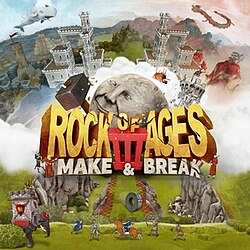
Rock of Ages III: Make & Break feels like a physics sandbox that went to art school and then decided tower defense was its true calling. Built in Unreal Engine 4 by ACE Team with help from Giant Monkey Robot, the game continues the series' absurdist mashup of rolling-object racing and lane-based assault, but this time it hands you tools to design the very racetracks you'll smash down. On PS4 the title lands as a quirky, occasionally brilliant experiment where code meets slapstick: good ideas, middling polish. If you're the sort of person who enjoys tuning collision restitution coefficients as a prelude to ruthless gate-barging, there are delights here. If you prefer your gameplay predictable and your UI legible, you'll be grumbling at load screens and font sizes in equal measure.
At its core Rock of Ages III folds two mechanical spaces into one: a procedural-feeling physics roll-race and a lane-focused tower-defense builder. The loop is simple to state and fiendish to master: construct a boulder, line up a run, roll down to the enemy gate, and then hope your boulder doesn't implode on a trap you didn't account for. The PS4 build exposes the underlying systems cleanly - the boulder is not a single stat but an assembly of mass, shape, and material choices that materially affect inertia, angular momentum and tumble behaviour. You can make a dense log of a boulder that punches gates like a battering ram or a spiky, low-mass sphere that ricochets through traps with chaotic glee. The physics model, driven by UE4's rigid-body solver plus custom gameplay hooks, strikes a decent balance between predictability and emergent chaos. That balance is the game's sweet spot; the moment-to-moment fun is often watching a carefully constructed simulation go gloriously wrong. The sandbox course editor is the major technical standout. It allows players to compose traversal geometry, place traps and defensive constructs, and tweak lanes in a way that actually changes how the physics engine will interact with a rolling mass. Level pieces snap together and the engine computes collision meshes and pathing in near-real time; props are baked into the scene so that subsequent boulder runs behave consistently. For competitive matches, the editor enables a meta-game of map design, where you want to make runs possible but perilous. This editor is precisely why reviewers praised the title: it's a systems-level toy that rewards iteration. Where the gameplay frays is in AI and balance. Enemy AI teams that populate single-player matches sometimes make baffling decisions - they spam defenses in ways that feel both too forgiving and occasionally punitive due to how collision outcomes are resolved. Casualty rates (how many units your boulder kills on impact, which ties into scoring) feel uneven, partly because contact resolution uses fixed formulas that don't always align with what the player sees on-screen. Difficulty spikes and 'unfair' interactions were flagged consistently in critic writeups, and they reflect a mismatch between deterministic physics and weighted gameplay systems: a boulder may tunnel through dozens of units in one run, then barely scratch a gate in the next. Multiplayer and trials modes are competent but not revolutionary. Netcode for head-to-head is serviceable: matches sync the deterministic elements (map geometry, placed traps) and transmit boulder inputs rather than raw physics states, which reduces bandwidth needs and prevents desyncs. However, the matchmaking and community level browser feel undercooked on PS4 - sharing levels is possible, but discoverability and quality control aren't robust, which blunts the long-tail value of the editor.
Visually, Rock of Ages III embraces a stylised, painterly aesthetic that leans into caricature and surrealism. On PlayStation 4 the art direction is arguably the game's friendliest feature: environments pop with colour, cutscenes are energetic, and the varied historical themes for boulders and lanes give the title clear visual identity. UE4's material system is used well, with stylised PBR that favors readability over photorealism, which is smart given the chaotic on-screen action. Performance on PS4 is mostly stable, but there are edge cases. When a level contains a dense arrangement of dynamic props and multiple heavy boulders collide, the physics solver ramps up CPU usage and you can see frame dips. These spikes are not catastrophic but they puncture the illusion of seamless chaos. UI implementation is a mixed bag: menus are crisp, but in-game HUD text can be illegible at a distance or when the camera gets into a cinematic spin. That illegibility is a real problem because so much of the game's feedback loop (scores, timers, and casualty counters) is communicated via small text overlays. Resolution scaling and font rendering choices on PS4 could have used a more generous type hierarchy and clearer contrast rules. Collision and particle effects deserve a mention. Collisions are satisfying most of the time - the thuds and crunches sell impact - but the visual cues for damage and gate breakage are sometimes out of sync with hit detection. Particle effects are economical rather than flashy, which helps maintain frame rate during multi-boulder frays but occasionally makes damage feedback feel muted. The soundtrack and voice/snark work in tandem with the graphics to sell the game's tone; audio mixing is generally clean and doesn't fight the action for attention.
Rock of Ages III: Make & Break is a studio-built Rube Goldberg machine: a clever concatenation of physics, level-design tools, and absurdist presentation. The technical scaffolding - UE4, a capable rigid-body simulation, a robust editor and sensible netcode architecture - demonstrates competence and ambition. Where the title loses steam is in polish and user experience: AI quirks, balance hiccups, illegible UI text and an unfinished-feeling community infrastructure reduce the satisfaction of the otherwise delightful systems at play. On PS4 it plays well enough to be recommended to players who like sandbox toys, trial-and-error physics, and screwball humour. For competitive or long-term players looking for tight balance and pristine UI, it will feel like a promising prototype rather than a finished arena champion. If you want to build bizarre courses, send a themed boulder hurtling into a rival's gate, and laugh at the glorious physics carnage, this one's worth the spin - just keep a critical eye on the maps you download and a tolerance for the game's occasional unfairness.
 Top Spin 3 on PS3
 Pro Yakyū Spirits 2019 on PS4
 Roary the Racing Car on DS
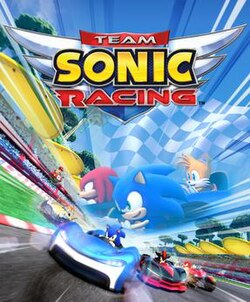
 Team Sonic Racing on Switch
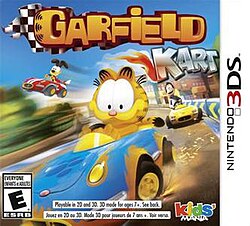
 Garfield Kart: Furious Racing on Switch
 Ben 10: Galactic Racing on PS3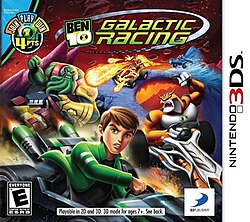










 Another SquareThought Site