

 Jul 2019
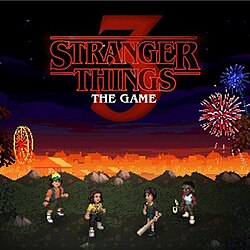

Stranger Things 3: The Game is what happens when a streaming hit decides it deserves a retro video game tie-in and someone remembers the 16‑bit era looked cool. Developed by BonusXP and released on PS4 in the summer of 2019, it recreates the third season of the show in earnest pixelated detail, like a VHS copy of your favourite mall montage but with fewer mullets and more inventory menus. If you were hoping this would be an ambitious reimagining of Hawkins, it politely declines to be ambitious. If you wanted a faithful, nostalgia‑drenched companion piece you can play with a friend on the couch, it mostly manages that - as long as your expectations are modest and your patience for repetition is elastic.
The game is a beat 'em up that looks like it belongs in an old arcade cabinet that smells faintly of sweat and cheap nachos. You get twelve playable characters from the show, each carrying a unique weapon and a small bag of special abilities. At any time you can have two characters active: one controlled by you, the other by the AI or a local co‑op partner. This is where the game shouts, in a pleasantly retro voice, "we love couch co‑op," and then hands you a large map to wander around while you punch things. Combat borrows heavily from the Streets of Rage school of button‑mashing with a sprinkle of tactical timing. It's serviceable, it lands hits when it needs to, and it occasionally rewards you with a satisfying knockback or an enemy flung into a conveniently placed environmental object. The problem is that it never really grows its teeth. Enemies cycle through the same handful of behaviors until the novelty of seeing Eleven swing a baseball bat wears off. Upgrades exist in the form of a crafting system for weapons, which at least gives you a reason to collect scrap and tinker. Upgrading feels neat in theory - there is pleasure in improving Nancy's slingshot - but the rewards often amount to marginal numbers on a screen rather than game‑changing differences. Exploration is framed as an open world, but "open" here is more like "several decently sized maps that sometimes feel suspiciously empty." There are pockets of great design: tiny puzzles, secret areas unlocked by recruiting a specific character, and little fanservice moments that recreate scenes from Season 3. When these moments land, they land with the warmth of a show‑accurate Easter egg. The downside is that many objectives are fetch quests that rearrange the same furniture. You'll run back and forth across Hawkins more than once to fetch a note, flip a lever, or clear the same corridor of monsters. The game's structure faithfully reenacts the season's events, which sounds cute until you realise the season's pacing isn't a perfect fit for a video game loop. Puzzles are a mixed bag. There are clever little brainteasers that nod toward classic action‑RPG design, and they provide the rare feeling of accomplishment. Most of the time, though, puzzles are scaffolding for the main act of the game: fighting waves of foes and sprinting to the next objective. The isometric viewpoint looks neat in pixel art, but it can occasionally obscure hitboxes and make platforming a bit of a guessing game, which is not an experience anyone signs up for unless they enjoy arguing about camera angles. Local multiplayer is where the title shines socially. Playing with another person turns the grind into a sitcom episode. You coordinate, you trade characters, you revive each other, and you make jokes about how the Upside Down would be much less fun if it had a snack bar. The single‑player experience relies on an AI companion that does its job but won't treat you to the same kind of shenanigans a human partner will. The last save point before a boss fight is still there, so you can rage quit and blame the controller if the boss is mean. Finally, someone should mention the game's history because it influences how you'll encounter it today. It launched across consoles and PC but was later delisted from storefronts and moved to exclusive availability for Netflix subscribers on mobile. That doesn't change the PS4 discs or your memories, but it's a neat footnote when considering how modern licensing and corporate decisions shepherd games into the wild.
The pixel art is unapologetically retro, a 16‑bit love letter with an isometric spin. For fans of chunky sprites and bright palettes, the aesthetic scratches an itch: characters are recognisable, locations are lovingly recreated, and the game captures the neon‑mall palette of the season. Critics pointed out that the style doesn't always gel with the eerie, atmospheric tone of Stranger Things - there's something dissonant about reducing a supernatural thriller to adorable, blocky sprites. That said, there are moments where the aesthetic works beautifully: explosions of pixel gore, neon signs that hum with colour, and small setpieces that feel like a postcard from 1985. Performance is generally fine on PS4, although reports from other platforms suggested hiccups elsewhere. The real visual flaw isn't framerate so much as design emptiness. Maps are large and sometimes uncomfortably vacant, like a suburban mall after hours. When the camera frames a wide empty street, the silence is supposed to feel spooky; instead it sometimes reads as content scarcity. Still, if you're buying this for nostalgia and visual callbacks, the graphics do most of the heavy lifting and rarely offend.
Stranger Things 3: The Game is a competent, clearly affectionate adaptation that will make die‑hard fans grin and everyone else shrug politely. Its strengths are in faithful fanservice, charming pixel visuals, and a cooperative mode that turns repetitive combat into a social ritual. Its weaknesses are the kind other games solve with variety, patience, and risk: combat that doesn't deepen, quests that lean too heavily on fetch mechanics, and maps that occasionally sniff of empty air. If you love Season 3 and want to stomp through Hawkins with a friend, collect lore, and hit enemies until they stop moving, you'll have a fine time. If you expect a sprawling reworking of the series that stands up as a classic beat 'em up, temper your expectations. BonusXP made something loyal rather than revolutionary, and that's a fair trade if you signed up for nostalgia over novelty. Consider this a middling sequel in the great tradition of tie‑in games: charming in parts, flawed in execution, and best enjoyed with a partner on the couch and a cold soda within arm's reach.
 Press Your Luck on PS3
 Game Dev Story on PS4
 Mom Hid My Game! on Switch
 Beat City on DS
 Crisis Beat on PlayStation
 Capcom Beat 'Em Up Bundle on PS4
 Teenage Mutant Ninja Turtles: Mutants Unleashed on Switch











 Another SquareThought Site