

 May 2016
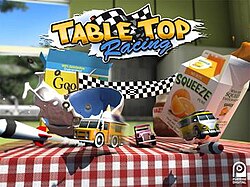

Table Top Racing: World Tour straps tiny, toy-like cars into dainty little tracks and dares you to treat them like world-class racers. Made by Playrise Digital (yes, the studio with team members who once worked on Wipeout), World Tour takes the Micro Machines / Mario Kart DNA and shrinks it into environments like kitchen tables, workbenches and picnic scenes - the kind of places where crumbs become boulders and chopsticks are legitimate obstacles. On PS4 this becomes less of a mobile party trick and more of an arcade racer with bite-sized circuits and surprisingly fiendish demands on your basic skills. If you were expecting in-depth sim tuning or luxury-car physics, you'll be disappointed. If you enjoy crisp arcade handling, tight, short races and enough modes to keep your thumbs busy, you'll get why this little kart wants your attention. This review zeroes in on the challenge side of things: what skills the game demands, how it punishes mistakes and what you'll actually be practicing when you grind the World Tour.
The core design philosophy here is "arcade and accessible," but don't confuse accessible with easy. World Tour uses auto-acceleration and auto-brake; you don't control throttle, you control direction, timing and items. On mobile that meant tilt and touch options; on PS4 that translates to instantaneous inputs and a focus on precision. The first big lesson the game teaches is that short tracks magnify small errors: a bad turn, a missed boost-start, or sloppy item usage is often fatal because you have almost no time to claw your position back. Mastering starts is an underrated skill in this game. Races are often short, so the first few seconds define the rest of the lap. The game rewards timing - hitting the boost at the exact moment in the countdown will get you a rocket off the line. That precise timing is a learned reflex: practice the countdown, watch the audio-visual cue and nail the timing until your fingers expect the beep. Because races are brief, consistent good starts equate to consistent podiums. Item management and situational awareness are the second pillar. World Tour dresses itself in toyroom charm, but it plays like a combat kart racer. Items include speed boosts and projectiles. Because tracks are tight, using an item in the wrong place can send you careening into a chip or a forked track and cost you more than it gained. Learning when to use a shield, when to fire forward and when to hold a boost for a straightaway is critical - you'll lose fewer positions if you treat items like tools, not panic buttons. Cornering and drift mechanics are deceptively important. Drifting is a game of balance here: you need to commit early on tight turns and let the car arc smoothly. The handling is forgiving compared to a sim, but the penalty for late corrections is steep on short circuits. This pushes you to memorize lines - the riffle in the track textures, the exact placement of a toy mug that clips your back bumper - and to execute with consistency. Practicing the same track repeatedly pays off dramatically; what feels random on your first run becomes predictable on run five. Modes like elimination and catch-up put different skills under the microscope. Elimination highlights endurance under pressure: avoid being last at the end of a lap and keep calm when chaos reigns. Catch-up forces you into opportunistic play - you may have to use risky shortcuts or perfectly-timed boosts to peg back a head start. Time trials and drift challenges demand repetition, route optimization and focus on micro-improvements. There's a light RPG-ish economy too: earning stars and currency to upgrade cars nudges you toward incremental performance gains, so part of the skill set is resource allocation - deciding which stat to boost for tight tracks versus long straights. A few caveats around challenge: some critics noted the game doesn't feel as fast as it should, and tracks can occasionally feel cramped. That changes the type of skill you need: instead of raw throttle control, you need razor reflexes and superior spatial awareness. Multiplayer can be rewarding, but older reviews observed empty lobbies on mobile; on PS4 the expectation is better online support, but the core challenge remains - outsmarting friends in short, frantic rounds beats brute-speed supremacy. So what do you practice? Start timing, drift commitment, item timing, and remembering the track quirks. The more you grind, the more the game reveals itself as a precision arcade racer that rewards ritualized repetition. If you like learning by repetition and tuning your reflexes until they behave like trained hamsters, World Tour will bite you in the best way possible.
The game looks a lot better than its toy-sized ambitions might suggest. Reviewers praised the presentation and imaginative track design - a workbench strewn with instruments, a children's toy room and a picnic table all become distinct obstacle courses. For a game with tiny cars, the level of polish on textures, lighting and props helps with readability: you can spot a water cup, a fork, or a raised edge from a distance and plan your line. That visual clarity feeds directly into the skill challenge. Because the environments pop, you can develop spatial cues and memory anchors for each corner. A particular Lego block or chopstick will become your braking point and that's useful when races are over in the blink of an eye. Some reviewers did mention that the sensation of speed feels muted at times; even so, the aesthetic detail and snap of presentation make the short races feel lively and give your practiced instincts something pleasing to lock onto.
Table Top Racing: World Tour isn't trying to be the bleeding edge of kart combat or a hardcore sim - it's an arcade sprint that asks a lot of your timing, spatial memory and decision-making in micro-doses. The challenge is skill-based: nail your starts, commit to the drift, use items smartly and learn every tabletop quirk. If you enjoy short, intense races where tiny mistakes are painfully, hilariously costly, this is a tidy package with enough polish to justify jumping in on PS4. If you want long grand prixs or hyper-realistic speed, look elsewhere. For players who enjoy improving through repetition and love the idea of tiny cars throwing themselves at giant household hazards, World Tour is a delightful little teacher - strict but fair. Scorewise, it sits comfortably as a solid mid-to-high tier arcade racer: fun, polished and challenging in the precise ways that reward practice. Grab it for local chaos or a few competitive online rounds, and be prepared to get better one crash at a time.
 Tennis World Tour on Switch
 Harvest Moon: One World on Switch
 Roary the Racing Car on DS
 Team Sonic Racing on Switch
 Chocobo Racing on PlayStation
 Michael Schumacher Racing World Kart 2002 on PlayStation










 Another SquareThought Site