

 Mar 2018
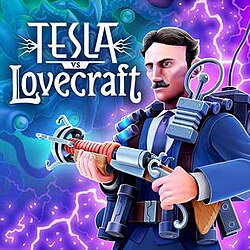

There are video games that announce themselves with a flourish and a production budget, and then there are games that show up in a lab coat, blow the power generator, and declare war on eldritch horror with nothing but a coil and some stubbornness. Tesla vs Lovecraft belongs emphatically in the latter category. Imagine a 1990s games magazine reviewer, cigarette (metaphorical) dangling from an editorially clenched jaw, peering down at a top‑down screen and pronouncing that what you're witnessing is both nostalgically familiar and freshly, gloriously bonkers. 10tons has taken historical oddity and pulp horror, smashed them together in a blender labeled "arcade catharsis," and served up a twin‑stick shooter that behaves like it was designed by Nikola Tesla on his break from inventing alternating current. The premise is deliciously absurd: H. P. Lovecraft barges into one of Tesla's demonstrations and becomes possessed by Cthulhu, then uses Tesla's own inventions to fling a menagerie of monstrous nonsense through dimensional rifts. You play Tesla. Your job is to not die, to acquire weapons and upgrades until your foes are little more than science fair projects gone wrong. The PS4 version arrives with the same twitchy thrill found on other platforms, and while it doesn't reinvent the wheel, it polishes it to a high, crackling sheen. This is a shooter that wears its inspiration on its sleeve - arcade adrenaline, pick‑up‑and‑play clarity - but hides a satisfying amount of depth under the hood for players who prefer their chaos with a side of strategy.
Gameplay wears the twin‑stick shooter label proudly, but it's the little design choices that stop this from being mere homage. Levels play out as tightly designed arenas where hordes of Lovecraftian flora and fauna spawn with the enthusiasm of an invasive species. At the outset Tesla is equipped with ordinary arms and a teleporter - enough to keep you moving and frantic, and just clumsy enough to make upgrading feel earned. Weapons and power‑ups are scattered through the stages; collect enough and you can augment Tesla into forms bordering on ridiculous, including a mecha. The mecha is not a throwaway flourish: it serves as a climax to the player's acquisition trajectory, a satisfying reward for surviving the escalating chaos. Combat hinges on positioning, prioritization and the filthy joy of watching numbers climb as enemies explode. The twin‑stick controls on PS4 feel tight, which cannot be overstated for this genre: when rooms fill and screen space becomes a currency, responsiveness keeps frustration in check and fun flowing. The teleporter mechanic provides a welcome burst of mobility and tactical repositioning, preventing the experience from collapsing into the typical "circle‑strafing until everything dies" routine. Power‑ups grant temporary advantages that spice up an otherwise relentless loop - they are brief, bright punctuation marks in longer bouts of sustained combat. A clever perk system elevates repeated runs. As you slaughter the horde you earn the right to pick perks - persistent buffs that alter the feel of Tesla between deaths. Dying isn't purely punitive; it allows you to reselect perks and experiment. Perks reset when you move to a new level, which both rewards mastery of a single stage and keeps the overall structure from stagnating. This system strikes a comfortable balance between roguelike experimentation and arcade continuity: you can chase incremental improvement without feeling punished for failure. Multiplayer exists, but the PS4 experience is strongest when treated as a single‑screen, local thrill ride. Some versions of the game drew criticism for lacking online co‑op, and that absence is felt here if you're the kind of player who expects to drag a friend through cosmic nightmare fuel via the internet. Still, local co‑op preserves the tradition of couch‑based mayhem and suits the game's arcade DNA. The game does run into the occasional repetition in level layouts and enemy types; a few stages begin to blur together after extended play. Even so, strategic variations introduced by weapon upgrades and the perk system keep runs sufficiently differentiated to sustain long sessions. The difficulty curve is satisfying rather than vindictive. Early levels teach you to juggle crowd control and resource management; later stages force you to make hard choices about which power‑ups to use and when to retreat. It's a shooter that rewards split‑second decision making as much as long‑term experimentation with loadouts, and that combination is what makes it compelling in short bursts or marathon sessions.
Visually, Tesla vs Lovecraft looks like a polished 16‑bit fever dream that learned some modern cosmetics in college. The top‑down presentation is crisp, with readable enemy sprites and explosions that convey impact without devolving into visual mush. Lighting and particle effects add a contemporary sheen; lightning bolts and eldritch energies snap and sizzle in a way that makes the tiny screen feel dangerously energetic. Critics noted that the game "looks and feels great," and that sentiment is apt: the aesthetic supports the gameplay without ever stealing focus. Environments are functional and occasionally clever in their use; they are not meant to be sprawling, photorealistic set pieces but rather compact arenas designed to facilitate emergent firefights. This is an old‑school attitude - design that prioritizes visibility and rhythm over environmental wanderlust. On PS4 the framerate is steady during most encounters, which is crucial for a twitch shooter; hiccups are rare and generally occur only in the most frenetic moments. Overall, the graphical style is consistent with the game's sense of humor and arcade roots: familiar, clean, and satisfyingly loud.
Tesla vs Lovecraft is the sort of title that would have made for a delightful magazine cover feature in the 1990s: bold premise, immediate hook, and gameplay that rewards both reflex and strategy. 10tons has delivered a compact, well‑constructed twin‑stick shooter that pairs chaotic combat with a perk system that encourages experimentation. It doesn't wholly escape repetition in level design and it lacks some modern conveniences - online co‑op being chief among them for those who play socially online - but it compensates with relentless, well‑tuned action and an aesthetic that matches the game's manic personality. For PS4 owners craving a shooter that respects classic arcade principles while adding modern polish, this is a strong pick. It won awards in Finland and earned generally positive reviews across platforms, which is appropriate: Tesla vs Lovecraft is not a sprawling epic, it's a brilliantly focused exercise in controlled chaos. Put it on when you want your thumbs tested, your score chased, and your sense of historical accuracy gleefully subverted. If Nikola Tesla could clap, he would probably zap Lovecraft and say, with a scientist's smug satisfaction, "I told you so."
 Tesla vs Lovecraft on PS5
 Close to the Sun on Switch
 PixelJunk Shooter 2 on PS3
 Ugly Americans: Apocalypsegeddon on PS3
 Ultratron on PS3
 Jydge on PS5
 Azkend 2: The World Beneath on PS4
 Jydge on PS4










 Another SquareThought Site