

 May 2020
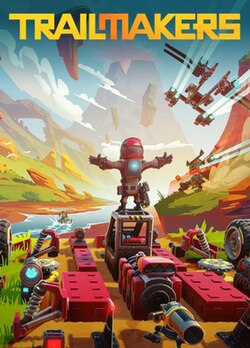

Trailmakers arrives on PS4 like someone who brought a toolbox to a philosophy debate and insists on answering every question with a Rube Goldberg machine. It is a 3D physics-based vehicle construction sandbox that hands you a generous pile of parts, a forgiving but honest physics engine, and a series of maps that seem to have been designed specifically to judge you. The game began life on PC as an early access project in January 2018, gathered over 100,000 sales while players tested the limits of buoyancy and hubris, then proceeded to leave the cosy Steam workshop for consoles in September 2019 and onto PlayStation 4 on 21 May 2020. On paper it is a vehicle-building simulator with exploration and racing modes. In practice it is a hobby, a creative outlet, and a way to learn that wings made of doors are rarely a good idea.
Trailmakers gives you the components and politely refuses to give you a manual for common sense. The core loop is: construct a vehicle, take it for a spin, observe the laws of physics mocking you, then iterate. Modes are flexible; adventure, sandbox, racing and some campaign missions all coexist, and everything can be played solo or with friends if you enjoy the special combination of chaos and laughter that multiplayer physics offers. The camera defaults to third-person, which makes sense unless you want to experience existential dread in first-person and so the game lets you switch perspectives. On PC there is modding support, which turns the already chaotic toybox into a proper toolbox of weirdness; on console you get the more curated experience but the creative freedom is still surprisingly broad. Maps are sensibly varied. There are eight sandbox-style maps including Stranded, Treasure Island, Danger Zone, Test Zone, Space Sector, Airborne, High Seas, and Pioneers. For people who prefer short bursts of competitive humiliation, there are two racing maps, Rally and Race Island. There is a PvP map called The Great Carrier Reef, and three campaign maps - Stranded, Airborne, and Pioneers - that reuse sandbox landscapes but add structured objectives. What this means in practice is that you can spend hours building a submarine that is also a convertible, test it in the High Seas only to discover you should have named it Titanic II, then hop to Space Sector and watch the same machine behave like a confused bird. The building system itself is accessible without feeling shallow. Blocks snap together, motors, wheels, propellers and basic aerodynamics are all exposed enough to be meaningful but not so baffling that you need a degree in mechanical engineering to make a working car. The physics are the star. They are honest: if your creation looks like a sensible vehicle in the editor, it will probably drive like a sensible vehicle. If it looks like a spider trying to get a mortgage, it will behave accordingly. That feedback loop of design, test, failure, and slightly improved redesign is the whole point, and Trailmakers handles it with gentle rigor. There are a couple of practical notes for PS4 players. Console controls are adapted well enough from mouse and keyboard, but precision building will always feel a bit friendlier on PC. Some community features like PC modding obviously do not translate directly, so the PS4 version leans more on the in-game toolset and the developer-supplied content. Multiplayer works smoothly for the most part; nothing bonds friends like simultaneous mechanical failure in a tiny made-up plane over a pixel ocean. The game is undoubtedly better with other people, because watching someone else suffer through their first cockpit of doom is entertainment of the highest order.
Visually Trailmakers is functional, clean, and happily unpretentious. The art style leans towards bright, slightly cartoony realism - enough detail to be satisfying without trying to trick you into thinking it's photo-real. Maps are distinct; Treasure Island feels different from Space Sector, which matters because you will be visiting these places repeatedly while your vehicles progressively flirt with catastrophe. The physics interactions look good: parts bend, spin and slosh in believable ways, and water will slap your craft with the emotional maturity of a disappointed parent. The game runs smoothly on PS4; there are no jaw-dropping graphical innovations, but performance is steady and the readable visuals are precisely what a building sandbox needs. There is an unobtrusive HUD, and the editing interface is straightforward to read on a TV screen. The only graphical complaint is that some visual polish and finer details feel like they belong on a checklist the developers promised themselves they would do later. The game was developed in Unity according to the sources, although that claim on the reference I found carries the small label 'citation needed', which is the internet's polite way of whispering 'probably, but let's not make promises.'
If you like to build things, break things, and then build slightly less broken things that still somehow qualify as transport, Trailmakers is the videogame equivalent of a Saturday afternoon in your garage - minus the smell of oil and with fewer lawsuits. It is charming rather than flashy, deep where it counts, and best enjoyed with friends who will either applaud your ingenuity or offer compassionate silence as your flying boat battles the tide. The game supports single-player and multiplayer, offers several maps and modes including racing and PvP, and keeps the core experience refreshingly focused on creativity and physics rather than achievements and microtransactions. There are limits: the PS4 version lacks the full modding ecosystem of the PC, and certain precision-building tasks can feel a tad easier with a mouse. But these are minor criticisms against a game that makes constructing improbable machines genuinely fun. The campaign and the sandbox maps provide enough structured and freeform content to justify returning, and the community creations on PC suggest a creative lifespan that will keep the game entertaining for a long time. Trailmakers is happy to be what it is: a sandbox where your imagination is the engine, gravity is the referee, and the only real failure is not trying at all. Score: 8/10.
 Derby Stallion 04 on PS2
 MotoGP 19 on Switch
 Power Pro Kun Pocket 13 on DS










 Another SquareThought Site