

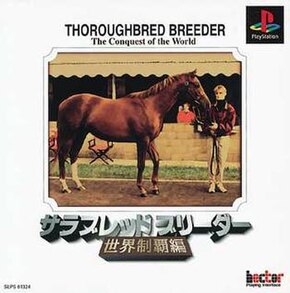

Thoroughbred Breeder: Sekai Seiha-hen arrives like a sensible hat at a horse-racing party: understated, very specific, and primarily appreciated by people who already own a sensible hat. It is the final entry in Hect's Thoroughbred Breeder series, a Japan-exclusive collection of horse-racing simulation games that ran across Super Famicom and PlayStation hardware in the 1990s. The Wikipedia entry for the series reads like an accountant's diary of nostrils and oats - factual, a little sleepy, and with a couple of 'citation needed' flags that suggest someone on the internet once made a bold financial claim about becoming filthy rich by breeding pixel horses. Sekai Seiha-hen, released for the PlayStation in 1998, positions itself as a niche pastime turned into software: play the life of a thoroughbred breeder, juggle feed and water, buy low, sell high, bet if you're feeling reckless, and presumably work toward some grander goal of achieving a global racing dominance as its subtitle (Sekai Seiha - world domination) suggests. The game is not currently celebrated in international retrospectives, which is fair. There are at least five entries in the series, Tsukasa Tawada handled the music across the franchise, and Hect developed and published these titles. If you were hoping for worldwide glossy release parties and cross-promotional horse figurines, you are in the wrong century and the wrong country.
At its heart Sekai Seiha-hen is a simulation that asks you to care for horses and the ledger in equal measure. The available source material is terse, so most of what we can say with confidence is actually given by the Wikipedia stub: you simulate the life of a thoroughbred breeder - which, delightfully, includes feeding and watering your animals - and you can buy and sell horses in a market where timing matters. Selling when prices peak seems to be the video-game equivalent of 'sell high, buy low', which is still sound financial advice even when applied to creatures that neigh. Two core modes are typically available across the series and are explicitly called out in the documentation: Betting and Watching. Betting lets you gamble on races, converting whatever dignity you had into redeemable credits. Watching, presumably, allows you to observe races, appreciate the choreography of hooves and silks, and maybe develop an unnervingly intimate understanding of the color-coding of jockey uniforms. The game apparently allows - and perhaps demands - a hands-on approach to stable management: feed the horses, give them water, acquire horses at low prices, and sell them when their market value peaks. The game's description on Wikipedia even claims that you can become very wealthy if certain conditions are met; that sentence is marked with a 'citation needed' tag, which is the digital form of saying "this might be true, but please don't cash your retirement checks on it yet." Because the series spans several releases (three Super Famicom titles, two PlayStation titles including a 'II Plus' on PlayStation and this final Sekai Seiha-hen), the gameplay likely evolved from menu-driven 16-bit interfaces to something marginally more refined on PlayStation hardware. The PlayStation entries gave Hect more CPU and a CD-quality soundtrack to play with - and indeed, Tsukasa Tawada is credited for the music across the series, which elevates the experience from 'quiet spreadsheet about animals' to 'quiet spreadsheet with a soundtrack that may occasionally swell dramatically when you sell a horse for a tidy profit.' What the documentation does not provide is granular control details: no explicit race-management interface descriptions, no deep dive into breeding mechanics, and no list of stats or micro-management minutiae. This makes the game feel like an old sports management sim where much of the joy - and the frustration - comes from learning undocumented systems through repetition, miscalculation, and the occasional fluke success that feels like destiny rather than design. If you enjoy optimization puzzles wrapped in leather and hay, this will feed your brain. If you prefer instant gratification and explosions, this will mostly feed your horses.
The Wikipedia entry is stingy on visuals. There is cover art for Sekai Seiha-hen attached to the series page, which is useful for confirming that someone, at some point, commissioned attractive art of horses that do not contain progress bars. Beyond that, the article offers no detailed account of in-game graphics. Given the PlayStation release year of 1998, one could reasonably expect presentation in line with late-90s Japanese sports sims: functional menus, static images, and possibly low-polygon 3D or pre-rendered sprites for races if the developers chose to animate them at all. If you are imagining cinematic gallops rendered with cutting-edge photorealism, you will be disappointed. This is more likely an environment where UI clarity and data presentation trump graphical flashiness. The charm, for the target audience, comes from the satisfaction of a well-run stable rather than the jaw-dropping visual fidelity of a thoroughbred's mane. For some players that is exactly the point; for others it will read as 'this is basically Excel in a saddle.'
Thoroughbred Breeder: Sekai Seiha-hen is a small, focused game with the personality of a straight-faced stablehand: it does its job, it asks you to take responsibility for animals and numbers, and it invites you to try to turn a profit. It is a Japan-exclusive final act of a niche series and, like many such titles, it's likely best enjoyed by people who already find horses and market dynamics engrossing. The soundtrack credit to Tsukasa Tawada is a nice pedigree detail for those who like their simulation games to come with composer names worth Googling. For prospective players outside Japan the experience will require either an import or a willingness to contend with language barriers; the Wikipedia stub doesn't mention an official international release, and the series' low profile suggests there was never the kind of localization push that gets a title noticed in the West. If you want a game that rewards patience, careful decision-making, and the peculiar satisfaction of watching a stable's value climb until you can fund more oats, Sekai Seiha-hen will oblige. If you want instant thrills, voice acting, and horses that emote like soap-opera leads, then seek elsewhere. Score: 6.5/10. This is a competent niche simulator with a dry charm and a strict dress code: bring spreadsheets, leave fireworks at home. It earns points for focus and concept, loses a few for limited documentation and accessibility, and ultimately feels like a title built for people who treat horse care as a hobby and fiscal responsibility as a form of entertainment. Which, to be clear, is a perfectly respectable way to spend an evening. If you are curious about a different kind of sports game - one where the wins are statistical and the losses are measured in hay - this is a historically interesting footnote worth tracking down.
 Elf o Karu Monotachi: Hanafuda Hen on PlayStation
 Rurouni Kenshin: Meiji Kenyaku Romantan: Juuyuushi Inbou Hen on PlayStation
 Accolade Sports Collection on Xbox Series X/S
 Deca Sports DS on DS
 Roary the Racing Car on DS
 Team Sonic Racing on Switch












 Another SquareThought Site