

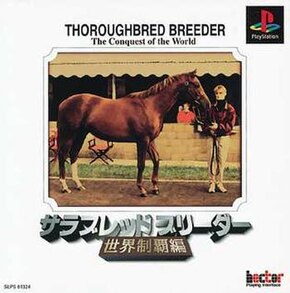

If your idea of a wildly good time is spreadsheets, pedigrees and the slow-burning thrill of capitalism filtered through equine genetics, Thoroughbred Breeder II Plus (1995, PlayStation) will whisper sweet nothings into your save-file. Birthed by Hect as part of a small Japan-only series that began on the Super Famicom, the II Plus entry moves the franchise into Sony's CD era. It keeps the franchise's stated purpose intact - simulate the life of a thoroughbred breeder, feed and water animals, buy low and sell high, and, when the moon and the game's internal dice roll your way, become obscenely wealthy - while nudging the underlying systems into the larger data allowances and audio capabilities the PlayStation provides. This review approaches II Plus as an engineer would: by pulling apart its systems, inspecting the UI scaffolding, poking at the simulation models and noting where polish meets compromise.
At its core, Thoroughbred Breeder II Plus is a deterministic-leaning simulation wrapped in a management interface. The public documentation around the series lists the recurring player activities: feeding, watering, purchasing horses at market, selling them when their price peaks, and either betting or spectating races. Those are the knobs and levers the player turns, and they reveal the game's architecture: a state-driven economy, entity-based horse records, and a rule set that converts care and breeding choices into market and race outcomes. From a technical perspective, the most interesting thing about a breeder sim like this is its data model. Horses are naturally represented as records with arrays of attributes - pedigree references, age, condition, racing statistics and a price variable subject to supply/demand mechanics. Given the era and console, II Plus likely migrated and expanded the Super Famicom entries' data tables; the PlayStation's CD medium makes it plausible the game stores larger lookup tables and more varied event text. Expect normalized references for sire/dam relationships and a compact encoding for traits (speed, stamina, temperament) that get read and updated each in-game cycle. The game's loop is intentionally slow and strategic: you edit rosters, manage resource inputs (food/water), and orchestrate financial moves. The economic subsystem is where the illusion of depth lives or dies. II Plus appears to lean on deterministic math with seeded randomness for race outcomes and market swings. From a technical design standpoint that is sensible: deterministic core logic with RNG gates gives the player meaningful patterns to exploit (if you learn breeding lines and seasonal price rhythms) while preventing exploits from purely deterministic optimization. The presence of betting and spectating modes implies two separate presentation layers for races - a data-only resolution for bettors and a viewer mode for players who want to watch the statistical result rendered to the screen. In many breeder sims of the 16/32-bit era, "watching" a race is a scripted replay rather than a full physics simulation. II Plus likely follows that pattern: the race is calculated by ranking horse performance values and then played back as sprite or simple animation sequences. User interface is the bridge between player's intent and the systems under the hood. II Plus is built on an era-typical menu-first design: large, information-dense screens, small fonts and columns of numbers. The game's usability design choices - how it surfaces pedigree lines, how it charts a horse's stat progression and what filters exist when browsing the market - determine whether you're consulting an ancient tome or running a modern dashboard. Given the series' lineage, II Plus likely improved data density but retained a text-heavy layout tuned for players who don't mind parsing tables. The technical constraints of the PlayStation controller (digital pad + face buttons) push the UI towards linear navigation and confirmation-heavy flows rather than mouse-like direct manipulation. On save architecture, the PlayStation era brought standardization: memory card storage with fixed block allocations. For a simulation that tracks dozens or hundreds of horses with pedigrees, save compression choices matter. Hect's implementation probably trades off human-readable saves for binary efficiency to keep file size within memory card limits. That decision affects how many concurrent farms the game supports and whether one can archive long-term breeding lines. Those limits also affect the player's long-term planning: if each save can only contain a certain number of registered animals, players will be forced to triage their stables - an emergent gameplay constraint that mirrors real-world breeders' capacity problems. Finally, artificial opponents and market AI are the invisible hands guiding the game's economy. Competitor breeders, auction behaviors and race entry strategies must be driven by rule-based logic with weighted heuristics. You can assume II Plus implements a few archetypal behaviors - conservative flippers, high-risk speculators, and strategic breeders - each with parameterized tendencies that shape market supply and racing competition. These heuristics determine whether the player is playing against predictable patterns or a responsive ecosystem; from a technical standpoint it's easier and often preferable to maintain a few robust behavior trees than a large population of unique, expensive agents on limited hardware.
Graphically, Thoroughbred Breeder II Plus isn't trying to be Ridge Racer; it's a management sim whose art is functional. Moving to PlayStation gave the series access to more palette depth, smoother fonts and (critically) CD audio for longer and higher-fidelity music tracks - the game's credited composer, Tsukasa Tawada, is a name from the series' past, and the CD medium would let his compositions breathe. The trade-off is obvious: the PlayStation's strengths lie in 3D and streamed audio, but II Plus chooses content density and legibility over flashy rasterization. Visual presentation centers on two domains: the UI and the race watching mode. The UI is likely composed of tiled backgrounds, compact tables and modest sprite icons representing horses, trophies and market markers. Expect a strong emphasis on readable typography (a must for data-driven screens) and small animated cues to indicate status changes (injury, conditioning, pregnancy). Race replays are probably low-polygon or 2D sprite sequences - sufficient to communicate position and excitement without simulating each hoofbeat. That's not a deficiency so much as a design choice: the player's interaction with the simulation happens at the data level, and graphical representational fidelity is secondary. Performance-wise, the PlayStation's CPU and GPU are more than capable of maintaining snappy menu transitions and playing streamed audio, but CD read latency could make frequent disk access feel sluggish if not masked. Well-designed II Plus builds caching into its systems - load the visible table and adjacent data pages into RAM, stream only the larger assets like music tracks - to avoid stuttering mid-navigation. Given Hect's experience porting prior entries, it's reasonable to infer II Plus handles these trade-offs adequately; the visual simplicity of breeder sims plays into smoother UX, since the engine doesn't have to churn through expensive geometry or complex particle systems.
Thoroughbred Breeder II Plus is a discipline-first simulation: it rewards patience, pattern recognition and a tolerance for number-heavy interfaces. The PlayStation port is technically sensible - it uses the platform's storage and audio capabilities to expand content while keeping the computational model simple and robust. For players who want a tight, deterministic management experience with just enough randomness to keep the spreadsheets lively, II Plus is a competent execution of that vision. Its technical strengths are in a clean data model, compact save design and a UI optimized for button navigation; its weaknesses stem from the era's user-interface conventions and the limitations inherent to non-graphical, rule-based simulations. If you expect real-time thrills or realistic, physics-driven racing, the game will feel sparse; if you enjoy iterating on breeding strategies and watching a simulated economy respond to your moves, II Plus will be oddly satisfying. The title sits comfortably as a specialized, technically sensible PlayStation-era sim that made sensible trade-offs between data depth and audiovisual polish. My score of 6.5 reflects a game that is well-built for its purpose, somewhat austere in presentation, and best enjoyed by players who prefer spreadsheets over speed. Put another way: if you want to breed a champion and don't mind reading numbers like love letters, Thoroughbred Breeder II Plus is a solid stablemate. If you want fast action and flashy visuals, go find a different barn.
 Constructor Plus on PS4
 Tetris Plus on PlayStation
 Accolade Sports Collection on Xbox Series X/S
 Deca Sports DS on DS
 Roary the Racing Car on DS
 Team Sonic Racing on Switch












 Another SquareThought Site