

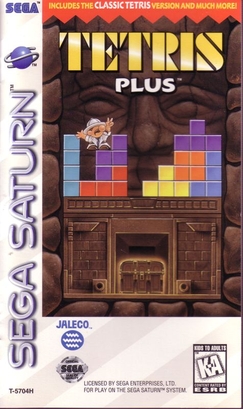

Tetris Plus tries to be both a faithful Tetris and a tiny design lab where the classic tetromino playfield becomes an obstacle course for a hapless sprite called "the professor." On PlayStation it arrives as a mixed bag: a competent classic Tetris mode, a mission-oriented Puzzle Mode that messes with expectations in interesting ways, and a console package that sold well enough to earn a Greatest Hits re-release. This review approaches Tetris Plus like a systems engineer with an unhealthy crush on falling blocks: I care about the collision model, actor state machine, pacing loop, input fidelity, and the ways the engine nudges the player toward - or away from - elegant solutions.
Tetris Plus ships two primary gameplay systems: Classic Mode (straightforward Tetris) and Puzzle Mode (a mission-based variant built on the same grid). Technically, that's smart engineering: reuse the tetromino placement, line-clear, and gravity subsystems while layering a new game logic on top. The most notable layer in Puzzle Mode is the professor actor and the spiked ceiling timer. The professor is implemented as a 2x2 entity on the same discrete grid as the blocks; he has a small finite-state machine (walk-left, walk-right, fall, climb, asleep, dead) and simple collision checks against placed blocks and the level terrain. That 2x2 footprint is crucial because it changes what constitutes a "passable" gap versus a trap, and it makes level geometry behave differently than simple line-clearing puzzles. Puzzle Mode levels start with pre-arranged bricks, so the engine must handle static geometry plus dynamic piece placement. The state change that sets Puzzle Mode apart is the spiked ceiling: it is a global, discrete timer that lowers the available vertical play space one notch approximately every 18 seconds. This is an elegant use of the grid: instead of a continuous clock, you have a stepwise spatial constraint that interacts directly with the core mechanic (dropping and clearing lines). Clearing three or four rows at once is a legitimate countermeasure - the ceiling moves back up - which introduces a risk/reward calculus where the player must sometimes build up to a multi-line clear to buy vertical space. That ceiling also destroys blocks in its path. From an implementation standpoint this is a forced garbage-removal routine: when the ceiling descends into occupied cells, the engine removes or flags those blocks and recomputes the playfield, likely triggering line checks and actor repositioning. The ceiling-destroy mechanic doubles as a soft reset: players can intentionally let the ceiling clear unwanted pieces while waiting for a specific tetromino. The designers therefore turned a punitive timer into a tactical tool, which is a neat piece of systems thinking. There's also a strict temporal escalation: if the ceiling has been forced back up repeatedly but the overall stage timer exceeds 125 seconds, the ceiling accelerates. That creates a two-tier timer: short-term spacing (18s per notch) and mid-term fail state (125s threshold), which forces players out of prolonged safety and into decisive action. For level design, this means pacing matters; stages can be tuned to encourage quick solves or methodical planning depending on the pre-placed geometry. The professor's behavioral rules create surprising emergent interactions. Since he walks until blocked, he will change direction after bumping a block and will fall through gaps large enough for his 2x2 body. He climbs placed blocks put on top of him, which can be used to shepherd him to the exit. He also falls asleep when immobilized, an idling state that must be interrupted by environmental change or strategy. Death occurs if he is crushed by the descending spikes or if blocks trap him with spikes in close proximity. Translating these rules into predictable outcomes is what makes Puzzle Mode more about planning than reflexes - provided the control and input model cooperates. Control fidelity is a sore spot across contemporary reports and remains the most technically significant criticism: reviewers described the controls as "counterintuitive" and "more difficult" than earlier Tetris incarnations. Without instrumenting the binary we can infer probable causes. Classic Tetris versions had tightly tuned horizontal movement, rotation rules, lock delay and piece-hold behaviors that players internalized. Tetris Plus likely deviates in one or more of these areas: either input polling frequency, per-frame movement resolution, rotation wall-kick rules, or lock delay timing. Slight changes to any of those parameters dramatically alter perceived responsiveness. For a puzzle title where split-second placements matter, any extra input latency, inconsistent rotation outcomes, or odd collision quirks will feel like bad controls. The editor for Puzzle Mode levels is another technical highlight. Allowing designers (or players) to place pre-arranged bricks implies a robust grid UI and serialization format. On PlayStation, this probably means a compact save representation (a bitmask per tile or run-length encoding) and an in-game editor that lets you toggle cells. The utility of the editor depends on how ergonomic the placement UI is and whether the engine exposes parameters like professor start position or ceiling timing - the documentation doesn't specify, so assume a basic but functional editor that creates interesting scenarios but might require patience. Multiplayer on PlayStation adds synchronous competitive options. The Versus Mode is essentially a head-to-head race using Puzzle Mode concepts. From a technical perspective, local multiplayer avoids netcode complexity, but it introduces the need to keep two independent state machines (two playfields, two professors) running at stable frame rates. The PlayStation hardware can handle that easily if rendering and logic share time-slices correctly; the more delicate part is ensuring input sampling for both controllers is low-latency and that the UI communicates both players' ceiling and timers clearly so you're not guessing whether you outraced someone or got lucky with a piece spawn. Classic Mode is straightforward: it's a baseline Tetris implementation that serves as a control group for evaluating Puzzle Mode's new systems. If your primary measure of a Tetris port is "does it feel like my childhood Tetris?" then Classic Mode's tuning will dominate your opinion. If the core timing parameters differ from what players expect, the entire package feels "off," even if the puzzle additions are mechanically clever. PlayStation-specific notes: the game was ported to console by Natsume and published by Jaleco; the PlayStation release sold well enough to reach Greatest Hits, suggesting market success despite critical reservations. Porting a time-sensitive puzzle game to different CPU architectures requires careful attention to timing loops and input sampling, and the mixed reception on Saturn (where many reviews originate) hints at possible regressive changes introduced during porting that could also affect the PlayStation build.
Critics called the graphics "subpar," and from a technical standpoint that criticism has two parts: art and rendering. The visual language of Tetris is functional - you need to identify piece shapes, cell occupancy, the professor, and the spiked ceiling quickly. If palette choices, sprite scale, or UI elements reduce clarity, the cognitive load on players increases. On PlayStation-era hardware the game likely uses 2D sprites and tiled backgrounds with modest color depth; if those assets lack contrast or crispness, blocks blend into the background and piece recognition suffers. Rendering-wise, the PlayStation can handle smooth 2D with no trouble, but port budgets matter. Texture filtering, resolution scaling, and palette use can make a block look flat or muddy. Several reviews complain that visuals do not add value; technically that usually points to low-resolution art, lack of clear edge contrast, and perhaps inconsistent scaling when the game switches between modes or shows the professor's animations. Animations for the professor and the spike descent are not flashy, and they don't need to be - clarity and timing are more important. However, when you combine mediocre sprite work with slightly wonky controls, it compounds the impression of a sloppy port rather than a polished reinvention.
Tetris Plus is an interesting engineering exercise that grafts a small AI-driven actor and a spatial timer onto a classic puzzle engine. Puzzle Mode's professor and spiked ceiling create genuinely new interactions: using the ceiling as a tactical garbage-removal, building multi-line clears to push the ceiling back, and manipulating a 2x2 NPC with block placement are clever design choices. The included level editor and Versus Mode add replay value and demonstrate the core engine's flexibility. On the negative side, reports of counterintuitive controls and below-par graphics undermine the package. For a game where millimeters of timing and single-frame inputs separate satisfaction from frustration, any slippage in input fidelity or rotation/lock tuning is fatal to the feel. The PlayStation release's market performance (Greatest Hits) shows there was an audience, but the critical consensus - "ambitious but imperfect" - is accurate from a systems perspective. If you prize new puzzle constraints and enjoy treating the playfield like programmable terrain, Tetris Plus offers rewarding puzzle craft and emergent solutions. If you are a Tetris purist who needs the exact tactile feel of classic implementations, the title may grate. My score of 6.5/10 reflects the game's smart mechanical ideas and useful editor, balanced against tuning and presentation issues that prevent it from joining the Tetris pantheon. It's clever, occasionally charming, and technically intriguing - just be prepared to forgive its occasional stubbornness when you're trying to nudge a professor past a gap with a piece that refuses to rotate the way you expected.
 Constructor Plus on PS4
 Monopoly Plus on Xbox One
 Puzzle by Nikoli 4: on PS4
 Professor Layton and the Last Specter on DS
 Puzzle Kingdoms on DS
 Puzzle de Harvest Moon on DS












 Another SquareThought Site