

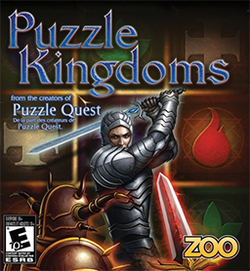

Puzzle Kingdoms arrives wearing the familiar patchwork cloak of its cousins: the Bejeweled-like match-3 combat loop and the fantasy playground of Etheria, the same world that hosted Puzzle Quest and the Warlords series. On the surface it's a palate of colored gems, unit portraits and a strategic map; under that veneer, however, there's an oddly theatrical roster of roles playing out a tiny, repeated drama every time the stylus taps a tile. This review reads the game like a script: treating the player, the map, and the units as characters whose arcs are told not through long cutscenes but through tiles swapped, combos pulled off, and decisions made between turns. The tone is light, sometimes sarcastic, occasionally rueful - much like a court jester who also happens to be the general staffwriter for your kingdom's propaganda newsletter.
If you insist on knowing what actually happens when you boot the DS, the short version is: you rule things; then you swap jewels; then someone dies or yields; then you feel oddly satisfied. The long version is where the character study lives. The protagonist in Puzzle Kingdoms is less a named hero and more a role: the fledgling ruler. That role has a simple but effective arc. At first you are a schemer with a small posse of units - not yet a charismatic king, because charisma costs skill points you haven't earned. The early matches are clumsy: you fumble three-in-a-row sacrifices that barely scratch the enemy, your troops are vanilla tiles that look like they came off the fantasy discount rack. The early arc is humility. The game teaches you to lose with dignity so you'll appreciate winning later. Across the campaign map - a minimalist board of provinces and contested territories - there is a rotating cast of adversaries who function as antagonists in the Aristotelian sense: each one presents a tactical problem that forces growth. They are not Shakespearean villains with soliloquies; they are mechanical foil. A defensive warlord forces you to play attrition, to wring small combos into steady damage. An aggressive raider punishes hesitation and demands you embrace riskier tile setups. In a game that doesn't bother with sprawling dialogue trees, these foes are the storytellers: their behavior writes chapters in the ruler's education. The supporting cast - the units under your command - are archetypal but narratively useful. They are the loyal knight, the glassy-eyed wizard, the gruff axeman, the healer who always shows up like an uncomfortable aunt at holidays. Their development is numeric: experience, levels, upgraded stats. Yet that arithmetic becomes drama when framed properly. When your battered healer survives a string of bad draws to keep a champion alive through a 1-HP cliffhanger, you feel a weird kinship with a pixelated sprite and suddenly the unit is a character again. Puzzle Kingdoms tells most of its emotional stories in micro-victories like this. No single line of dialogue tells you that the archer has grown; a series of tactical successes does. The game's duel system - a match-3 board where colored gems translate into mana, movement, or damage - is the medium through which the story breathes. Each match is a scene. Combos are soliloquies. Pulling off a four- or five-tile cascade is essentially the ruler's Hamlet moment: a decision that has consequences, usually satisfying ones. This mechanic makes for a unique kind of pacing. Instead of a linear narrative arc, you get episodic beats. The ruler's growth is incremental and repetitive, exactly like real leadership, which is either a sobering insight or the saddest way to describe a game about matching gems, depending on your mood. Comparisons to Puzzle Quest are inevitable and instructive. Both games graft puzzle mechanics onto strategy frameworks, but Puzzle Kingdoms leans more into the turn-based map and unit micromanagement. Where Puzzle Quest shoehorns role-playing trappings in the form of equipment and spells to dress up its gem battles, Puzzle Kingdoms gives those trappings modest weight - enough to let the player imagine a life beyond the puzzle grid but not so much that the player needs to stop matching to read long, earnest exposition. This design choice says something about character presentation: instead of telling you who your units are through text, the game shows you who they are by making you rely on them in predictable patterns. A unit that proves repeatedly decisive becomes beloved not because of dialogue but because of function. One of the most interesting arcs is not any single unit's but the player's relationship with randomness. The DS's match-3 randomness is both ally and antagonist. You will learn to anthropomorphize bad draws - blaming them, pleading with them, whispering promises about better loot. That quasi-religious relationship is comedy gold and also a genuine narrative: Puzzle Kingdoms makes you feel like the ruler who prays to the RNG gods. Seeing that arc through a storytelling lens is the closest the game gets to psychological depth. That said, the game's storytelling ambitions are intentionally modest. There are no weighty moral choices that split your kingdom into two philosophical factions; there are instead small tactical choices that shape how the ruler's campaign feels. Want a tight, defensive playthrough where units become veteran bulwarks? You can. Want an all-in, explosive combo-based blitz? Also viable. These divergent playstyles are the closest Puzzle Kingdoms comes to branching character arcs: the ruler who chooses patience grows into a hoarder of provinces, the ruler who gambles becomes a legend known for dramatic conquests. The narrative richness is emergent, not authored - and that's both the game's strength and its limitation. Reception context matters for the character study too. Critics generally found Puzzle Kingdoms middling: Metacritic places it in the low-to-mid 60s, and outlets like GameSpot and IGN landed around the 6-7/10 range. Those scores reflect an industry-level shrug: the game is competent, occasionally clever, but not transcendent. From a narrative viewpoint, this middling status is apt. Puzzle Kingdoms is excellent at sketches and small scenes; it does not deliver sweeping epics. If you want a 50-hour saga full of named NPCs and branching romances, you will leave unsated. If, however, you enjoy watching personalities coalesce from mechanics - seeing the stoic spear-carrier become your favorite by virtue of a clutch revive - the game offers a quiet satisfaction.
The Nintendo DS presentation is, predictably, functional rather than glorious. Tile art is clear and readable, unit portraits do enough to suggest personality without indulging in close-ups. The game doesn't pretend to be a canvas for high art; it's more a story told through postcards. This minimalist visual strategy actually helps the character arcs: with fewer cinematic distractions, the emotional weight shifts to gameplay moments. The sprites are expressive enough that you'll remember faces, but not so detailed that you'll expect Oscar-worthy monologues. The palette is cheerful, the animations brief and punchy, and the UI keeps the focus on matches and numbers. In short, the graphics are the wardrobe department of the play: they dress the characters adequately so the performance (game system) can do the heavy lifting.
Puzzle Kingdoms is a compact drama of rulers, tiles and incidental heroism. It's not a grand chronicle with legendary names whispered in taverns; it's a sequence of short stories where characters are born from mechanics and loyalties are formed by utility and timing. If you approach it craving authored lore you'll be disappointed; if you're open to emergent narratives, the game rewards attention. The DS version's strengths are convenience and clarity: matches are immediate, the map is approachable, and the little victories land with satisfying thuds. Critics called it mixed, which is fair - Puzzle Kingdoms is a reliable entertainer with modest ambitions rather than a genre-defining tour de force. For an 18-year-old looking for something to play on commutes or in between classes, and who secretly enjoys assigning personalities to pixels, Puzzle Kingdoms offers a surprisingly charming stage. You won't be moved to tears by a plot twist, but you might find yourself defending a grizzled unit in more heated terms than you defend some real-life friendships. That odd emotional loyalty is the game's quiet success: it proves that characters don't always need long speeches - sometimes they just need to hit a four-tile combo at the right time. In the end, Puzzle Kingdoms is a small court where the drama plays out in match-3 acts, and if that sounds like your kind of theater, buy a ticket.
 Professor Layton and the Last Specter on DS
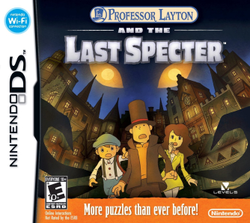 Puzzle de Harvest Moon on DS
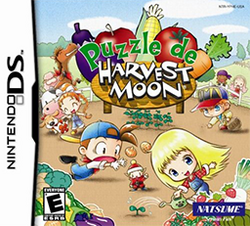 Coloball 2002 on PS2
 Nobunaga no Yabou Online: Haten no Shou on PS2
 Puzzle Quest: Galactrix on DS
 Puzzle Quest 2 on DS












 Another SquareThought Site