

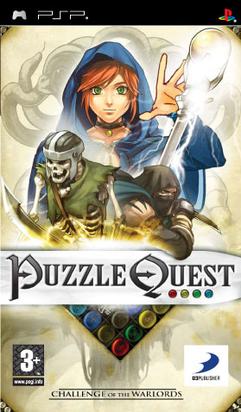

Puzzle Quest: Challenge of the Warlords wears two hats at once and somehow never lets either one fall off. It's part cozy match-3 puzzler, part crunchy RPG - like if Bejeweled learned to swing a sword and read a spellbook. For the Nintendo DS release this means a portable game that asks you to do more than just swipe colourful rocks: it asks you to plan, prioritize, and occasionally clutch your stylus like a tiny, desperate general. The premise is delightfully simple: move around a fantasy map, accept quests, buy gear, raise levels, and fight enemies - but all the combat is resolved on a Bejeweled-like board. Matches of coloured gems yield mana, skulls do damage, and chains let you pull off spectacular combos. If you're after a mellow puzzler to lull you to sleep, Puzzle Quest will still keep you thinking. If you want a game that will test your planning, adaptability, and tactical patience, you're in the right place. This review focuses on exactly that: the challenge the game throws at you, and the skills you'll need if you want to survive (and gloat) in the courts of Warlords.
At first glance Puzzle Quest looks like a match-3 game with a robe on. Behind that fashionable robe is a surprisingly deep machine of resource management, timing, and spatial foresight. Combat is turn-based, but the turns happen on a grid where you swap adjacent tiles to make matches of three or more. The immediate skill test is obvious: pattern recognition. You must spot matches, but winning consistently requires thinking at least a few moves ahead. The tiles are multi-purpose tools. Coloured gems translate into different colours of mana that fuel spells and abilities. Skull tiles are the purest form of violence - matching them deals direct damage. There are also tiles for gold and experience (and wildcards that can pair with anything). Managing these resources under pressure is the core of the game's challenge: do you go for mana to cast a lifesaving spell next turn, or do you snap a skull match now and risk not having enough mana to block an incoming lethal combo? Matches of four or more grant extra turns and bonuses. That mechanic is the game's sugar and also its calculus. Planning to create a four-tile match (or better, a setup that triggers a cascade) requires spatial planning and a bit of opportunism. Chain reactions are rewarded heavily-long chains can swing a fight in an instant, but setting them up is high-skill work. If the board resets when no match is possible, you're occasionally punished by RNG; learning to cope with board variance is part of the experience. Character progression introduces a second layer of challenge. At level-ups you distribute skill points that affect how many bonuses you get for matching certain tiles, how much damage spells do, and other combat modifiers. Picking a class at the start changes your predisposition toward attributes and spells: some classes will make you a mana-hungry spell-slinger who manipulates the board, while others push you toward skull-heavy aggression and brute force. Your equipment and companions further tilt the math of each match. The game doesn't just ask you to be good at match-3; it asks you to select a toolkit and then squeeze every last bit of value from it. Spells add strategic depth that rewards planning and memory. You'll be juggling cooldowns, mana colours, and timing - cast a mass-of-one-colour removal at the wrong moment and you might inadvertently give your opponent a cascade of skulls. Some spells alter the board, some do direct damage, and others provide armour which soaks hits before HP drops. Armor adds another decision axis: are you playing to outlast or to burst down? The game forces you to balance offense, defense, and resource generation in tight, discrete steps. Mini-games and citadel mechanics introduce micro-challenges outside of the battlefield. Building your citadel unlocks forge options, bestiary functions, and mount training - but most of those actions require you to beat specialized tile-matching mini-games. This turns every activity into another test of pattern recognition and consistent execution: crafting isn't just paying gold, it's proving you're worth the sword you want to make. Difficulty curves are subtle. Early fights teach the basics: match gems, cast spells, buy armor. Later fights layer in enemy spells, stronger AI behaviour, and more complex opponents. Notably, other ports (PSP) were praised for a tougher AI; on the DS the scaling is a hair gentler, but strategic enemies still force you to think. You'll find yourself replaying boss fights to test different builds, or dodging the temptation to brute-force progression with repeated low-risk encounters. The reward loop pushes you to refine decision-making: how much gold do you spend on gear versus saving for citadel upgrades? Do you invest skill points into making skulls hit harder or into mana generation for spell diversity? Multiplayer and expansions widen the challenge. The game shipped later with expansions that added new classes and spells, expanding the decision space. Multiplayer, when available, turns the match board into a duel of wits: now your opponent is an unpredictable human who can punish repetitive logic and bait moves. These modes reward adaptability and the ability to read an opponent's strategy. In practice, the skills the game asks of you boil down to: sharp pattern recognition; mid-term planning (setting up combos over several turns); resource allocation (mana, gold, skill points); risk assessment (when to cash in a skull match vs. building a cascade); and emotional discipline - patience to set up combos and the willingness to accept occasional RNG resets without raging at the DS. If you bring those skills, Puzzle Quest becomes addictive in the way a tough puzzle should be: every victory feels like you earned it.
Graphically, the DS version keeps things functional and focused. The tiles are clear, the boards readable, and the character portraits express a cheerful amount of fantasy grimness. Don't come here expecting a visual flex of modern lighting and particle porn; Puzzle Quest on DS is economical. That said, the simplicity plays to the game's strengths: there's no visual fluff to distract from the board, and that's a good thing when every tile swap could be your last. UI and feedback are important in a game where every micro-decision matters, and the DS version mostly nails the essentials: matches are obvious, mana gains are tracked, and spell cooldowns are visible. The presentation is serviceable rather than showy, and in that plainness lies an advantage - you're never searching for information when the board is on the line. The remasters and other ports added polish and more content, but the DS build carries the same core clarity which makes strategic play possible on a small screen.
Puzzle Quest: Challenge of the Warlords is an excellent challenge disguised as a friendly puzzle game. It will make your spatial reasoning work for its dinner, demand that you think ahead, and reward the kind of methodical play that turns accidental success into deliberate triumph. For an 18-year-old with a short attention span and a taste for beating systems, this is an ideal test: fast to pick up, deceptively deep, and brutally fair. If you want something to swipe mindlessly while your brain naps, look elsewhere. If you want to skill-up - learn to set traps on a board, manage multi-colour mana economies, and time spells so precisely that your opponent questions their life choices - Puzzle Quest is a tiny, portable boot camp. The DS presentation keeps the focus on the puzzle-RPG synthesis, and while the visuals won't win awards, the gameplay will keep you practicing combos until your thumbs tingle. That's a very worthy trade-off. Score: 8.5/10 - because it turns simple gem-swapping into a satisfying test of tactics, but occasionally lets RNG and modest DS polish get in the way of absolute perfection.
 Professor Layton and the Last Specter on DS
 Puzzle by Nikoli 4: on PS4
 Combat Elite: WWII Paratroopers on PS2
 The Banner Saga 2 on PS4
 Arcania: The Complete Tale on PS3
 Predecessor on PS4












 Another SquareThought Site