

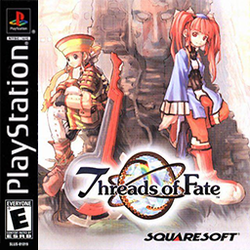

Threads of Fate (known in Japan as Dewprism) is a compact, polished action-RPG built by a small team at Square near the end of the original PlayStation's life cycle. Directed and co-programmed by Koji Sugimoto with a staff of roughly twenty, the project intentionally traded the long-form JRPG bloat Square was famous for in favour of a lighter tone, two parallel campaigns, and a gameplay loop that emphasizes real-time combat, transforms-on-demand (for one character), and on-the-fly 3D rendering instead of pre-rendered cinematics. From a technical perspective, the game is an interesting study in ambition vs. platform limits: a fully 3D game on PS1 that attempts real-time cutscenes, multiple transformation models, and a lively animation set while balancing memory, CPU, and streaming constraints. The result is not flawless, but it's a neat example of what a small but experienced team could squeeze out of the hardware when they prioritized interactivity and visual personality over sheer scale.
Threads of Fate presents itself as an action-RPG with a simplified interface and deliberately approachable systems, but the technical choices under the hood are where the design becomes interesting. Controls are mapped to a very compact scheme: basic locomotion, jump, and two action buttons that chain into different attack combinations. That minimal input palette forces the game to do a lot with a little: combo timing, attack cancel windows and situational counters become the emergent depth. The camera is primarily a fixed, overhead perspective with the option to adjust in certain dungeons; this is a classic PS1-era compromise. Fixed cameras reduce processing burden (less dynamic camera math and fewer edge-case occlusion problems) but introduce practical problems for platforming and targeting. Reviewers frequently noted the camera's limits, and it's easy to see why: collision and depth perception rely on camera angles being predictable, which the engine largely enforces, but the design then has to choreograph platforming and enemy placement around those camera slices. The character systems depart from traditional experience-point progression in a clever technical and design twist: HP and MP growth are usage-driven. HP increases based on damage taken and MP increases based on times magic is used. From a systems-engineering viewpoint this removes the need for an experience-point aggregation and level-cap table, trading a database lookup for a set of counters manipulated during combat events. It reduces bookkeeping overhead and also changes player incentives; it nudges players into using mechanics they want to improve, and it can be exploited or balanced easily by adjusting drop rates, damage thresholds, and magic-cost-to-MP-gain ratios. However, it also carries design pitfalls: players can intentionally hurt themselves to boost HP progression or spam weak spells to raise MP, and balancing that without bloating the codebase with anti-exploit checks is the dentist's drill of simple system design. Rue and Mint are implemented as asymmetrical protagonists with shared geometry and asset reuse where possible to save memory and dev time. Rue's transformation mechanic is the game's most technically demanding feature: he collects up to five monster coins, and then can morph into any of the collected monster forms, inheriting movement and attack abilities tied to the form. Each transform requires separate polygonal models, animation cycles, hitboxes, collision parameters and AI hooks for form-specific moves; programming and memory-wise this is the equivalent of shipping multiple mini-characters inside one protagonist. The development team explicitly noted this increased workload, because each form required programming and animation, and on a PlayStation memory budget that meant careful streaming and culling decisions. Mint's design counters that complexity by being a magic/melee hybrid using dual rings that serve as both melee and projectile weapons, and by featuring elemental spell combinations. That means Mint's engine work focuses on modular spell instantiation, elemental interaction rules, and a projectile subsystem - different technical hotspots to Rue's many-model workload. Dungeon design alternates between open-carona hub exploration and enclosed dungeons that rely on the engine's rendering and collision systems. In dungeons the camera occasionally becomes adjustable, which is useful because the PS1's fixed-camera art style makes platforming precarious otherwise. The platforming itself is intentionally minor, but its success depends on tight collision detection and jump arc tuning - two areas where polygonal clipping and depth-perception problems on PS1-era hardware show up most vividly. The game restores health and magic via bottles dropped by enemies, which is a simple deterministic item drop mechanic that reduces the need for expensive state persistence between rooms. Death and recovery mechanics are worth a technical shout-out: a player who reaches zero health can reload from a save or return to Carona at the cost of half their items, an operation that requires the save/load manager, inventory shrinkage logic, and a teleport-with-cost transaction all to interoperate without corrupting state. There is also a Coin of Life that restarts the game immediately with new attributes, which is a gated one-time transaction mechanic. These recovery systems are examples of small state-machines the engine must juggle alongside combat. Finally, the inclusion of New Game+ demonstrates foresight in save semantics. Allowing unlocked abilities to carry over and unlocking secret areas requires the team to partition persistent player state into what persists across runs and what resets, plus additional conditional logic for revealing new content. For a 1.5-year project on PS1 with a tiny team, that's a tidy bit of systems design that extends playtime without requiring unprecedented content volume.
Threads of Fate is notable for being fully 3D with real-time cutscenes rather than pre-rendered movies - a deliberate technical choice by Sugimoto and the team to leverage PlayStation's capabilities. Rendering everything in-engine on a PS1 is an achievement in constraints management: polygon budgets had to be split between characters (with high-priority geometry and animation), environments (which often used textured planes and low-poly modules), and special effects (particle sprays, spell FX). The character models often look better than the environments because the team allocated polygons and texture memory preferentially to the cast; reviewers repeatedly observed this, and the effect is audible in the art/engine tradeoffs. Animation quality punches above what you'd expect for the platform: flamboyant, energetic character animations and small polishing touches - like the eye-focus system where sprite-based eye textures shift along preset lines of sight during cutscenes - give the characters personality without expensive skeletal rigs. Those are classic memory-efficient tricks: animate fewer bones, swap eye textures to simulate attention, and add hand-animated cloth cycles where they matter most. The use of real-time cutscenes instead of prerendered movies eliminates the need to store large MPEG assets on disc, but it increases CPU and GPU draw-time work; to keep framerate reasonable the engine must carefully manage draw calls, polygon counts, and texture swaps. The trade-off pays off aesthetically: the story remains in the same visual language as gameplay, which reinforces unity, but it also exposes the environment rendering limitations in long vistas or busy rooms. Camera and targeting problems crop up as technical liabilities. A mostly fixed overhead camera simplifies rendering but amplifies occlusion issues and complicates collision checks for verticality. Targeting logic attempts to compensate by locking on or adjusting attack vectors based on relative positions, but the results are mixed; some reviewers faulted the targeting and camera for hampering tight combat and platforming. On the audio side, Junya Nakano composed a large suite of tracks using the Roland SC-88Pro and sample libraries; however, disc space limitations forced the team to cut several completed tracks. That speaks to the era's storage trade-offs: higher-fidelity audio competes with art and model data for a limited ~650MB disc, and the decision to prioritize in-engine visuals over lengthy music files is a deliberate allocation of scarce resources. Sound design choices further reflect the game's tone - most effects were intentionally non-threatening and cartoonish to match the lighter narrative voice, which also allowed the use of sample collections rather than bespoke Foley recording when budgets and time were tight.
Threads of Fate is a compact technical showcase wrapped in a colourful, approachable shell. It's not trying to be an epic JRPG in scope; instead, it's an exercise in efficient systems, focused asset allocation, and thoughtful compromises. The fully 3D approach with real-time cutscenes, the unusual HP/MP growth-by-usage system, Rue's multi-form transformations, and the New Game+ persistence model are instructive design choices that reveal a team prioritizing interactivity and character over raw content volume. Where it stumbles is largely due to platform-era constraints and the design decisions that follow: camera and targeting limitations, occasional repetitiveness, and environments that sometimes lag the characters in polish. If you care about technical craft-how a team juggles memory, models, audio, and engine features on a platform pushed to its limits-Threads of Fate is worth studying and playing. If you want sprawling dungeons or deep RPG progression, you'll find it lean. For its era and ambitions, though, it delivers a tight, charming package that still informs later Square work and shows what a small, experienced studio can do when it prioritizes cohesive design and technical finesse. Final verdict: an enjoyable, technically interesting action-RPG with a handful of frustrating camera and variety moments, but overall a solid 7.7 out of 10.
 The Awakened Fate Ultimatum on PS3
 Fate/Extella Link on PS4
 Combat Elite: WWII Paratroopers on PS2
 Onimusha: Dawn of Dreams on PS2
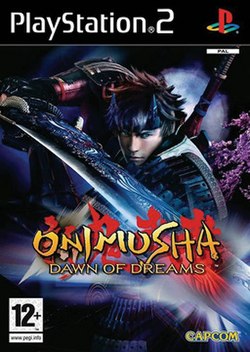 Action Man: Operation Extreme on PlayStation
 Project Sakura Wars on PS4
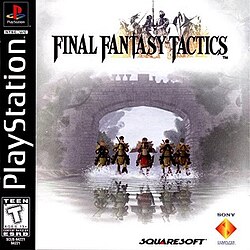 Final Fantasy Tactics on PlayStation
 Final Fantasy IV on PlayStation
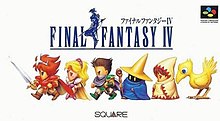 Final Fantasy VII Rebirth on PS5
 Final Fantasy IX on PlayStation
 Final Fantasy IX on PS4












 Another SquareThought Site