

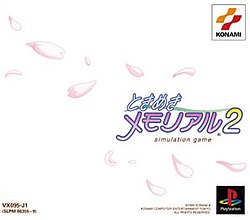

Tokimeki Memorial 2 arrives at the tail end of the millennium like a lacquered yearbook - glossy, ambitious and a little obsessed with hair highlights. Konami's second full‑scale attempt at capturing adolescent desire swaps some of the original's chaotic charm for a more deliberate, nearly academic study of teen romance. Released on five PlayStation discs in late 1999, the package is unapologetically lavish: voice acting trumps text boxes, and an 'Emotional Voice System' (EVS) promises the peculiar thrill of being addressed by name by a virtual paramour. The game was a commercial hit in Japan, shifting some 370,000 copies within six months and earning a respectable 33/40 from Weekly Famitsu - not bad for a title whose primary objective is matchmaking and melodrama. This is not a flashy action epic. Tokimeki Memorial 2 is a dating sim that treats school life like a board game with personality. Its strengths are in systems and presentation: voice work that was groundbreaking at the time, a multi‑disc scope that allowed for more content than lesser PlayStation productions, and an approach to character scripting that forces the player to think - and sometimes fail - in pursuit of a relationship. If you came looking for fireworks, you will find them in conversation trees and calendar choices rather than explosions and quads of pixels. For those who cared about the subtle craft of 1990s Japanese sim design, this is a title that rewarded patience and method.
Konami did not reinvent the wheel with Tokimeki Memorial 2; it refined it. The skeleton of the experience is familiar to fans of the first game: you are a high school student navigating schedules, club activities, exams and the slow grind of social currency. Unlike action games where reflexes dictate success, here you manage weeks, choices and the invisible meters that govern a girl's interest. The most notable systemic shift from the original is a reduction in the bomb mechanic - those sudden, interest‑dropping events that once lurked like landmines - and a renewed focus on individualized challenges. Each heroine in Tokimeki Memorial 2 has a set of specific triggers and story sequences; the game's challenge is learning those patterns and responding with the right activity, gift, or line at the right calendar moment. This emphasis on bespoke interactions turns each playthrough into a mini‑experiment. Where the original encouraged broad strategies and a little seat‑of‑the‑pants panic management, the sequel rewards research and repetition. You will find yourself memorizing club timetables and the idiosyncratic likes and hates of each girl. Konami made sure that there isn't a single universal solution; a tactic that wins one girl's heart will leave another puzzled. In practice this means you can replay the game multiple times and still be surprised, because the puzzle pieces change depending on whom you chase. It is a design choice that tilts the game toward the cerebral: you are not only roleplaying a student, you are reverse engineering a social system. The EVS feature was the real marketing crown jewel. Tokimeki Memorial 2 came on five CDs with copious voice assets - an extravagant commitment for a PlayStation title of the era - and the EVS allowed certain characters to pronounce the player's name. In the shipped game only Hikari Hinamoto and Kasumi Asou are fully EVS‑enabled, which adds a rare, uncanny intimacy when they speak. Other characters' EVS lines were distributed on promotional audio discs packaged with the Tokimeki Memorial 2 magazine "Hibikino Watcher," a marketing tactic that doubled as collector bait. A later EVS append disc and a PlayStation Store reissue in 2009 expanded accessibility, but the original CD set felt like a gilded collector's item in its day. Gameplay pacing is deliberate to the point of meditative. There is strategy in choosing study time versus club practice, money management for gifts, and timing for the all‑important confessional sequences. The consequences are rarely binary: a missed opportunity might cool a relationship rather than instantly ending it. This design makes for a forgiving but engaging loop - it lets players learn from mistakes rather than feel punished by them. However, that forgiving nature also means the stakes don't always feel visceral; if you crave sharp, adrenaline‑charged decision moments, Tokimeki Memorial 2 will seem like a long, carefully choreographed scene rather than a firefight. The game rewards attention to narrative detail. Girls have unique events that require precise conditions, and reaching a girl's true route often requires completing a sequence of specific steps across months. This plays into Tokimeki Memorial 2's strength as a replayable title: the second or third attempt, with knowledge of what each heroine wants, yields a different rhythm and satisfaction. The price of this depth is time and patience. The game expects you to learn its sociology, and that process can be either charmingly rewarding or mildly tedious depending on the player's temperament. Presentation and extras extend the experience beyond pure gameplay. The title shipped with abundant voice acting - a rare luxury in 1999 - and Konami treated audio like a feature rather than garnish. One quirky note: Maeka Kudanshita, one of the game's characters, never uses EVS and invariably refers to the protagonist as 'Shounen' (young lad), which is somehow both infuriating and characterful. There was even a real‑world board game spin‑off, 'Tokimeki Memorial 2: Game of Life,' a sign that Konami saw the property as more than just a console sim but a cultural tiny empire of teenage possibility.
In the context of late‑1999 PlayStation software, Tokimeki Memorial 2's visual ambitions are significant. The game uses pre‑rendered art and character portraits rather than attempting full 3D high drama, and that decision pays dividends: the artwork is polished, expressive and tailored to the slow, conversational rhythms of the gameplay. Faces are where the game lives and breathes; subtle shifts in expression punctuate dialogue in a way that text alone could not. Five discs of content also meant plenty of artwork and voice lines, so scenes rarely feel economized. If you are assessing graphics by contemporary 3D standards, the game will appear quaint. This is not a criticism so much as a statement of context - Tokimeki Memorial 2 is a theatrical, portrait‑driven experience, not a polygonal playground. The character art is clean and consistent with late‑90s anime sensibilities: a tendency toward expressive eyes, soft shading and hairstyles that defy gravity in a way only teenage heroines are allowed to. The visual layout of menus and calendars is functional and clear; Konami prioritized legibility and atmosphere over flashy interface tricks. The result is a presentation that supports immersion rather than distracts from it. Audio is another area where the production values stand out. The voice acting was touted at release and with good reason: having certain girls call you by name - even if originally limited to a couple of characters - elevated the fantasy in a manner few contemporaries bothered to attempt. Composers Mikio Saito, Atsushi Sato, Hana Hashikawa, Sayaka Yamaoka and Norikazu Miura contributed to a soundtrack that is quietly melodic and frequently wistful. It is the sort of background score that insists on being in a corner of your mind, prodding you into after‑school hangouts and ceremonial confessionals. For a game that trades in mood, the audio and portraits are perfectly calibrated.
Tokimeki Memorial 2 is an exercise in controlled obsession: Konami applied the resources of a major studio to the subtle, fragile craft of simulating adolescent romance. It is not a universal experience; the game's rewards accrue to players willing to invest time, memorization and a taste for systemic puzzles delivered in soft tones. The reduction of the bomb mechanic from the original and the heightened focus on character‑specific challenges make this sequel feel smarter and more deliberate. Five CDs of voice and portrait work were overkill in the best possible way, and the EVS gimmick - with Hikari and Kasumi in the lead - delivered a cultural hook that turned buyers into collectors. For players coming from the 1990s, the title reads as a mature evolution of the dating sim template; for newcomers it remains a compelling historical artifact of how the genre flirted with mainstream production values. Its sales and Famitsu score underline that this was not a niche oddity but a mainstream success in Japan. If you appreciate methodical, character‑first design and the peculiar pleasure of learning a system through repetition, Tokimeki Memorial 2 is worth revisiting. If you prefer instant gratification and kinetic spectacle, you will respect its craftsmanship but probably not fall in love. Verdict: a thoughtful, well‑produced sim that rewards patience - and yes, it still sounds uncanny when someone in your speakers calls you by name. Nostalgia doesn't hurt, but neither does the solid design underneath it all.
 Tokimeki Memorial Selection: Fujisaki Shiori on PlayStation
 Tokimeki Memorial 2 Taisen Puzzle Dama on PlayStation
 Thousand Arms on PlayStation
 Kitty Powers' Matchmaker on PS4
 Eternights on PS4
 Days of Memories 3 on DS












 Another SquareThought Site