



Tokimeki Memorial Taisen Tokkae Dama sits in that curious niche where Konami took its famous dating-sim cast and dropped them into a board of falling pieces and combo chains. Launched in 1997 for PlayStation (and also on Sega Saturn), Tokkae Dama is not trying to be an emotional magnum opus; it's a puzzle game first. But to call it merely a 'puzzle game' is like calling a mixtape 'sound' - you miss the point that the people on it matter. For fans of the original Tokimeki Memorial, the attraction isn't only clearing lines or stacking combos; it's hearing Shiori laugh at you after you mistime a chain, or seeing Ayako's tiny victory pose when you finally pull off a long match. This review is less about frame-rate minutiae and more about what those cameos and portrait cards do to a player's heart. How well do the characters and their arcs from the main series translate into a puzzle format? Can a falling-block board convey the nervous hum of a high-school confession scene? Spoiler: sometimes it surprisingly can.
Tokimeki Memorial's core premise - juggling stats, dates and the slow burn of high-school romance over a three-year game clock - is not what Taisen Tokkae Dama sets out to replicate. Instead, Konami grafted the franchise's personalities onto a head-to-head puzzle engine (the Puzzle-dama lineage is the clear mechanical ancestor). What that means in practice is that the game trades the original's branching narrative trees for micro-narratives: short quips, victory dialogue, image cards and the occasional animated sequence. From a mechanical point of view you win matches by outscoring your opponent, chaining combos and capitalizing on special moves. From an emotional point of view you win by collecting enough moments with a character to feel like you 'got' them. The smart move Konami made with Tokkae Dama was to treat characters not as static skins but as distilled arcs. Shiori Fujisaki, the franchise's signature heroine, is still cast as the anchor: present in menus, front-and-center in promotional art, and framed as the reward for the most dedicated players. Her arc across the series is the 'default' one - she is the one most likely to appear in spin-offs, music clips and image galleries - so in Tokkae Dama she functions as the emotional barometer. Pull off a clutch comeback and you'll unlock Shiori art or a heartfelt line; fail spectacularly and she'll chide you with the warmth of someone who once carried an entire dating sim on her back. The puzzle format compresses her long, original arc into a handful of snapshots: reminders of reliability, gentle encouragement, and an ending card that is pleasingly wholesome. Ayako Katagiri's treatment is where the puzzle spin-off gets clever. In spin-offs like Tokimeki no Houkago and the Private Collection, Ayako's 'Paris dream' and creative leanings are foregrounded; Tokkae Dama can't send you to an art school, but it can make her reactions and victory animations reflect that aspiration. In-game, Ayako rewards players who play elegantly - long, aesthetic chains rather than brute-force combos - with prettier animation flourishes and a slightly different voice clip set. It's a neat mechanical echo of her canonical arc: where Ayako wants beauty and discipline, the game rewards patient, skillful play. Saki Nijino, whose drama game Nijiiro no Seishun focuses on soccer and encourages players in athletic ambition, becomes the 'risk-reward' character in the puzzle roster. Her in-game bonuses tend to favor high-risk sequences; if you attempt a long build-up you might get a huge payoff, and when it succeeds you get the bursty, celebratory Saki animation that telegraphs exactly what the original drama promised: triumphant, sporty release. It's the closest Tokkae Dama comes to translating a gameplay loop into character development - Saki's arc in the drama series is about making the team after relentless effort, and the puzzle engine makes you chase similarly difficult but satisfying bursts. Miharu Tatebayashi's presence is quieter and more tender. In Tabidachi no Uta, Miharu shares a marathon-centered story with Shiori, and that sense of steady, slow endurance pervades her puzzle characterization. She is forgiving of mistakes in early rounds, offers reassurances in voice snippets, and her reward images favor sincere, offbeat smiles rather than flashy costumes. The game's pacing choices for Miharu's sequences - longer cooldowns between special moves and more sustained, low-key animations - mirror an arc built on steady companionship rather than dramatic peaks. There are also delightful easter-characters who exist in the universe's periphery: Yoshio Saotome, the info-otaku who in Tokimeki no Houkago is a playable partner, appears in menus and as a trivia commentator, giving the player congratulatory facts when they pull off certain combos. The 'Drama' series' fact that Hideo Kojima worked on the Saki/Ayako/Shiori focused visual novels bleeds through as meta-winks in dialogue: Kojima's penchant for character-driven detours in gameplay shows up in Tokkae Dama as occasional non-sequitur dialogue boxes that make token references to school festivals, band contests and marathons. Mechanically, the game is competent: the puzzle engine is solid for its era, with an emphasis on chain building and some competitive special abilities that feel balanced overall. But the true value is in the tiny narrative rewards. The game frequently interrupts matches with short 'scene' pop-ups - congratulatory text and a portrait - and those feel less like padding and more like micro-chapters in an anthology. For fans who came for the characters, those interruptions hit. For puzzle purists, they can feel like a cute but unnecessary blooper reel between serious chains. What's interesting here is the reverse adaptation: rather than slimming characters down to match a puzzle premise, the developers used the puzzle mechanics to highlight specific traits. A character obsessed with style rewards classy play, a sporty heroine rewards risky all-or-nothing combos, and the steady, shy type rewards patience. That sort of translation is where Tokkae Dama earns sympathy from the original game's audience. If you ever wondered how you'd make a confession scene feel like the satisfying cascade of a 12x combo, this is the game that tries to answer. That said, the game is not a substitute for the depth of a full Tokimeki Memorial playthrough. The original game's three-year schedule, stat-building, and date-choice branching are compressed into vignettes. If you want to shepherd a character through exams, club activities, fashion choices and evolving relationship thresholds, you should still play the mainline TokiMemo. Tokkae Dama, instead, is a skin-deep but affectionate anthology: perfect for fans who want condensed moments and for newcomers who enjoy a puzzle match with charming face-cards as trophies.
PlayStation-era visuals mean that Tokimeki Memorial Taisen Tokkae Dama wears its age like a sweater: occasionally pilled but comfortingly familiar. The game uses clean 2D portrait art and chibi character sprites for the playfield, leaning into the charm of late-'90s anime aesthetics. Konami repurposed the series' original illustrations for gallery unlocks and music-video-like cutaways that, while not high-definition by modern standards, have a warmth to them. Some spin-offs in the franchise - Private Collection and the Music Video Clips titles - emphasize animated music sequences, and Tokkae Dama borrows that idea in micro-form: short animated reactions, a few framing sequences and a handful of unlockable images that reward completionists. On a technical level, there are no fireworks; on an emotional level, the portraits do the heavy lifting. If you care about expressions and the little hand gestures of these characters, the game's art direction will keep you smiling between combo chains.
Tokimeki Memorial Taisen Tokkae Dama is exactly what it says on the tin: a Tokimeki Memorial-themed competitive puzzle game. It won't satisfy players seeking a full-blown dating-sim arc, but it does something arguably harder - it translates character into mechanic. By aligning each heroine's personality with distinct risk-reward playstyles and by serving up collectible narrative postcards for your efforts, the game becomes more than a time-killer; it becomes a sampler platter of the series' emotional beats. Fans of Shiori, Ayako, Saki and Miharu will find enough to make their hearts flutter, while puzzle players get a competent head-to-head match with characterful frosting. If you're a TokiMemo purist, think of Tokkae Dama as a fun weekender: not the main course, but a dessert that recalls the flavors you loved. If you're a puzzle fan who enjoys a dash of personality, it's a pleasant curiosity worth a rental or a low-cost pickup on a retro store shelf. The score - 7.5/10 - reflects that balance: solid mechanics, charming if shallow narrative treatment, and a clear love for the characters that underpins every match. In the end, the game proves a cheeky little thesis: love can be compressed, sliced into portraits and voice clips, and still taste pretty sweet - especially when it arrives in the satisfying clatter of falling pieces.
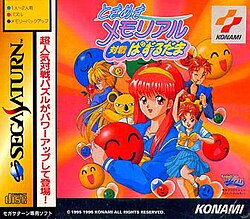 Tokimeki Memorial 2 Taisen Puzzle Dama on PlayStation
 Tokimeki Memorial 2 on PlayStation
 Metal Gear Solid: Integral on PlayStation
 ISS Pro Evolution 2 on PlayStation
 Pro Evolution Soccer 2 on PlayStation
 Metal Gear Solid 3: Snake Eater on PS2
 Dance Dance Revolution Best Hits on PlayStation












 Another SquareThought Site