

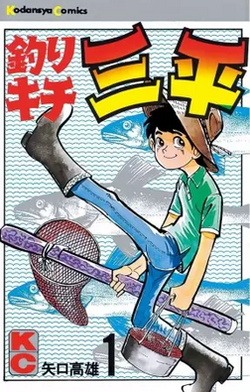

If you grew up with the manga and anime of Fisherman Sanpei (Tsurikichi Sanpei), you already understand the core thesis of any game bearing that name: fish are living, scheming little beasts and catching them is an art, a game of patience, and occasionally a duel of wills. The source material is massive - 57 bound volumes of manga and a 109-episode anime run - which gives any adaptation a buffet of ideas to steal from. Tsuri Kichi Sanpei: The Tsuri (PlayStation) leans into that lore, turning episodic fishing tales into interactive challenges. This review focuses almost exclusively on the difficulty curve, the skills the game demands, and how those demands make the game either a zen-like puzzle or a maddening twitch-fest depending on your temperament.
The core loop is deceptively simple: pick a spot, choose tackle, cast, and wrestle with whatever surfaces. But the challenge here isn't in the rote motion of casting; it's in translating a fisherman's intuition into game inputs. The Tsuri rewards planning and penalizes sloppy guesses. Early play teaches you basics - how rod tension, reel speed, and lure type interact - but quickly introduces subtler mechanics: water temperature bands, time-of-day fish activity, current strength, and even how surrounding vegetation alters bite behavior. If you treat it like an arcade clicker, the game will snack on your hubris. One of the game's best design choices is its layered difficulty. Beginner areas present patient, predictable fish that act as training wheels. Intermediate spots require you to learn species patterns: some fish are honor-bound to hit only on the drop; others lazily nibble before suddenly bolting. Boss fish - the kind of monsters that take entire anime episodes to subdue - function as high-tension endurance tests. They force you to micro-manage drag, rhythmically pump the rod, and decide when to risk reeling hard versus bleeding line to avoid a snapped tip. Success feels earned because failure usually comes from a misread rather than RNG cruelty. Skills the game consistently leans on: - Pattern recognition: Species have telltale behavior. Learning these patterns is equivalent to memorizing a boss's attack in an action game. Miss the tell twice and the fish will ghost you for minutes. - Patience and restraint: The Tsuri punishes button-mashing. Waiting a beat before reeling, letting the fish run line to tire it, and timing your counter-pulls are the difference between landing the catch and losing your trophy rod. The game turns patience into an active skill rather than a passive waiting room. - Resource management: Lures, bait, and special tackle have durability and situational bonuses. Choosing the wrong tackle for a long session will inflate your costs and reduce success rate. The challenge is balancing inventory with the expected difficulty of a location; carry too much and you waste slots, too little and you'll be sitting on a rock swearing at your empty lure box. - Environmental reading: The Tsuri integrates subtle visual cues - ripples, bird activity, and shadow patterns - to hint at schools or individual big fish. This makes exploration meaningful. Knowledge of where and when to fish is not hand-held; you learn to read the environment like an angler, not like a radar overlay. - Reflex and rhythm: There are moments where reflexes matter: quick tugs to set the hook, rapid reel-to-drag adjustments during a sprint, or split-second dodges to avoid hazards (snags, underwater debris). These are less frequent than the patience sections but escalate the game from purely contemplative to occasionally tense. Difficulty spikes can feel abrupt. Some late-game spots expect near-perfect execution: perfect tackle combos, flawless timing, and the patience to let a fish expend itself for several real-time minutes. For some players this is the dream - an authentic, high-stake duel with nature. For others it feels like punishment for not grinding prior areas to earn better gear. The game doesn't much soften these spikes with catch-up mechanics; instead it assumes you'll either adapt or go practice elsewhere. That design philosophy will split players into two camps: those who love the rigor, and those who prefer more frequent reward pacing. Mini-games and episodic challenges patterned after the anime's story beats provide variation. Certain episodes turn into puzzles - lure color matching, stealth approaches when fishing around wildlife, and timed conservation tasks where freeing a hooked turtle tests precision more than luck. These mini-tests are where the franchise's narrative flavor really shines; they emphasize technique over brute force and often reward creative solutions. Multiplayer modes, where present, lean into rivalry: who can land the biggest specimen using identical gear, or who can adapt fastest to a surprise environmental shift. These modes expose how much the core mechanics reward meta-knowledge. Playing against a friend quickly reveals whether your skill set is theoretical (knowing which lures work) or practical (executing the micro-timing under pressure).
Borrowing from the anime's pastoral charm, the game nails mood if not photorealism. The water shimmers with convincing surface behavior, and fish shadows are often the only honest thing between you and a wrong guess - you learn to read them like a weathered captain reads the horizon. Character portraits and cutscenes lean heavily on the source's style, so fans of the series will smile at the faithful designs. The visual language is functional: it prioritizes readability for gameplay cues - ripples, wakes, and lure trails are clear, which is important given how much the game asks of observation skills. Where it falters is in variety. Locations reuse assets, meaning the same ducking reeds and rocky outcrops crop up across disparate biomes. This doesn't break gameplay, but it reduces the joy of exploration after the first dozen hours. When the game needs to telegraph difficulty - 'this is a big fish area' - it sometimes does so with loud visual tropes rather than letting the environment and soundscape build the tension organically. Still, for a title that prizes technique and planning, the graphics do what matters: they communicate essential fishing information without clutter, and they look endearingly like a moving panel from the manga during story sequences.
If you're the kind of player who finds zen in mastering a niche system, Tsuri Kichi Sanpei: The Tsuri will reward you like a rare catch. It asks for patience, teaches pattern recognition, demands inventory discipline, and occasionally punishes sloppy reflexes with a snapped rod and bruised ego. Its difficulty is deliberate: not cheap, but not forgiving either. The game channels the spirit of the manga and anime, turning episodic tales into mechanical lessons about reading water and trusting rhythm. That said, this is not a pick-up-and-play snack. Expect long sessions where progress is incremental and the real joy comes from dwindling a fierce fish down through practiced technique. If that sounds like a good Saturday, you'll get an authentic angling simulator flavored with nostalgic anime charm. If your game time is measured in quick dopamine hits, you may find the pacing frustrating. Either way, the challenge is the point - and for players willing to sit in the silence and learn, Tsuri Kichi Sanpei: The Tsuri delivers a gratifying duel with nature that feels earned rather than handed out.
 MotoGP 19 on Switch
 Derby Stallion 04 on PS2
 Power Pro Kun Pocket 13 on DS












 Another SquareThought Site