

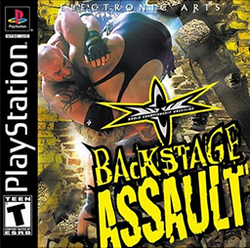

WCW Backstage Assault is the wrestling game that decided rings were passé and that every wrestling feud should be settled in a loading-screen-friendly labyrinth of trailers, corridors and flaming barrels. Developed by Kodiak Interactive and released by EA on PlayStation in late 2000, the title doubles down on "hardcore" by removing most of the genre's usual trappings: no ring, no tags, no count-outs, and only two combatants per match. It ships with commentary provided by Tony Schiavone and Bobby Heenan and a visual style the marketing folks labeled "cartoonized." The final product was divisive at best and critically panned at worst - the aggregate scores and low critical reception tell that story - but the more interesting chapter is how the game's mechanically ambitious idea collided with PlayStation-era technical constraints and some design choices that felt like duct-taping a demolition derby into a sports sim.
From a systems perspective, Backstage Assault is a focused experiment: by constraining combat to backstage spaces and enforcing Hardcore Rules, the designers trade the ring simulation and multi-person dynamics of contemporaries (like SmackDown! and WCW Mayhem) for a tight one-versus-one melee engine. That constraint simplifies some subsystems and amplifies others. For example, the arena topology becomes a first-class gameplay resource - the game world is effectively a seven-level graph with sixteen nodes (rooms) connected by doors. Matches begin in a node (the Truck Arena for most campaign starts) and can finish in any room the avatars can access, so map knowledge and traversal decisions matter more than ring positioning. Mechanically the game revolves around a damage/momentum system with clearly communicated state changes. Player names shift color from white to yellow to red to flashing red as health deteriorates, which is a simple but effective HUD cue that sidesteps complicated stamina meters. Momentum accumulates through successful strikes, grapples and taunts; reaching "Max Momentum" unlocks a finishing move window. That architecture - input → state change → reward window - is the core loop, and it's sound on paper. Bleeding is implemented as a binary escalation of visual damage, and win conditions include pinfall, submission and knockout anywhere, reinforcing the "use environment as weapon" design philosophy. Where the design idea starts to strain is in its execution and accompanying systems. The game explicitly forbids disqualifications and count-outs and limits matches to two characters, removing many of the balancing levers that wrestling titles typically use (run-ins, tag teams, referee logic). That makes AI behavior and object interactions the primary pacing drivers, and reviewers consistently noted that the single-opponent dynamic can feel repetitive. Weaponization of the environment is encouraged - chairs, barrels, hazards - but collision fidelity and object physics are constrained by PlayStation-era budgets: many weapon interactions are scripted or use simplified hitboxes rather than fully simulated ragdoll/physics outcomes. This reduces emergent spectacle and makes some flubbed hits feel like missed cues rather than audience-worthy near-misses. Modes are implemented as distinct state machines. Hardcore Challenge acts like a campaign runner: you pick a character, pursue a championship by navigating the room graph, and save between matches. Decisions about which room/opponent to tackle next provide light strategic structure, and unlocking rooms for Exhibition mode is a practical progression loop. Hardcore Gauntlet is a single-run permadeath-style sequence of seven matches with no mid-run saves, increasing tension but exposing balancing issues; if one match feels artificially difficult due to AI or cramped geometry, the whole run collapses. Exhibition offers quick play options, including First Blood (single-player only) and the bizarre Human Torch mode (two-player only; win by setting opponent on fire), which are curiosities but largely novelty spicings rather than core mechanical depth. Overall, Backstage Assault is architecturally interesting: it builds around map traversal and environment-as-weapon, but the lean technical implementation and limited combat variety mean the higher-level design ambitions frequently outpace what the engine reliably delivers.
The look is unabashedly stylized - Wikipedia summarizes it as "cartoonized" - and that aesthetic was polarizing. On PlayStation hardware, delivering high polygon counts, fluid animation and detailed textures is non-trivial; the team opted for cell-shaded-ish character art and simplified environmental textures to hit a consistent framerate. The result is a visual identity that stands out among its contemporaries but also highlights resource trade-offs: character models are lower in polygon detail compared to promotional claims (and compared to the rumored PlayStation 2 screenshots that later turned out to be higher-quality renders, not in-engine captures). Animation is functional but repetitive; finishing moves and grapples trigger canned sequences rather than dynamic transitions, which undermines the impact of landing a Max Momentum finisher. Technical presentation also extends to audio. The inclusion of Tony Schiavone and Bobby Heenan as commentators is a nod to presentation authenticity, yet the PS1's memory and streaming constraints limit line variety and dynamic mixing. Commentary lines tend to loop and can become grating across extended play sessions, particularly since matches are stripped of the arena crowd ambience that typically fills audio gaps in wrestling games. Lighting and particle effects are serviceable - the flaming barrel in Human Torch mode is a memorable prop - but lighting lacks per-pixel nuance and shadows are rudimentary due to platform limits. Overall, the graphics read as a compromise: clever stylization to sidestep hardware ceilings, but not enough engine polish to make the compromise feel intentional rather than forced.
WCW Backstage Assault is a textbook case of an interesting core premise undermined by constrained execution. The decision to relocate every match backstage and to design around Hardcore Rules produces a mechanically coherent title with smart ideas: room-to-room level design as strategic space, a clean momentum-to-finisher loop, and an emphasis on environmental weapons. Those ideas are weakened by limited combat variety, two-player-only matches, scripted-feeling weapon interactions, and presentation choices that clash with player expectations for a wrestling sim. For a PlayStation-era curiosity hunter or a collector of oddball licensed titles, Backstage Assault has enough unique bones to be worth a look: it's novel, occasionally fun in short bursts, and it has a few genuinely memorable moments (the Truck Arena starts, the Human Torch novelty). For anyone expecting the pacing, polish, and character variety of the era's better wrestling games, it's a hard sell at full price. The critical reception and Metacritic scores back that up, and sales reflected the lukewarm enthusiasm. Score-wise, the game lands around a 4/10: credit where due for a bold divergence from genre norms, but the technical compromises and repetitive combat loop keep it from being a hidden gem. Rent it for a laugh, add it to a nostalgia shelf, but don't expect it to dethrone the classics.
 WCW/nWo Thunder on PlayStation
 WCW Mayhem on PlayStation
 Deca Sports DS on DS
 Accolade Sports Collection on Xbox Series X/S
 Alan Hansen's Sports Challenge on PS2
 Olympic Games Tokyo 2020 - The Official Video Game on Switch












 Another SquareThought Site