

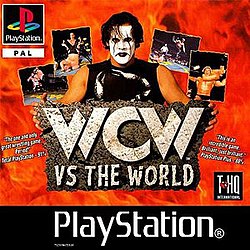

When the PlayStation was still being touted as the future of polygons and CD audio, a curious translation experiment landed on our shores: WCW vs. the World. Birthed in Japan as Virtual Pro Wrestling and shepherded overseas by The Man Breeze and THQ, this title arrived at a moment when wrestling games were leaving sprite-based shenanigans and stepping, somewhat awkwardly, into 3D. The result is a game that sits squarely in the transitional era - ambitious in scope, uneven in execution, and oddly proud of it. For fans of the Monday Night War and those who appreciated a full roster over silky-smooth controls, WCW vs. the World offered a feast of options. For purists wanting tight gameplay and audio that punches like a piledriver, it was a mixed bag.
The headline figure here is scope. WCW vs. the World boasts sixty wrestlers, a number that makes modern roster bloat look timid by comparison. The collection mixes WCW mainstays - names like Sting, Ric Flair, Hulk Hogan and The Giant - with a gaggle of "fictional" foreign wrestlers. Those fictional monikers are not attempts at creative genius so much as licensing sleight-of-hand: many of the renamed fighters are in fact Japanese stars from the original Virtual Pro Wrestling, retitled for the American release. It's an odd franken-roster that reads like a collector's checklist: authentic WCW personalities rubbing shoulders with disguised versions of Jushin Liger, The Great Sasuke and Mitsuharu Misawa. Modes are where the title really tries to flex. In an era when many console wrestling games offered a single exhibition match and called it content, this game piles on League Challenge, Best of Seven, Exhibition, Elimination, Tournament, League and Double Title modes. These options reflect a Japanese sensibility toward pro wrestling structure - championship creation and defense are front and center here, features which, tellingly, were absent in the series' immediate successor. The result is a package that rewards time investment: you can tinker with titles, grind through league play, or set up long-form rivalries in ways that were rare on the 32-bit console landscape. Mechanically, this is a stepping-stone title. The game introduces what it calls a "spirit meter" in lieu of a linear energy bar, a system intended to capture the momentum swings of a real bout. When you get rolling you feel it; when you're on the ropes it's brutally obvious. This was an early attempt to move beyond simple health depletion and toward wrestling's theatrical ebb and flow. Unfortunately, the control scheme doesn't always keep pace with the ambition. Too often the inputs feel loose, the timing fussy, and the promised variety of moves gets lost in cramped animation windows. Critics at the time noted the control was "a little off," and that observation still rings true - the game hints at the grappling depth AKI would later perfect, but WCW vs. the World does not yet offer that intuitive grab-and-counter system which made its successor a classic. Multiplayer is serviceable and can deliver those hot-button living-room matches that make you forgive a lot of flaws. Up to two players can duke it out in exhibition or tournament formats, and the sheer variety of characters keeps the matchups fresh. The AI, meanwhile, is competent rather than inspired; it offers a reasonable challenge in league and tournament modes but does not generate the kind of emergent drama you hope for in a wrestling sim. The legacy here is instructive. WCW vs. the World feels like a prototype: it set down many ingredients that would later be refined - the spirit meter, deep modes, and a colossal roster - but it lacks the bedrock mechanics to make those ingredients sing. For collectors and historians of wrestling games, the title is an important evolutionary step. For players who want a polished, immediate arcade experience, it can be a little rough around the edges.
By 1996 standards the polygons are clean. Wrestlers are blocky by today's standards, but they move with a level of fidelity that, at the time, felt impressive coming out of the PlayStation's early years. Reviewers praised the cleanness of the models; faces and costumes are recognisable enough that the game captures the personalities of real wrestlers, which is half the battle for a licensed title. That said, the textures are sparse. Backgrounds and mat details are minimal, colors are often flat, and the camera can make matches feel staged and distant. There's an honest attempt at authenticity - outfits, entrance trademarks and signature poses are generally well represented - but the spectacle is undermined by bland arenas and an audio presentation that reviewers called lackluster. Sound effects are functional but forgettable; the crowd noise rarely rises to the level of drama and entrance music is more placeholder than fanfare. If you judge it as a 32-bit artifact, the visuals succeed at conveying the wrestlers and the match structure. If you expect the cinematic spectacle of later wrestling titles, you'll be disappointed. It's serviceable, occasionally charming, and patently of its time.
WCW vs. the World is one of those games that made more of an impression for what it attempted than for how neatly it accomplished that attempt. It arrives as an influential awkward teenager: ambitious roster, ambitious modes, and an experimental approach to match momentum, but hamstrung by control quirks and a less-than-exciting audiovisual package. Contemporary critics were divided - some lauded the breadth of content and the authentic use of real holds, while others complained it lacked the drama and polish that made more arcade-oriented wrestling games pop. For the serious 1990s gamer - someone who remembers unwinding with a DualShock in one hand and a magazine review in the other - WCW vs. the World is worth a look. Its best selling points are the breadth of its modes and the sheer number of wrestlers, a lineup that even today makes you pause and appreciate the ambition. Its weaknesses are equally clear: controls that predate the intuitive grappling system AKI would later nail, textures that are gloriously minimal, and sound that doesn't sell the action. In the saga of wrestling video games, this is the draft version that foreshadows a masterpiece. If you want refinement, skip ahead to WCW vs. nWo: World Tour. If you want an honest-time capsule of mid-90s transition to 3D wrestling - flaws, experimentation and all - then strap in. The bell has rung; the match is messy, memorable and, most importantly, historically significant.
 Harvest Moon: One World on Switch
 Nobody Saves the World on Xbox Series X/S
 Ultraman Fighting Evolution on PlayStation
 ACA Neo Geo: Art of Fighting 2 on Xbox One
 ACA Neo Geo: The King of Fighters '98 on Xbox One
 Touhou Hyoibana: Antinomy of Common Flowers on Switch












 Another SquareThought Site