

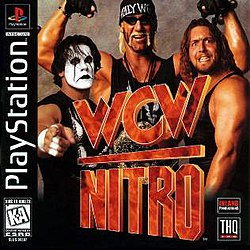

WCW Nitro for the original PlayStation arrives like a neon-splattered VHS highlight reel: loud, familiar, and occasionally a bit fuzzy around the edges. It wears its TV-show pedigree on its sleeve with full motion video intros and a roster that would make any late-90s wrestling obsessive grin. But this review isn't here to flirt with nostalgia. I want to talk about what WCW Nitro demands from the player as a challenge: the skills it tests, the gaps it exposes, and the satisfaction it hands out when you finally land a Diamond Cutter without panic-mashing the controller.
At the heart of Nitro is a controls philosophy that sits somewhere between old-school button brawling and the input discipline of a fighting game. Moves are not random flurries off of a single attack button; most actions require specific button combinations. That design forces you to learn move lists and to commit certain inputs to muscle memory. If you enjoy the kind of challenge where your thumbs have to remember choreography, Nitro gives you that homework. The game opens with 16 playable wrestlers, each with their own video intro, and offers 48 unlockables through tournament runs or cheat codes. Unlocking characters is a challenge in itself: you need to run the one-player tournament mode with a variety of wrestlers to coax some of the roster out of hiding. That pushes you to learn different move sets and forcing you out of a single comfort pick, which is great for player skill development. The tournament also functions as the game's main single-player gauntlet. It tests endurance, match-to-match adaptation, and the ability to string together consistent offenses despite the occasional CPU fluke. There's a debate in the contemporary reviews about whether Nitro is a button-masher or a tactical fighter. Both camps have a point, and that conflict plays into the player challenge. On one hand, some moves feel easy to execute, and in multiplayer you can get away with frantic button-spamming that looks dramatic and occasionally wins the day. On the other hand, several reviewers and many players noted that certain signature moves demand patience and timing. Jeff Gerstmann observed that the game leans toward a fighting-game sensibility, where specific button combinations net specific moves. For players who want to climb the skill ladder, that is welcome: it rewards deliberate inputs and punishes sloppy reflex presses. The biggest skill Nitro asks of you is timing. Whether you're attempting a reversal, preparing a finisher, or coordinating a tag-team exchange, the windows for success are often narrow. Some reviewers said that the controls suffer from delayed responsiveness, and that is the game's cruel leveller. Inputs don't always translate to actions immediately, which increases the cognitive load: you must anticipate as much as react. That turns matches into a test of prediction and controlled aggression rather than pure speed. Learning to counteract that delay becomes a skill in its own right. Tag team matches add another layer of complexity. Teamwork with either a human or teammate AI requires ring awareness: when to hot tag, when to isolate your opponent, and when to set up a finisher without letting the second wrestler interfere. The game's frame rate can dip when more than two wrestlers are on screen, and this can throw off timing-sensitive moves. Adapting to these technical hiccups is part of the challenge-good players learn to account for visual lag and still execute. There is also a psychological skill component. Nitro rewards mental discipline. Because some moves are difficult to land and some are too easy, the meta becomes about choosing the right moments to go for big plays and not reacting emotionally to failed attempts. The best matches feel like a chess match disguised as an eight-minute punk-rock commercial. You learn to bait, punish, and preserve your momentum. Multiplayer is where the skill ceiling shines best. Two human players create a feedback loop of adaptation: you learn to read tendencies, punish button-mashing habits, and exploit the quirks of each wrestler's move set. The PC version later added TCP/IP network play, which theoretically expanded this competitive aspect, though on PlayStation the best tests of skill will be local and sweaty. Finally, there's an unlock and experimentation loop that develops practical skills. To unlock many of the hidden characters you need to win tournaments with a variety of wrestlers. That nudges you into learning new inputs, different signatures, and varied strategies. It's a smart way to turn roster hunting into a purposeful training regimen.
Visually Nitro aimed to impress for its day. Inland Productions claimed a seamless texture-mapped animation system that tried to avoid the disjointed limb look of earlier wrestlers. The result is a roster that, in motion, captures recognizable silhouettes and signature moves. Full motion videos pepper the roster selection, which adds atmosphere and a tangible link to the TV product. Where graphics intersect with challenge is the impact of framerate and responsiveness. Several reviewers called out dropped frames when more than two wrestlers populated the ring. In practice this means that when the match gets chaotic, your window for precise timing effectively narrows. The visuals remain serviceable in single-on-single combat, but when you want to rely on pixel-perfect timing in a four-person brawl, the graphical limitations can interrupt your rhythm. The PlayStation version's graphical ambition is admirable, but it occasionally undermines the gameplay's timing demands. The Nintendo 64 and Windows ports changed some of the presentation. N64 omitted FMV entirely and the Windows port removed entrance videos, though the latter added network play; these changes slightly alter the feel of matches but don't fundamentally change the core control challenges.
If you're judging WCW Nitro as a pure simulator of wrestling moves, it's far from perfect. If you're judging it as a test of player discipline and timing wrapped in a loud, roster-heavy package, it holds up better. The skills Nitro asks for include memorizing move inputs, mastering timing in the face of input lag and occasional frame drops, ring awareness for tag exchanges, and restraint to avoid becoming a glorified button masher. The inconsistency in control responsiveness and the framerate dips are the game's main kryptonite; they keep Nitro from being a higher-tier competitive title but don't ruin the experience for determined players. For a wrestling fan with an appetite for a learning curve and the patience to build muscle memory, Nitro is rewarding. You will fumble a lot, learn from it, and hit that satisfying finisher with style. For players who want instant gratification and predictable controls, the game's quirks may grate. Overall, Nitro lands in the midrange: imperfect but engaging, with a modest skill ceiling and a fair amount of depth if you're willing to put in the reps. It's the kind of retro wrestling game that teaches you to respect timing more than twitch, and that's worth something in a genre that too often rewards nothing but noisy thumbs.
 WCW/nWo Thunder on PlayStation
 WCW Mayhem on PlayStation
 Deca Sports DS on DS
 Accolade Sports Collection on Xbox Series X/S
 Alan Hansen's Sports Challenge on PS2
 Olympic Games Tokyo 2020 - The Official Video Game on Switch












 Another SquareThought Site