

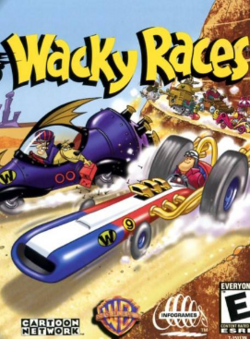

Wacky Races for PlayStation is Appaloosa Interactive's attempt to translate the chaotic, gadget-laden spirit of the classic Hanna-Barbera cartoon into a console kart-racer. The game ships the familiar cast - eight immediately playable vehicles and three unlockable boss rigs - and leans on a token-and-gadget economy to add combat and strategy to the racing. On paper it checks a lot of genre boxes: varied vehicle stats, items that can defend, attack, or boost, and championship and multiplayer modes. In practice the PlayStation port is a lesson in how concept and execution can drift apart during the pipeline from art to disc. This review concentrates on the technical underpinnings: handling model, control input, AI and balancing, resource allocation for items, and presentation performance. Expect notes on what works, what is sloppy, and where the porting process likely tripped over its own bumpers.
Wacky Races organizes itself around a small, well-defined systems stack: vehicle archetypes, a purchasable/collectible gadget economy, and a set of modes (Time Trial, Championship, Multiplayer, and a Super Gadgets index). The game exposes eight core vehicles with distinct stat profiles and three boss vehicles unlocked as progression rewards; the doc explicitly notes contrasts such as the Army Surplus Special (low acceleration, high top speed) vs. the Arkansas Chugga-Bug (moderate top speed, strong handling). That means the game is designed around asymmetric driving roles instead of single "best car" dominance, which is a sound design foundation for replayability. The gadget economy is implemented via Wacky Tokens - pink floating coins scattered on track segments that are consumed to activate vehicle-specific gadgets. This is an unusual coupling of resource pickup and item access compared with genre peers that often grant items via random boxes; token collection incentivizes route optimization and risk-reward decisions (go for a detour to collect tokens, or hog the racing line?). Gadgets fall into three mechanical categories: defense, speed, and attack, which provides clear telemetry for a designer to balance against vehicle stats. Where the PlayStation version begins to fray is in the deterministic systems that should make token-driven items meaningful. The documentation indicates Mario Kart-like arms-race combat and a final reward of the Mean Machine after clearing championship mode once. That unlock loop is fine, but the PlayStation release earned poor aggregate scores (32% GameRankings, a 21/40 in Famitsu and a 4/10 from PlayStation Official Magazine UK), which strongly implies imbalance or poor feel in the actual driving and combat systems. From a technical perspective, the likely culprits are: input latency, sloppy collision and hit detection for weapons, and AI rubber-banding or naiveté that undermines competitive pacing. Input and handling are the beating heart of any racer. Wacky Races attempts to differentiate vehicles by acceleration, top speed, and handling but the translation into player feel matters more than raw stat numbers. If acceleration feels floaty, or steering lacks fidelity at higher speed bands, the high-top-speed archetypes become frustrating to pilot rather than rewarding. Similarly, gadgets that rely on precise timing (land mines, bubble gum, exploding pumpkins) require consistent physics and collision responses. The PlayStation reception suggests these subsystems weren't tuned tightly enough: vehicles feel inconsistent between hits, and gadget interactions can be unpredictable - you might slip past a land mine because the collision box didn't register or get punished by a trap that visually missed you. That inconsistency kills strategic depth because players can't reliably anticipate outcomes. AI design is another technical axis. Good CPU opponents must offer competitive lap times while avoiding exploitative behaviors (teleporting to your bumper, invisible rubber-banding that negates a lead, or getting stuck on geometry). Reviews clustered around the PlayStation release imply AI and balancing issues: either opponents were too easy (leading to boredom) or too artificially assisted (leading to perceived unfairness). The token economy also interacts with AI: do CPU racers prioritize tokens and gadgets intelligently? If not, the entire item economy feels lopsided. Multiplayer on a single PlayStation in 2000 is always a technical constraint story - split-screen requires halving rendering budgets and often forces lower LODs, reduced object counts, and additional compromises to physics update rates. The documentation lists multiplayer as present but the lower aggregate score on PS suggests the implementation likely came with noticeable technical trade-offs (frame-rate drop, reduced draw distance, or diminished input responsiveness) that harmed head-to-head play.
Graphically, Wacky Races leans into its cartoon license, which is a pragmatic art direction for a lower-budget racer. The PlayStation hardware was capable of charming low-poly visuals when developers optimized art budgets and memory streaming, but ports that aimed to match a PC build frequently struggled with the PS1's limited VRAM and transform/lighting throughput. The PlayStation release's poor critical reception hints at a presentation that fails to impress: bland textures, pop-in on track objects, and shallow environment LOD transitions. These issues are not unexpected for cross-platform titles of the era but are still technical failures in the context of a competitive racing market. Additional technical problems likely include clipping artifacts and primitive particle systems for gadget effects, leading to ambiguous feedback for hits and near-misses. Clear visual feedback is crucial in an item-based racer; if an exploding pumpkin lacks a readable blast radius or a defensive gadget doesn't present an immediate visual state change, players cannot develop the reaction skills the game intends to reward. Audio cues are part of that telemetry loop as well - in a tight technical critique one would look for distinct SFX and priority mixing for gadget use and collisions. The aggregate scoring suggests those mixes were probably low priority in the port. On the positive side, the PlayStation port at least preserves the vehicle roster and character identities from the cartoon, and the unique vehicle archetypes (e.g., Creepy Coupe, Bullet Proof Bomb) provide an asset baseline that should have been enough to carry an otherwise competent racer. Unfortunately, the production didn't fully exploit or polish these assets for a consistent on-console experience.
Wacky Races on PlayStation is an instructive case study in how a solid design skeleton - asymmetric vehicles, a collectible token economy, categorized gadgets, and classic IP - can be undermined by uneven technical execution. The published vehicle stats and gadget taxonomy indicate the game had a defensible mechanical core, but the PlayStation port's reception (low aggregate scores and poor magazine reviews) points to problems in input handling, collision consistency, AI behavior, and rendering performance. For a player looking for reliable physics and tight competitive feel typical of the best kart racers, this version will disappoint; gadget interactions feel inconsistent and the presentation misses the polish needed to communicate gameplay events clearly. If you're a Wacky Races completist, collector, or fan of Hanna-Barbera nostalgia, the PlayStation version has value as a licensed curiosity and for unlocking the Mean Machine as a reward loop. Competitive or casual racers seeking a crisp, well-refined kart experience should instead look to better-executed contemporaries or the Game Boy Color iteration, which reviewers treated more kindly. In technical terms this release reads like a port where time spent on CPU-side fidelity, collision/feedback tuning, and split-screen optimization would have yielded vastly better results. Consider this a cautionary tale: interesting systems need reliable low-level engineering to sing, otherwise polished ideas end up idling in neutral.
 Initial D Extreme Stage on PS3
 Winning Post 7 Maximum 2008 on PS3
 Roary the Racing Car on DS
 Team Sonic Racing on Switch
 Garfield Kart: Furious Racing on Switch
 Ben 10: Galactic Racing on PS3












 Another SquareThought Site