

 Oct 2025
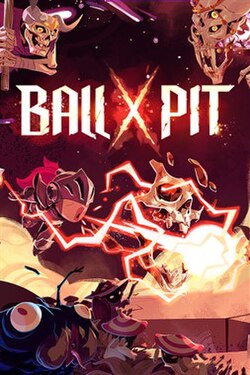

Ball x Pit is the videogame equivalent of being handed a paddle, a sack of angry balls, and a map to a monster-filled sinkhole, then being told: "Good luck." On the surface it's a charming mash-up of Arkanoid-style block-breaking action and a town-building meta that rewards persistence, but underneath lives a hair-pulling, timing-demanding roguelike that keeps you on your toes. If you like games that punish sloppy reflexes and reward thoughtful upgrades, this Switch version delivers a tidy, cheeky package that expects you to learn fast and fail faster.
Ball x Pit splits its heartbeat into two clear lungs: the pit (action) and the surface (meta). The pit is where you do the sweaty-palmed work. You pick an adventurer, each with a loadout of balls, and launch projectiles into a crowded arena where monsters march toward the bottom of the screen. If a monster reaches your baseline, you take damage, and too much of that and your run is history. The immediate challenge is deceptively simple: keep things from reaching the bottom. The skill ceiling, though, comes from mastering angles, judging ricochets, and juggling multiple ball behaviors at once. Mechanically, Ball x Pit borrows block-breaker lineage: balls bounce, hit enemies, and interact with the environment. But instead of neat rows of bricks, enemies are moving targets with their own attack patterns; some spit projectiles back, while others march in tight formations. This shifts the player's focus from pure aim to mixed-mode threat management - you must prioritize which monsters to thin out, when to split your attention across lanes, and how to angle shots so the balls do maximum work while you plan the next move. Precision aiming matters, but so does predictive thinking: a well-placed ricochet can clear a lane and set up chain reactions that feel delightfully skillful. Roguelike progression is a major part of the challenge diet. Killing monsters drops gems that level up your adventurer. Each level presents a choice: add a new ball, buff an existing one, or pick up a passive item. These decisions are often tradeoffs - power now versus utility later - and learning which combinations scale best for your playstyle becomes a kind of meta-skill. The game introduces a clever fusion/fission system: special items can be fissioned to create multiple powerups, used to fuse two balls together so their effects combine, or evolve balls into superior versions. That system raises the stakes on decision-making. Do you gamble a rare fusion for an untested combo, or play it safe and bank a reliable upgrade? The best runs come from the players who can assess value quickly and commit. The level structure forces rhythm into your runs. Early segments generally end in mini-boss fights that test whether your build can handle concentrated pressure. The final segment presents a true boss with unique behaviors that punish tunnel vision - if you rely on one trick, the boss will happily punish you for it. Boss fights are a study in pattern recognition and adaptation: learn the tells, reposition, and change strategies mid-fight when your chosen ball types reveal weaknesses. Outside the pit, the village-building stage is where the long game lives. Resources collected from runs - gold, blueprints, wood, stone - are invested into buildings that grant characters, passive bonuses, and construction that changes how future runs play out. You can assign workers to resource spaces to bring in materials and speed up building projects. Boss fights yield gears that unlock deeper elevator levels in the pit, exposing you to new enemy archetypes and tougher bosses. The surface layer forces you to switch mental gears from twitch-heavy micro to measured macro: which building yields the best return? Which adventurer do you unlock next? How many resources should you spend on immediate upgrades versus saving to expand the village and access tougher pits? That juggling act of short-term survival versus long-term investment is where Ball x Pit's strategy muscle really flexes. Skills the game demands are broad but specific. You need aim and timing for the physics-led action, spatial awareness to track multiple balls and enemy projectiles, and pattern recognition for boss behaviors. Beyond the basics, the game rewards risk assessment (do you fuse balls now or later?), resource prioritisation for the village, and the ability to adapt: runs can snowball or crumble quickly based on one choice. Learning to pivot mid-run - swapping targets, exploiting fusions, or leaning into passive synergies - separates the long-term survivors from the quick casualties. The learning curve is steep but fair: mistakes teach faster than tutorials, and success tastes earned.
Ball x Pit runs on Unity and presents its chaos with a clear, readable aesthetic. The visual language prioritizes clarity - important when the screen is full of bouncing spheres and marching monsters - and the UI communicates upgrades and choices without getting in the way of the action. Enemy designs are distinct enough to telegraph behaviors, which is crucial for a game that asks you to parse threats quickly. On Switch, performance is stable; there's a nice balance between visual flair and practical legibility so your eye isn't tricked out of noticing an incoming wave. The soundtrack by Amos Roddy does a solid job of keeping tension up during pit runs and easing off during village management, which helps the brain switch modes between twitch play and strategy.
Ball x Pit is a bite-sized masterclass in hybrid design: it combines the immediate satisfaction of Arkanoid-style banging-and-bouncing with roguelike decision-making and a satisfying village meta that rewards time and patience. The challenge is the star: the game forces you to learn quickly, make smart tradeoffs, and blend mechanical skill with strategic planning. If you want a Switch game that punishes sloppy play and celebrates clever solutions, this is your sinkhole. The fusion and evolution mechanics add a delightful layer of experimentation, and the city-building loop makes every failure feel like progress. The game's polish and steady performance on Switch, combined with its addictive risk-versus-reward systems, justify the high critical reception. Expect to die a lot, adapt faster each time, and grin when a perfect ricochet saves an otherwise doomed run.
 Pinball on PS2
 Q-Ball Billiards Master on PS2
 River City Girls on PS4
 River City Melee: Battle Royal Special on PS4
 City Shrouded in Shadow on PS4
 Cities: Skylines Remastered on Xbox Series X/S










 Another SquareThought Site