

 Apr 2022
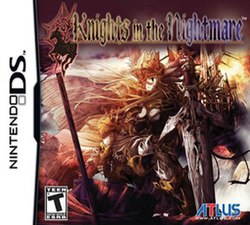

Knights in the Nightmare has always been the kind of game that reads like a graduate thesis on systems design presented as a tactical RPG - and then decides to set that thesis on fire with a bullet‑hell flamethrower. The Switch remaster (released in Japan on April 7, 2022) brings that famously eccentric hybrid to modern hardware. This review focuses on the technical architecture that makes Knights so singular: the layered interfaces (Setup, Tactics Screen, Battle), the fusion of turn‑based decisionmaking with real‑time, touchscreen‑driven micro‑dodging, and the many interlocking subsystems - experience distribution, equipment leveling, Transoul, Phase affinity, Rush Count, and permadeath mechanics. If you like your games with clearly defined rules and thirty ways to break them, you will want to read closely.
Knights in the Nightmare divides its loop into three discrete screens that shape player cognition and technical flow: Setup, Tactics Screen, and Battle. That triptych is more than UI partitioning - it is the game's rhythms and tempo. Setup is the heavy data‑management phase: experience points are pooled and allocated manually, equipment can be merged and levelled, and the Transoul mechanic lets you transfer a soul from one fallen Knight to another. From a systems perspective this is a deliberate inversion of the usual RPG flow (where XP flows automatically into characters). By forcing players to allocate XP as a resource, Knights shifts strategy from moment‑to‑moment tactics to meta‑resource planning. The tradeoffs are rich: investing in one Knight unlocks higher tier equipment and vitality at the cost of breadth of usable units, and Transoul has a staggering web of conditional modifiers (past lives, elemental and race affinities) that act like hidden modifiers to expected value calculations. The Tactics Screen is the mid‑level planning layer where you select the loadout and - crucially - change the initial Phase of the battle. Phase switching is an elegant mechanical pivot: Equipment and Knights carry Phase affinities, and the two phases operate similarly to Ikaruga's polarity system. Technically, Phase acts as both a damage multiplier and a gating condition on which attacks affect which enemies; this gives strategic weight to preturn configuration and in‑turn toggling. The Tactics Screen is also where enemy previews and roulette selection occur. The roulette enemy selection feeds the Battle layer but also introduces stochastic elements into multi‑turn planning, so you cannot fully plan the matrix in one go. This design nudges the player toward flexible, probabilistic strategies rather than rigid checklists. Battle is where the game's most interesting technical hybridization lives. Battles are rendered on an isometric grid and controlled - in the original DS architecture - almost entirely via the touchscreen. The player manipulates the Wisp, a cursor entity that functions as both command interface and active dodge avatar. Contacting a Knight with the Wisp initiates an aiming routine (one of four compass directions) and lifting the stylus releases the attack. At the same time the Wisp is under continuous bullet‑hell fire; the player must micro‑navigate to avoid damage while positioning for attacks. This dual role creates a continuous motor‑cognitive loop: spatial pathing for survival versus spatial precision for attack vectors. Two resource streams structure the combat economy: Gems (generated by normal attacks) recharge the Magic Point (MP) meter, and Equipment perform Skill Attacks that consume or convert MP into powerful effects. Time is another resource but handled unconventionally. The turn timer only decays when the Wisp takes damage or when attacks are charging, meaning a well‑skilled player can effectively create more planning time by dodging well. Leftover time at the end of a turn is convertible into XP or MP, which means in‑turn efficiency translates into long‑term resource gains. Rush Count is another discrete counter that changes the state of the battlefield based on the number of consecutive hits: some counts grant healing or buffs, others spawn adverse effects. The Rush Count functions like a state machine with discrete outputs for discrete input counts, encouraging combo planning and hit sequencing. Goals in normal battles are not straightforward "defeat everything" tasks. Instead the Enemy Matrix at the bottom of the screen is a tic‑tac‑toe field where enemies must be killed in aligned patterns to score KILL markers. This turns enemy selection into a spatial puzzle over multiple turns and converts the roulette randomness into a constrained planning problem. Boss encounters strip away the Matrix abstraction and expose traditional health bars, but they compensate by increasing bullet‑hell intensity and scale. Permadeath is represented via Vitality (for Knights) and Durability (for Equipment), both of which deplete with use and can be replenished via levelups, merging, or Rush Count effects. Combining permadeath pressure with a high reward economy makes every decision weighty: do you expend a fragile high‑tier Equipment now for a tactical pivot, or conserve for a future Matrix placement? From a technical balance perspective, Knights's systems are tightly coupled and purposely complex. The original DS release prompted the development team to lengthen and deepen the tutorial and to adjust the interface before launch, a clear sign that the designers preferred systemic depth over low entry friction. The game rewards players who can model the interactions between Phase affinities, Rush Count states, XP allocation, and Wisp pathing, and punishes sloppy play with irreversible losses.
Visually, Knights uses an isometric projection that serves both aesthetic and functional roles. The isometric grid grants clear spatial relationships for pathing the Wisp while allowing sprites and bullet patterns to read cleanly at a glance - a critical property when the screen is filled with projectiles. The character illustrations (Satoko Kiyuduki, Sunaho Tobe, Yoshinori Iwanaga) and the soundtrack (Shigeki Hayashi) are repeatedly referenced in the development notes, and they provide the high‑level polish that keeps the dense mechanics emotionally engaging. The original DS implementation split information across two screens: this separation is a technical affordance that reduces cognitive load by dedicating space to Setup/Tactics details and to active Battle telemetry. The remaster's documentation in the source does not enumerate specific graphical upgrades for the Switch release, so the precise nature of resolution or UI refinements is not confirmed here. That said, porting an interface built around a touchscreen stylus to a single‑screen console is a nontrivial UX challenge: the DS's persistent touchscreen context supported rapid tap‑and‑drag operations for the Wisp and menus, and any Switch release must either preserve touch support (on Switch's tablet mode) or rebind those operations to analog/gyro inputs. From a technical standpoint, ensuring pixel‑level hit detection for the Wisp and preserving the clarity of rush counters, phase icons, and the Enemy Matrix are the minimum requirements for the remaster to be faithful and playable.
Knights in the Nightmare is a study in systems engineering disguised as a strategy RPG. Its most arresting technical achievement is how it blends real‑time motor skill (bullet‑hell dodging and Wisp pathing) with slow, high‑variance metagame decisions (XP pooling, Transoul, equipment fusion). The result is mechanically rich and occasionally unforgiving - its hour‑long tutorial and steep learning curve are not design bugs so much as gatekeepers ensuring players internalize the rules language. The Switch remaster brings these systems to a modern platform, but the documentation supplied here leaves open important UX questions (touch vs. stick controls, UI consolidation from dual screens). If the remaster preserves the original's informational clarity and offers sensible input mapping, this is a near‑perfect port for players who love tight, emergent systems and don't mind doing a little bookkeeping with their bullets. If you want a streamlined, hand‑held‑style pick‑up‑and‑play, this is not it. For the rest of us who savor mechanical puzzles with a pulse, Knights rewards the investment handsomely.
 Gloria Union: Twin Fates in Blue Ocean FHD Edition on Switch
 Utawarerumono: Prelude to the Fallen on PS4
 Baroque on Switch
 Dokapon Kingdom on PS2










 Another SquareThought Site