

 Jun 2019
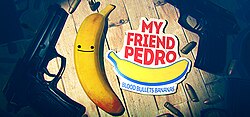

If you've ever wanted to be an action movie where the laws of physics politely ask for a time-out, My Friend Pedro on Switch is the game that gives your inner stuntman a megaphone. The premise is gloriously bonkers: a masked, silent protagonist guided by a talking banana named Pedro through a string of themed levels that involve equal parts acrobatics and lead distribution. On the surface it's a stylish run-and-gun with slow-motion tricks and ricocheting bullets; underneath it's a machine that rewards timing, planning and the kind of improvisational control that makes your thumbs sweat in a very satisfying way. This review zeroes in on the challenge aspects and the skills the game asks of you. If you like looking cool while failing spectacularly and then learning exactly how not to do it, this is a game designed to teach through glorious explosions. If you value repetition without growth, stick to vending machines. For everyone else, My Friend Pedro gives you the tools to become briefly phenomenal and permanently hooked.
The core loop of My Friend Pedro is gloriously simple: move through a tightly designed arena, find the enemies, and kill them in the most stylish way possible. But "simple" here is a trap - the game layers mechanics that combine into a flow that is both elegant and brutally demanding. Slow-motion is your bread and butter. It lets you thread shots while spinning like a caffeinated ballerina, and while it feels like an unfair advantage, the real challenge is learning to exit slow-mo at the right moment and chain moves for maximum multiplier. Timing is everything; overstay the cinematic slo-mo and you'll miss a window to continue the combo, lowering your rank at the end of the level. The point system isn't just cosmetic: it's an incentive structure that forces you to learn efficiency and precision. Each hit increases a multiplier, and your final rank depends on how well you maintain that rhythm. Aim-splitting is a feature that rewards ambidexterity - or at least fast mental juggling. You can lock onto two targets at once and shoot in different directions, so levels throw groups of enemies at you that encourage, or outright demand, split attention. The challenge here is twofold: spatial awareness and quick prioritization. You can't treat enemies as mere HP bars; you must decide which threat to neutralize first while keeping your positioning optimal. Then there's the physicality: parkour elements like flips, wall jumps and rolls are not cosmetic showboating. They're scoring multipliers and survival tools. Flipping through the air to dodge a hail of bullets while lining up a ricochet off a frying pan is where the game sings. The platforming is precise rather than forgiving. Wall jumps and rolls require correct timing and direction; a mistimed wall jump can flip you into a hail of bullets and a humbling restart. The game expects you to treat movement as an offensive tool, not just a way to reposition. Ricochets elevate the combat from pew-pew to chess with gunpowder. The environment is littered with objects you can kick or use - frying pans, signs, even enemies. Learning geometry becomes a practical skill: angles of incidence matter, and sometimes the solution to a room is less about shooting than about bouncing shots through the seams of cover. That means you must learn to think in reflections, not just trajectories. Dodging and spinning are central to survival. The spin dodge is a satisfying evasive maneuver that both animates your character like a drunken breakdancer and gives you an instant window to avoid incoming bullets. Mastering how long to spin, when to stop, and how to reorient your aim after a spin is part of the muscle memory the game crafts. The developers reward risk: stay in the line of fire but dance through it and your multiplier climbs. Play timid and you'll survive more but score less. Weaponry is straightforward but functional. You're not juggling huge inventories; instead the game asks you to master a handful of firearms and improvisational uses for them. It's less about gun upgrades and more about you becoming a better user of the tools on hand. Kicking enemies or objects becomes an additional 'skill tree' of sorts - the better you are at using the environment, the more stylish and effective your run. The scoring and leaderboard system pushes the game's replayability from simple completion to competitive refinement. Levels are short and tight, which means they are ideal for iterative improvement. Expect to replay the same stage dozens of times while trying to shave off mistakes and increase multipliers. This breeds a certain type of player: the one who can see a level as a puzzle of human motion and bullet timing. If you're someone who enjoys incremental mastery - learning the precise timing of a flip to chain into a ricochet while splitting aim between two thugs - then the game hooks you hard. Difficulty comes less from punishing enemy damage and more from the cognitive load: multitasking, precise movement, and timing. The campaign nudges you into learning the full kit quickly; later encounters require you to combine slow-mo shots, parkour maneuvers, ricochets and aim-splitting in rapid succession. The difficulty curve is about learning to parse a chaotic tableau and convert it into a rhythmic performance. When that rhythm clicks, the gameplay delivers a high unlike many modern shooters: you feel like a choreographer of carnage. There are design caveats worth mentioning. The campaign is tightly directed, so while it is great for teaching and showcasing mechanics, its scripted nature limits emergent moments. That is to say, the game expects you to perform a particular dance in many rooms; it rarely throws open a sandbox for you to improvise in a completely unconstrained way. This ties into the observation from some critics that replay value outside score-chasing is capped: once you've mastered the moves and seen the tricks, the novelty fades. However, if leaderboards and self-improvement are your poison of choice, there's a lot of life here. A final unsung skill the game demands is risk assessment. Playing to rank means balancing survival and style. Sometimes sprinting into obvious danger to pull off a high-multiplier combo will net a better score than methodically clearing a room. That judgment - to be bold or safe - becomes a meta-skill you refine. The best runs feel like a tightrope walk: one misstep and the house of cards collapses; one perfect sequence and you are suddenly serenaded by glorious point numbers.
My Friend Pedro's visuals are stylized and functional rather than photorealistic. The aesthetic favors clear silhouettes and readable spaces, which is crucial when so much of the game depends on quick visual parsing. Enemies, bullets, and interactive objects stand out clearly, which keeps the challenge fair: you lose because you messed up timing and decisions, not because you couldn't see what was happening. Animations are crisp. The flips and spins sell the game's choreography, and the slow-mo transitions are buttery enough to make each moment feel cinematic. Environmental detail is intentionally sparse in places so that ricochets and interactive props read cleanly, and the themed levels establish variety without obscuring gameplay readability. On Switch, performance is solid; the gameplay is responsive, and frame consistency matters here because the smallest input delay undermines the skill-based systems the game builds. Sound design plays a role in the challenge too. The beat of the soundtrack and the punchy audio cues help you sync moves and build combos. The game knows how to make you feel like a sequence is 'on' with audio flourishes that coincide with multiplier growth and stylish kills. It's a subtle but important reinforcement loop: the game rewards not just with points but with sensory feedback that says, yes, that was awesome, do it again.
My Friend Pedro on Switch is a concentrated school of stylish violence that turns precise movement, split-second decision-making and spatial reasoning into an art form. The challenge isn't piled on through spongy enemies or convoluted menus; it's baked into the mechanics: slow-mo timing, splitting your aim, nailing parkour maneuvers, and mastering ricochets. If you like being forced into rapid multitasking and then being rewarded with a perfect run that looks like you planned it all along (even when you didn't), this game scratches that itch like nothing else. The campaign's tight scripting limits sandbox improvisation and some players might find the long-term replay value depends heavily on how much they enjoy chasing higher ranks and leaderboard glory. For those players, and for anyone who wants to develop the specific suite of skills the game tests, My Friend Pedro is a brilliant, sometimes brutal playground. It asks for precision and gives back cinematic satisfaction in spades. Bring patience, quick reflexes, and a willingness to treat failure like a rehearsal, and you'll leave every level feeling a little more like an action-movie legend - or, depending on the run, a very stylish cautionary tale.
 My Friend Pedro on Xbox One
 The Swords of Ditto: Mormo's Curse on Switch
 PlayStation Home on PS3
 Gaelic Football '25 on Xbox Series X/S
 Together! The Battle Cats on Switch
 Crash Bandicoot: The Wrath of Cortex on PS2










 Another SquareThought Site