

 Aug 2025


Together! The Battle Cats (released on Switch as a revamped port titled The Battle Cats Unite! / Together! The Battle Cats) is basically what happens when a tower defense game and a surreal internet sticker pack decide to run a conquest simulator. Built originally by PONOS as a mobile free-to-play darling and ported to consoles by Tose with Bandai Namco handling Switch publishing in some territories, the game keeps its idiosyncratic 2D sandbox of ridiculous feline units while bolting on some console-focused features: two-player co-op and a handful of minigames. If you care about the engineering side of things, what matters is that this is a heavily-evolved mobile system transplanted to a handheld/TV hybrid - which means UI, input, and monetization patterns originally designed for touchscreens are now running on controllers and on a platform with different player expectations. That tension between mobile architecture and console expectations is where the technical story of Together! lives.
Mechanics overview Together! is a straightforward tower defense loop at its core: deploy cats from your base, spend money to field units, and stop waves of themed enemies from reaching your base while pushing toward the enemy base. Under that deceptively simple loop sits a dense, modular systems stack: discrete unit stats, a taxonomy of enemy traits, an upgrade and evolution pipeline, and a gacha acquisition layer. The game explicitly encodes a unit-role model (meat shields, crowd controllers, backliners) but exposes it through numerical stats and binary/conditional abilities (e.g., "strong vs Red", floating/nullifies damage, warp-away mechanics in later story sagas). Unit design and traits Units are defined by base stats (HP, DPS, range, movement), discrete traits (Red, Floating, Black, Metal, Angel, Alien, Zombie, Aku, Relic, Traitless, Behemoth, Colossus, Sage), and special abilities. This creates a combinatorial counter/soft-counter design where the player must match unit abilities to enemy trait sets. From a systems perspective it's a textbook rock-paper-scissors augmented with numeric scaling and special-case immunities: units can have multiplicative damage modifiers against certain traits, or resistances that change their effective survivability. That predictable determinism is what allows high-level play to be technical and repeatable - if you know an enemy lineup, you can plan a deterministic solution with specific unit types and timing. Progression systems Progression is layered. XP and Catseyes are the primary currency for level-ups; NP (Nyanko Points) buys Talents; Catfruit/Catfruit Seeds and Behemoth Stones/Gems are gating resources for major evolution milestones (True Forms, Ultra Forms). The game implements level caps per unit (20-60) which create soft power ceilings and force players to strategize resource allocation. There is also a duplicate-to-plus-level mechanic in the gacha, which lets players marginally increase the power of units they pull multiple times; this preserves both the rarity hierarchy and a path for incremental power growth without relying only on consumables. Talents and meta-evolution Talents (and the later Ultra Talents) introduce a second layer of depth: they are essentially modular passive abilities bought with NP that can alter roles or create niche interactions (e.g., anti-floating optimization, longer stun windows). Versioned updates (v12.1 and v13.0 referenced in the source) iteratively added Ultra Talents and Ultra Forms for some uber units, which materially changes unit viability and the meta-game. From a technical balance perspective, adding these layers post-launch is a way to extend the power curve and reconfigure counters without rewriting base unit stats - it's an efficient patching strategy for a live service title. Stages and game-mode engineering The campaign is split into main sagas (Empire of Cats, Into the Future, Cats of the Cosmos, Aku Realms) and Legend Stages (Stories of Legend, Uncanny Legends, Zero Legends). A handful of special challenge modes exist: the Catclaw Dojo - an event-driven, ranked mode emphasizing time/throughput with money scarcity - and the Underground Labyrinth, a 100-stage sequence with persistent restriction mechanics (used unit becomes non-removable; units can become "trapped" after stages). These are cleverly designed mechanical constraints: rather than change the core combat engine, they modify stateful equipment & roster constraints, which forces players to plan permutations and adapt to partially stochastic penalties (trap outcomes). That's a neat way to get emergent difficulty from a static combat engine. Acquisition and monetization: gacha and event tickets Cat Capsules (gacha) are the acquisition funnels. Multiple ticket types (Cat Tickets, Rare Cat Tickets, Lucky Tickets, and Cat Food) let the player access random draws that yield units or upgrade items. The gacha also serves dual roles: a player-acquisition mechanic and a power progression lever via duplicates-to-plus-levels. On a technical level, the reliance on gacha for access to high-rarity units means the power curve is deliberately gated behind randomness and resource sinks, which colors the difficulty curve of later chapters and events. The console ports attempt to mask free-to-play roots by adding local features (co-op, minigames), but the underlying progression economics remain designed for recurring engagement and monetization. Controller and platform considerations The Switch port is described as a "revamped" version with two-player co-op and minigames, and Tose is credited with development on the Switch version. Porting a UI designed around touch input to controller input (joycons + docked play) is non-trivial: selection grids, upgrade menus, and rapid unit toggles must be mapped ergonomically to buttons and sticks. The original mobile UI assumes precise taps and swipes; a well-done port will present context-aware cursors, button shortcuts for the gacha and upgrade flows, and local multiplayer-friendly HUD scaling. The 3DS POP! port previously retained mobile stamina mechanics and drew criticism; for Switch, the addition of console modes is promising but the console audience still expects less artificial gating, so the degree to which the port removes or softens stamina/energy walls is an important technical and UX decision. Design trade-offs and balance implications The design trades persistence and breadth for repeatability. Units and stages are often reuse/reskinned across chapters with adjusted difficulty and enemy lists; this is efficient from asset and engineering standpoints but can lead to perceived content repetition. On the other hand, the granularity in unit traits and talent interactions yields deep puzzle-like encounters where optimization and timing create high-skill play. For players and analysts who like deterministic, testable systems, Together! provides clear mechanics and measurable outcomes; for those who dislike gacha randomness or mobile-style gating, the monetization layer will conflict with the otherwise clean technical scaffolding.
Art direction and sprite systems Together! keeps the original title's deliberately bizarre 2D aesthetic: cartoonish, often meme-adjacent sprites where "cats" can be anything from simple round felines to literal machines and collaboration characters. From a technical viewpoint, the art pipeline favors vector-like simple silhouettes and flat shading, which scales cleanly across devices. The game uses sprite-based 2D assets laid out on a side-scrolling battlefield; that approach minimizes GPU burden and keeps draw calls low, which is appropriate when the source engine needs to run on low-power mobile SoCs and the Switch's Tegra alike. Stage reuse and memory efficiency The documentation notes that early chapters are essentially reskins with repeated level geometry and changed enemy spawns. This is a typical memory and development trade-off: reuse high-level tile sets and level skeletons while swapping enemy tables, spawn timing, and aesthetic overlays. The result is smaller storage footprint and faster iteration cycles for new content, which is ideal for a live-service model where ongoing event content and collaboration stages are frequent. Console-specific graphical considerations The 3DS POP! spinoff used stereoscopic 3D; for the Switch port the commentary focuses on added modes rather than on a major graphical overhaul. Practically, this probably means the Switch version retains the 2D sprites but benefits from higher native resolution and sharper scaling on-dock output. Because the visual style is intentionally low-poly (in terms of pixel/shape complexity), the port can rely on crisp upscaling and low artifact risk when switching from mobile to a 720p/1080p environment. This conserves resources and avoids the need for high-resolution art pipelines, while still looking clean on a TV. UX and readability The game's UI must handle dense on-screen information: unit cooldowns, spawn queues, trait icons, and talent overlays. The strong silhouette art style helps unit readability - even when the battlefield gets crowded, the simple shapes and bold counters reduce visual ambiguity. However, the heavy reliance on trait icons and textual tooltips makes a well-designed HUD necessary; cramped layouts on smaller screens or poor remapping to controller inputs could impair micro-decisions. The presence of many unique abilities and status effects increases cognitive load, so good typography, contrast, and iconography are crucial to keep the technical depth playable.
Together! The Battle Cats on Switch is an interesting technical transplant: it takes a dense, system-rich mobile tower defense and attempts to dress it in console clothing. The strengths are clear - a deterministic combat engine with a deep trait-and-talent lattice, efficient asset reuse, and a progression pipeline that gives long-term goals (True/Ultra Forms, Talents, Behemoth gear). The Switch-specific additions (two-player co-op, minigames) are sensible for the platform and help disguise the game's free-to-play DNA, but the underlying gacha economics and mobile-oriented progression loops remain visible in the game's bones. If you're the sort of player who enjoys dissecting deterministic systems, optimizing counters, and squeezing the maximum throughput from a constrained roster, Together! offers a rewarding technical playground. If you hate randomized acquisition and stamina-style gating, the console port's added features won't entirely override those structural choices - and critics of the 3DS POP! release already pointed out how odd it feels to carry over mobile energy systems to a console environment. Overall, the Switch version is a competent, mildly eccentric port that preserves the mechanical depth while adding local multiplayer flourishes. It's engaging, occasionally brilliant in its design, and frequently silly in a way that grows on you - but it keeps enough of its mobile heritage to temper its score. 7/10.
 Orphen: Scion of Sorcery on PS2
 One Piece Grand Battle! on PS2
 Bakugan Battle Brawlers: Battle Trainer on DS
 Defense Grid 2 on Switch
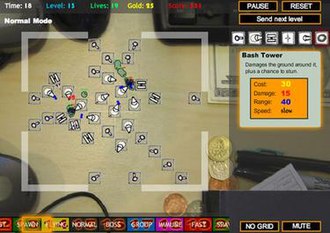
 Desktop Tower Defense on DS
 Defense Grid 2 on PS4
 PixelJunk Monsters on PS3










 Another SquareThought Site