

 Oct 2018
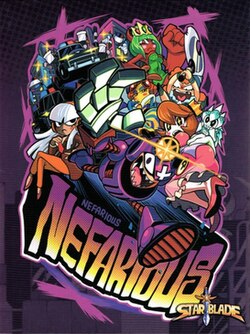

Nefarious turns the platformer inside out by handing you the cape, monocle and questionable moral compass of Crow, a supervillain whose business model is princess abduction for the explicit purpose of powering a doomsday device. From a systems perspective it's a deliberately contrarian design choice: instead of the usual hero-versus-boss loop, the game stages boss encounters where you are the boss, and the enemies are genre archetypes (plucky plumber, spiky speedster, et cetera). The project started life on Kickstarter-raising over $50,000-and was built in Unity. It launched on PC in early 2017 and arrived on Switch on October 4, 2018. Critical reception was mixed, with the Switch version averaging 65/100 on Metacritic alongside PC's 67/100. The following review is aimed at technical readers who like their comedy with collision boxes and their humor with hitboxes: a system-oriented look at how Nefarious' mechanics, structure and engine choices interact on the Switch.
On a mechanical level Nefarious is a 2D side-scroller constrained to the classic X/Y plane: left-right movement and jump, with combat layered on top. Crow's offensive toolkit is compact but mechanically expressive. He has a close-range melee attack and a thrown grenade for ranged threats. The implementation that stands out is independent aiming for both attacks. In practice that means projectile vectors and melee directions are decoupled from locomotion, giving the player fine-grained control over threat prioritization without contorting movement inputs. For players who enjoy micro-optimization, this design opens opportunities for skill expression: juggling grenade arcs, intercepting moving targets and using grenade blast physics to perform grenade-jumps for extended verticality. Grenade-jumping is not a cosmetic trick-it's a designed traversal mechanic. When the blast impulse is strong enough it becomes part of the level-design vocabulary, so encounters and platform spacing reflect the possibility of players amplifying jump reach via explosions. That has implications for level geometry: ledge distances, ceiling clearance and enemy placement must be tuned to prevent sequence-breaking while rewarding mechanical mastery. The currency and progression loop is straightforward and tightly coupled to performance: Lucre is scattered through levels alongside three collectible crowns and a vinyl record per stage. The vinyls unlock tracks at an onboard jukebox-an undeniably nerdy way to expose the audio system and to reward exploration. Death is punitive in a measured way: health depletion sends you back to the last checkpoint and strips off a portion of accrued Lucre. The implementation mitigates grind by spawning a small flying robot at the death site that carries retrievable Lucre. That single-system decision influences risk calculus: players can push for higher reward runs knowing they won't irreversibly lose everything, but recovery requires returning to the death marker which affects level routing and retry strategies. Between missions the Sovereign airship functions as a hub world. The hub contains shops for spending Lucre on modular upgrades-health extensions, grenade capacity, and equippable modifications that alter attack properties. This upgrade layer is deliberately incremental rather than transformative: it biases players toward gradual build diversification over radical power spikes. Hidden stages with specific unlock requirements gate the true ending, which forces players to engage with optional content and the upgrade economy. Where Nefarious gets creative is in its encounter design. The boss fights are the game's thesis statement: the player, as the villain, faces off against heroes whose mechanics mirror or parody well-known series. The game borrows archetypes-platforming plumber, high-speed hedgehog, turn-based JRPG party-and then remixes them so your boss patterns must adapt to different sub-systems. It also slips in genre-bending segments (a Final Fantasy-inspired RPG boss and a dating-sim level among them), which shows an ambition to create a varied mechanical palate. Technically, that requires the engine to host multiple combat subsystems and state machines without excessive loading or context-switch friction. Using Unity makes that achievable: modular scenes and scriptable behaviours let the developer swap rule-sets between encounters while reusing core assets. Design-wise, the grading system at the end of each level (letter grades) encourages players to refine play patterns rather than just brute-force progression. There's a definite arcade sensibility here: repeated playthroughs for higher ranks are meaningful because of the in-level currency, the collectible gating and the hidden-stage requirements. The net result is a compact loop with measurable player agency and room for mechanical depth, despite the overall simplicity of Crow's moveset.
Nefarious runs on Unity and opts for a hand-drawn 2D aesthetic rather than heavy engine-driven post-processing. That choice simplifies cross-platform porting-particularly to the Switch-because high-frequency, expensive shaders and AAA-level particle systems are not central to the art direction. The result is an art-forward presentation where clean silhouette design and readable animations matter more than lighting theatrics. One reviewer praised the game's "gorgeous graphics," which aligns with the idea that strong 2D illustration can outshine technical polish when character design and level backgrounds are cohesive. From a technical standpoint, the art pipeline decisions are sensible for an indie team: lower shader complexity, sprite-based animations and tiled backgrounds reduce runtime cost and memory pressure. Unity's sprite atlasing and sprite animation systems are well-suited for this workflow, which makes builds lighter and loading faster on constrained hardware like the Switch. The game also integrates music as a collectible-driven subsystem (vinyl records unlock tracks at the jukebox), which is a neat example of coupling audiovisual assets to gameplay progression rather than loading all audio assets up-front. Performance on Unity titles can vary wildly depending on optimization, but the art choices here minimize the usual traps (overdraw, expensive global illumination, etc.). That said, some critics labelled the game "sloppy" and "half-done," observations that pertain more to execution and polish than to the raw visual architecture. Visual clarity and character readability are priorities in platformers; Nefarious generally maintains those, which preserves mechanical fairness-players can clearly see enemy telegraphs and Crow's own animations, which is crucial for a game where split-second grenade-aiming and grenade-jumps determine outcome.
Nefarious is an exercise in focused design: it trades mechanical breadth for a tightly defined set of systems and then interrogates those systems by reversing genre expectations. Technically, it benefits from sensible Unity-based choices-sprite-focused art, modular encounter scripts and a hub-and-upgrade economy that scales without complex simulation overhead. The boss-as-player concept is clever and often mechanically satisfying because encounters feel like puzzles that invite creative use of the grenade, the aiming system and explosive movement. The game's limitations are equally technical: a relatively small move list and an inconsistent polish level lead to moments where ambition outpaces implementation. That mismatch is likely what produced the mixed Metacritic consensus (NS: 65/100, PC: 67/100) and the spread of review scores from 5.5/10 to 8/10. If you prioritize inventive encounter design, clear 2D presentation and the novelty of playing the villain, the Switch port is a competent package. If you expect wide-ranging platformer systems or AAA-level finish, the game may feel a step short. At a score of 6.5/10, Nefarious is recommended as a technically interesting indie experiment with solid core systems and a distinct personality-warts and all-and it's worth a playthrough for anyone curious about what happens when the boss finally gets to have all the fun.
 Evil Genius 2: World Domination on PS5
 Orcs Must Die! 3 on PS5
 Onimusha: Dawn of Dreams on PS2
 Action Man: Operation Extreme on PlayStation
 Door Kickers: Action Squad on Switch
 Vividred Operation: Hyper Intimate Power on PS3










 Another SquareThought Site