

 Feb 2023
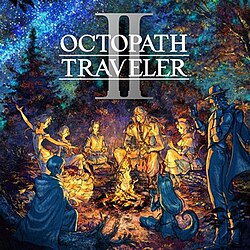

Octopath Traveler II arrives on the Switch carrying the weight of its predecessor's cult status and wearing the same striking HD-2D armor. If you spent your youth poring over instruction manuals and staring reverently at SNES JRPG title screens, this is the kind of game that will make you sit up and take notice. It is, unmistakably, a modern JRPG dressed in retro couture: pixel sprites with depth, diorama lighting, and composition that looks like someone painstakingly photographed a living, breathing sprite-based toy town. The sequel eschews returning characters in favor of eight new protagonists, places them in a more industrialized world called Solistia, and refines the systems that made the first game interesting. It does not reinvent the wheel, but it does give it better bearings and a fatter tire.
At its heart Octopath Traveler II is conservative in the most admirable sense: it takes a familiar JRPG blueprint and polishes the moving parts until they hum. You manage a roster of eight disparate travelers, each with a class, a motive, and a solo chapter structure that can be played in almost any order. This design allows for a pleasingly modular campaign-choose your starting protagonist and the world unspools from that vantage. The chosen lead cannot be removed from the active party until his or her chapter concludes, a wrinkle that preserves narrative focus while still allowing the cast to intersect. The 'path actions' return, now split between day and night. The addition of distinct diurnal behaviours is a smart evolution: the same character who will duel a rival at noon might bribe or entice someone at dusk. It deepens exploration and gives towns real personality, and it nudges you to revisit corners of the map when the lamps come on. Combat remains turn-based and unapologetically tactical. The break-and-boost systems from the first game are back and continue to reward observation and planning: discover an enemy's weaknesses, exploit them to 'break' the foe, and spend build-up boost points on extra actions. New to this iteration are Latent Powers-character-specific abilities that charge under certain conditions, encouraging you to take hits and break foes rather than play like a careful accountant. Jobs, weapons and elements form the familiar lattice: eight base jobs (hunter, apothecary, thief, scholar, merchant, dancer, cleric, warrior), six weapon types and six elemental schools. You can equip characters with secondary jobs and, unlike before, multiple characters may share the same standard job, simplifying party experimentation. Four special jobs-Armsmaster, Arcanist, Conjurer and Inventor-must be unlocked through side-quests and are unique per party, providing flavorful asymmetry to builds. The implementation of guilds and job acquisition encourages a comfortable rhythm of exploration, questing and incremental empowerment. Narratively the game splits into contained vignettes: each character has four to five solo chapters plus two 'Crossed Paths' chapters where partnerships form. This anthology approach is both strength and weakness. It produces memorable, compact character arcs-an amnesiac apothecary piecing her past together, a prince reclaiming his throne, a hunter confronting prophecy-but it also yields a curious dissonance in party scenes. As some critics noted, battles demand coordination between characters, yet cutscenes will sometimes collapse to a single protagonist, making your assembled squad feel like a strategic mechanic rather than a fully integrated fellowship. The late-game convergence and the 'Journey for the Dawn' finale do knit the threads into a coherent endgame, with a Moonshade Order, the revival of an ancient entity and a satisfying if familiar showdown, but expect moments where the dramatic framing prefers theatrical monologues over ensemble presence.
The visual identity of Octopath Traveler II is its most headline-grabbing achievement. 'HD-2D' is no longer a gimmick; it is a mature art direction that reads like an extremely well-dressed tabletop diorama. Pixel artists and lighting technicians have apparently been sent to couples therapy and returned with a spectacularly resolved marriage: sprites retain charming two-dimensional readability while world geometry, depth of field and particle lighting lend scenes cinematic weight. On Switch this is handled with care. Performance is solid, and the technical compromises-lesser draw distance and occasional pop-in-are the kind of trade-offs you grudgingly accept when a game is squeezing this much aesthetic richness out of handheld silicon. The character portraits, battle animations and spell effects retain an old-school punch; spells still feel like events rather than UI transactions. Audio complements the pixelwork admirably. Yasunori Nishiki's score leans into sweeping motifs and quaint, mood-setting themes. The soundtrack knows when to swell and when to let a single instrument carry a scene. Voice work is minimal and used sparingly, which fits the game's tonal balance: it prefers written beats with musical punctuation to non-stop spoken dialogue.
Octopath Traveler II is an excellent follow-up that tightens and expands the formula without abandoning what made the first game distinctive. On Switch it offers a portable, contemplative JRPG experience that will please anyone who misses the era of slow, careful RPGs that rewarded patience. Systems are deeper, the day/night path actions give towns a new lease of life, combat gets meaningful new wrinkles, and the HD-2D visuals are among the best examples of the style to date. Its anthology structure will not satisfy everyone-moments of narrative isolation can make the party feel like a roster rather than a band of compatriots-but the individual character arcs and the eventual convergence into a proper endgame provide ample reward. If you cherish tactical turn-based battles, love buildcraft and want a game that wears its retro influences proudly without being shackled by them, Octopath Traveler II deserves a place on your Switch. It is a refined, occasionally indulgent JRPG with enough new ideas to justify a sequel, and its roughly 8.5/10 grade reflects a project that is polished, ambitious in modest ways and, above all, respectful of the genre's traditions while nudging them forward.
 Octopath Traveler II on PS5
 Dragon Quest III HD-2D Remake on PS5
 Combat Elite: WWII Paratroopers on PS2
 The Banner Saga 2 on PS4
 Arcania: The Complete Tale on PS3
 Gnosia on Xbox Series X/S










 Another SquareThought Site