

 Feb 2022
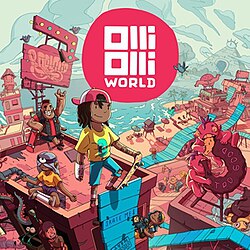

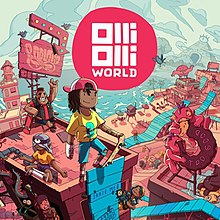
OlliOlli World is a skateboarder's fever dream wrapped in a hand-drawn comic book and driven by surprisingly deliberate engineering. Built in Unity by Roll7 and released on the Switch in February 2022, this third entry in the OlliOlli series trades the chunky pixel grit of its predecessors for a lush, 2D-platforming world that looks like a carnival for indie animators. On the surface it's a jaunty, approachable arcade-skater - under the hood it's a careful balancing act: tight input response, combo-preserving physics, and level geometry designed to reward precision rather than button-mashing. The Switch version sits comfortably with critics (Metacritic NS: 87/100) and, more importantly, gives you the technical tools to feel skilled without being cruel about failure.
OlliOlli World operates as a 2D platforming skate game, but calling it "just 2D" understates the depth of its mechanical systems. The core loop is deceptively simple: approach, launch, perform tricks, link moves into combos, land cleanly. Where it earns its mettle is in the chaining system and the physics model. Tricks net score but combos multiply value, so the game nudges you toward improvisation across rails, quarter pipes and walls. Quarter pipes and branching paths are new to the franchise; they expand the state space of movement possibilities and introduce branching decision points that affect speed, trajectory, and combo potential. Input fidelity is the story here. Roll7's development goal was to make the series more accessible while preserving high-skill play. That shows in how forgiving the controls are: air time and trick windows feel wide enough for players to string multiple moves together, but still tight enough that a small timing error ruins a run. A failed landing no longer boots you back to the start - it robs you of speed and breaks your combo. This is an important design change from previous entries and fundamentally alters risk calculus. Rather than harshly punishing exploration or ambitious lines, the game encourages you to attempt bigger setups because the cost of failure is local and recoverable. Physics-wise, moving from pixel art prototypes to a hand-drawn aesthetic allowed Roll7 to implement ramps, angled launches and huge jumps that were previously impractical. They mention a prototype allowing forward and backward skating as an inspiration for adding more 3D-like arc behaviors while retaining a fundamentally 2D plane. The result is a hybrid feel: movement is predictable and planar, but trajectories and launches have nuanced momentum, which rewards players who understand velocity vectors and landing geometry. Rails and walls are treated as velocity transforms - hitting a rail preserves forward momentum while enabling new trick states - and the game telegraphs these transitions clearly in level geometry. Level design complements the mechanical fidelity. Each stage often contains multiple routes and hidden side-quests, rewarding exploration with alternative combo opportunities and score multipliers. The branching paths are not cosmetic: choosing a route changes your available transitions and can radically alter how you build a combo. Replayability emerges organically because levels are dense with mechanical affordances; replaying to hunt higher-scoring routes feels like running experiments in a physics lab with a skateboard. The side quests and NPC interactions in Radlandia add context without bloating the mechanical loop, striking a good balance between progression and playground experimentation. Accessibility touches are numerous and practical. The game reduces the severity of mistakes, offering a gentler learning curve for newcomers while leaving room for advanced tricks and optimal lines that reward practice. This is a deliberate trade: the barrier to entry is lowered, but the depth ceiling remains intact thanks to nuanced timing windows and route complexity. The control scheme is readable, the feedback for successful inputs (visual and audio cues) is immediate, and the combo system provides clear numerical feedback for when you're doing well - essential for players who want to analyze their runs technically rather than just play for vibes. Expansions such as VOID Riders and Finding the Flowzone extend the mechanical palette and present new geometry to test your mastery of the movement systems. They keep the core loop fresh without undermining the baseline physics that make the game feel consistent and fair.
OlliOlli World marks a visual pivot from the pixel-based aesthetic of earlier OlliOlli titles to a hand-drawn, cel-shaded look inspired by Jet Set Radio and comic books. This change is not mere cosmetics - it's a technical decision that affects readability and gameplay. The hand-drawn backgrounds are highly detailed and colorful, but Roll7 avoids visual clutter in the foreground that could obscure rails, ramps and collision geometry. That separation of aesthetic detail and gameplay-critical readables is classic level-design discipline: pretty backdrops, clean interaction planes. Using Unity as the engine, Roll7 balanced stylized art with performance on consoles like the Switch. While the source does not list framerate specifics for the Switch, the Switch Metacritic score (NS: 87/100) indicates the platform holds up well in critical reception. From a technical standpoint, Unity's flexible rendering pipeline and batching capabilities suit OlliOlli World's 2D/platform mix: it renders layered hand-drawn artwork while keeping collision and physics calculations deterministic and responsive. The art direction also complements the game's feel: eye-popping palettes and quirky character design add personality without compromising the player's ability to judge distance and timing. The game's visual cues (sparks, motion lines, camera shakes) are lean and informative - not just flashy - and they serve as real-time feedback on lands, bails and combo hits. Performance considerations appear to have been handled pragmatically. The game prioritizes consistent input latency and predictable physics over pushing a higher polygon budget or expensive visual effects, which is the right call for a title where milliseconds and pixel-perfect landings matter. The result is a presentation that looks alive and detailed, yet never gets in the way of the mechanical fidelity the series is known for.
OlliOlli World is a rare sequel that grows the franchise by expanding mechanically and artistically in ways that complement each other. The game preserves the tight input-response and combo-focused scoring that veteran players crave, while adding ramps, quarter pipes and branching paths that create genuinely new mechanical possibilities. The change to a hand-drawn aesthetic is more than pretty paint - it's a readable, deliberately engineered visual layer over a carefully tuned physics and input model. Accessibility improvements, like replacing instant failure with a speed/combo penalty, show thoughtful iteration: the game no longer punishes curiosity and instead rewards exploration and practice. If you're playing on Switch, you'll get the full Radlandia experience: dense level design, strong feedback loops, and expansions that extend play without breaking the underlying systems. For anyone who enjoys dissecting movement systems, input windows, and level geometry, OlliOlli World is both a cozy sandbox and a precise machine. It earns a 9/10 for marrying technical rigor with charm - it's fluent in the language of skate physics, but it speaks it with a smile.
 Harvest Moon: One World on Switch
 Nobody Saves the World on Xbox Series X/S
 Tennis World Tour on Switch
 Accolade Sports Collection on Xbox Series X/S
 Deca Sports DS on DS
 Alan Hansen's Sports Challenge on PS2
 Olympic Games Tokyo 2020 - The Official Video Game on Switch
 OlliOlli on PS3
 OlliOlli World on PS5
 OlliOlli: Switch Stance on Switch
 Not a Hero on Switch










 Another SquareThought Site