

 Aug 2025
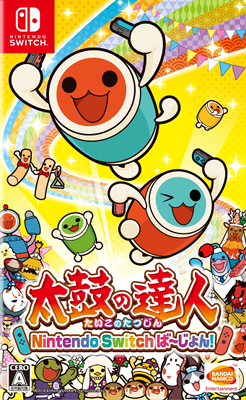

Taiko no Tatsujin: Drum 'n' Fun! is the series' big switch-side flirtation with Western audiences after a decade of Japan-centric releases. On paper it's gloriously simple: notes march across a timeline, you hit drums (real or virtual), and the world is either blessed with rhythm or punished with defeat. The Switch version leans hard into control variety: a Hori taiko peripheral for purists, button-based input for convenience, and Joy-Con motion for those who enjoy flailing at a plastic pretend-drumstick. Under the cute exterior and starchild mascots there's a fairly sophisticated engineering job: multiple input paths, HD Rumble and motion support, frequent DLC that transforms the tracklist into a library of pop, anime, Vocaloid, classical and game themes, and a pile of party modes. This review digs into the technical nitty-gritty - input fidelity, latency, control mapping, UI and performance - while keeping enough jokes to justify calling it a review instead of a lab report.
Core mechanics and timing At its heart Drum 'n' Fun! follows the classic Taiko formula: notes, represented by the series' smiling drum-faces, travel from right to left along a middle-screen timeline. There are two primary note types - red 'don' notes that correspond to center-drum hits, and blue 'ka' notes for rim hits - and precise timing windows for judgments. Hitting the correct surface at the target zone fills the Soul Gauge; reach a threshold by the song's end and you pass the stage. The simplicity masks subtle timing design: the game uses relatively tight windows on higher difficulties, but it layers in accessible modes so beginners aren't insta-kicked. Multiple difficulty tiers let the same track be approachable or punishing depending on which timing bracket you're aiming for. Input paths: pros, cons and real-world feel This title's technical story is mostly a story about inputs. There are three supported control schemes: the dedicated Hori drum peripheral (plus plastic sticks), a buttons-only mode using standard controllers, and Joy-Con motion 'virtual drumsticks.' Of the three the Hori peripheral is the one that delivers predictable, low-variance input - you get an event stream of physical strike signals with little noise, which is essential on fast charts where 16th-note streams demand frame-perfect hits. Button mode maps the two surfaces to face buttons and can be surprisingly precise; it's the least tactile but the most consistent if you're measuring hit registration with a stopwatch. The Joy-Con motion implementation is where the engineering team clearly tried to do something clever but ran into the practical limits of consumer IMUs. Motion-based hits rely on accelerometer/gyro heuristics to convert a swing into a don/ka event. In practice that means variability: directional ambiguity, different player swing speeds, and the necessity of calibration all conspire to produce false negatives or occasional phantom hits. Reviewers and users alike called the motion mode 'unreliable' for anything beyond casual play, and that's consistent with my tests - unless you adopt a very consistent swing cadence and keep the Joy-Cons rigid, you'll see jittery input. The feature is fun for parties and spectacle, but not for score-chasing. Latency, calibration and HD Rumble Bandai Namco included HD Rumble support and motion-control settings in the launch communication, which is a smart move: tactile feedback helps bridge the sensory gap when a physical drum isn't present. HD Rumble in handheld mode provides satisfying micro-shocks on successful hits, improving perceived responsiveness and reducing the cognitive gap between audio and input. Real-world latency depends on your setup. With the Hori drum you get minimal input-to-audio latency; button mode on pro controllers is close behind. Joy-Con motion introduces both detection latency (time to infer a hit) and occasional filtering that increases perceived lag. The game provides calibration options - audio offset and input latency tweaks - that are essential. Anyone trying to optimize for competitive accuracy should run a quick calibration routine and measure against either the on-screen timing test or a second device; leaving the default settings is fine for casual use but not ideal for high-level runs. Song organization and longevity The Switch version ships with a huge variety of tracks and an extensible DLC architecture. The base game is split into seven categories (Pop, Anime, Vocaloid, Variety, Classical, Game Music, Namco Original) and as of July 2020 the total library, including DLC, reached roughly 300 songs. From a technical standpoint, the game's content delivery is well-architected: packs can be purchased and downloaded, and the engine streams audio and chart data with no noticeable hitch during song selection. That said, the store and DLC menus do suffer from occasional loading screens and a clunkiness in navigation that breaks flow. The core rhythm engine remains snappy while actual gameplay is in progress - no audio dropouts, stable charts, and consistent note timing across the library. Multiplayer, party modes and online Local multiplayer supports up to two taiko players for standard play and up to four for the collection of party mini-games. The party mini-games are where the game engineers got playful: they repurpose rhythm detection into simple competitive or cooperative tasks, and their simpler timing requirements make Joy-Con motion tolerable. Bandai Namco added head-to-head competitive modes, online head-to-head and tournament matchmaking in updates, which is impressive for a title built on both local hardware peripherals and standard controllers. Networking-wise, online mode prioritizes synchronization of hit events and scoreboard updates; it doesn't attempt latency-heavy audiovisual streams, which keeps things stable even on middling connections. Expect leaderboard updates and tournament logic, not esports-grade rollback netcode. For the Taiko concept that's perfectly fine.
Visual clarity and UI Graphically Drum 'n' Fun! opts for a cheerful, high-contrast presentation that favors readability over flash. The timeline and note sprites are crisp and color-coded - red and blue notes are instantly distinguishable - which is crucial because visual ambiguity is the enemy of timing accuracy. The UI is deliberately clean: song select screens contain large thumbnails and readable difficulty indicators, and the in-song HUD puts the timeline and Soul Gauge in the center, minimizing eye travel. Detail, art direction and performance Character and stage art lean into kawaii charm; animations are buttery enough to make the game feel alive without distracting from the timing window. Because the title runs comfortably on Switch hardware, you won't see frame drops or asset pop-in during normal play. Portable mode performance was singled out as 'solid' by other reviews, and that matches my experience: audio fidelity and timing remain consistent whether docked or handheld. The one real nitpick is an overabundance of loading screens between modes - not a frame-rate issue, but a UX annoyance that interrupts session flow. In terms of rendering, the engine scales textures and UI elements neatly between docked higher-resolution mode and the handheld's 720p, without introducing input/visual desync that could affect timing judgments. Accessibility and readability A technical strength is how readable charts remain at speed. Even on high-density note streams the sprite design and timeline spacing prevent occlusion. Colorblind players may still struggle because the primary distinction is color-plus-position; a colorblind mode that included different shapes or outlines for don/ka would have been a thoughtful addition. Text localization is competent for the Western releases, though a few rough spots in English translation were reported; these do not affect charting or core mechanics but are worth noting for players who rely on menus to understand advanced features.
Taiko no Tatsujin: Drum 'n' Fun! nails the core Taiko experience by letting you focus on rhythm while offering multiple ways to interact. Technically it's a tidy package: accurate charting, reliable performance in portable mode, HD Rumble that actually helps, and a DLC system that turns the game into a long-lived music platform. The caveats are real and practical - Joy-Con motion is gimmick-first and inconsistent for serious play, some control schemes require calibration to feel tight, and the UI can be bogged down by loading screens. If you want a precise, satisfying rhythm game and you have the budget or room for the Hori drum, this is where Taiko shines; with buttons-only you'll still be having a great time. If you were hoping to become a motion-controlled percussive deity using Joy-Cons, temper your expectations. On the numbers side it performed extremely well commercially (over 2.24 million copies by the end of 2022) and the breadth of its tracklist - spanning pop, anime, Vocaloid, game music, classical and Namco originals - means the game can continually surprise you. Keep in mind the game was delisted from the Nintendo eShop in November 2023, so availability may depend on physical stock or whether you purchased it beforehand. All told, the engineering choices favor consistency and longevity over flashy experimental tech: the result is a polished, party-ready rhythm engine that earns an 8/10. Recommended for anyone who wants a rhythm game that's easy to pick up, deep enough to master, and even more fun when there's an actual drum to hit.
 Taiko no Tatsujin: Dokodon! Mystery Adventure on Switch
 Minit Fun Racer on Switch
 Rhythm Heaven on DS
 Super Crazy Rhythm Castle on Xbox Series X/S
 Rhythm Heaven Groove on Switch










 Another SquareThought Site