

 May 2017
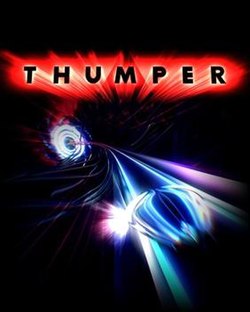

Thumper is that rare rhythm game that feels less like a chill drum circle and more like being chased through an industrial rave by a very judgemental beetle. On the Nintendo Switch the experience is compact, immediate, and brutally honest: you hit notes, turn on rails, jump spikes, and survive boss sections that don't do subtlety. Made by the two-person studio Drool (programmer Marc Flury and musician/artist Brian Gibson), Thumper strips rhythm gameplay down to pure velocity and precision. The Switch port keeps everything that made the original shine - the blistering speed, the punishing checkpoints, the raw audio-visual feedback - and wraps it into a handheld package. If you're buying Thumper thinking it will be casual background music, prepare to be humbled. If you want to train your reflexes, timing, and emotional resilience while entertaining yourself with glorious sensory overload, you're in the right place.
Thumper is simple to state and spectacularly relentless to master. You control a beetle-like vehicle racing down a straight and curved track that scours forward at a relentless pace. The controls are pared back: press a button to strike lit notes in time with the music, brake into turns, jump over obstacles, and occasionally slam into enemies. That stripped interface is deliberate. Stripping complexity away forces the game to ask only one thing: can you react precisely at speed? The rules are merciless but fair. You have a shield that absorbs a single hit - think of it as a fragile 'I have one more mistake before the game publicly shames me' buffer. Lose the shield and the next hiccup sends you back to the last checkpoint. Levels are divided into short segments with checkpoints after each. This design choice is a masterstroke for challenge-focused players: it gives you bite-sized goals, encourages repetition, and rewards incremental learning. The checkpoint system feels like an encouraging drill sergeant: 'You died? Good. Try that section again and do it better.' Rhythm is the heartbeat of Thumper, but it's rhythm on steroids. Each level is mapped to a time signature that follows the level number, ranging from partial measures like 1/2 up to complex signatures like 9/8. This isn't music theory homework; it's how the game organizes the beats you see and the hazards you face. Once you start recognizing how the music shapes the obstacles, the gameplay becomes a satisfying loop of pattern recognition and timing refinement. You don't just match beats; you learn to anticipate them. Anticipation is the game's secret sauce: once you stop reacting and start predicting, your runs stop being flukes and start being deliberate. Challenge ramps not by throwing more button types at you, but by compounding demands. There are lit notes to hit (perfect timing required for score), curved rail turns that require precise holding or timing, spikes to jump, and enemies to smash. Then there are environmental hazards and boss sequences that flip the script: everything accelerates, visual cues become more intense, and your mental bandwidth gets tested. The game scrolls at high speed in a third-person perspective, which ratchets up the required reaction time and peripheral processing. The higher difficulty layers demand near-perfect muscle memory. If your thumbs are not trained to micro-adjust in fractions of a second, the game will kindly remind you with an explosion. Play+ mode is where Thumper puts on its competitive, miserable crown. After you beat a level normally, Play+ unlocks as a variant that strips back allowances: you must clear the entire level on a single life. You still have the shield, but once it's gone you're on borrowed time. The twist here is that the speed increases with your score multiplier, so the better you do, the faster the game punishes you. On one hand that's satisfying: improved performance literally makes the challenge harder. On the other it's an exercise in controlled escalation. Play+ is a study in stamina, concentration, and the terrifying joy of being forced to sustain perfection. What skills does Thumper demand? First and foremost, lightning-fast reflexes. The game can go from calm to nuclear in a fraction of a measure, and surviving requires instantaneous micro-decisions. Next is rhythm sensitivity - not just tapping on the beat, but internalizing irregular time signatures and letting the music dictate your inputs. Pattern recognition is crucial: obstacles repeat in motifs and mastering them means learning their signatures. Precision is non-negotiable. The beetle can forgive very little; accuracy in timing and in positioning (for turns and jumps) separates decent players from great ones. Mental stamina is a skill Thumper trains accidentally. The game is addictive by design; segments are short enough to encourage repeated attempts, and the incremental reward of mastering a tricky turn or boss phase keeps you coming back. You will fail a lot. Thumper's checkpoint system softens the sting and turns failure into iteration, but repetitive failure still demands thick skin. If you crumble at the idea of resetting to a checkpoint again and again, Thumper will test your persistence. There's also an improvisational element: sometimes visual cues get messy or human input lags, and you must rely on instinct, muscle memory, and the audio track to carry you through. Outside of pure mechanics, the game rewards observational discipline. Brian Gibson's music and art are integrated into level design so that beats are not arbitrary-they map to patterns and hazards. Players who listen as much as they look will find shortcuts, rhythmic anchors, and subtle cues that make perfect runs possible. Learning to split focus between the lane, upcoming hazards, and audio cues is the meta-skill of Thumper. For Switch players, the control fidelity matters. Thumper's inputs are minimalist, which is good for the handheld's layout: one or two face buttons plus directional inputs handle everything. The comfort of repeated plays on a Joy-Con or Pro Controller makes grind sessions bearable. The Switch version doesn't include VR, so you won't have the head-tracked immersion of other platforms, but you also won't have those VR-related motion sickness issues; what remains is pure, concentrated reflex training. If there's a criticism from a challenge perspective, it's that Thumper is not gentle to newcomers who mistake aesthetic for accessibility. The game broadcasts its difficulty: the visuals are loud, the pace is ruthless, and bosses can feel like vertical walls of execution. But that's also why it's satisfying - the game trusts you to get better and gives you a fair environment to do so. The checkpoint segments, the consistent mapping of music to hazards, and the clear feedback for success or failure make improvement measurable. Expect to rage. Expect to grin when you finally clear that section without dying.
Thumper's visuals are an assault with intent. The art - Brian Gibson's contribution - is minimalistic but intense: sharp contrasts, neon pulses, and geometric shapes that morph in time with the music. The effect on Switch is crisp and coherent; the palette and visual rhythm never feel like cheap noise because they're tightly synchronized with audio cues. That synchronicity is the visual scaffolding your reflexes hang onto. When the screen starts to swirl during boss fights, it's not just aesthetic flair - it's a deliberate mechanic that tests your ability to parse important cues from ambient spectacle. On the small-screen Switch, the clarity and speed still read well, although a larger TV or a Pro Controller session can help tidy up input precision if you're chasing scores.
Thumper on Switch is a masterclass in game design for players who love challenge as a loop: fail, learn, retry, and gradually convert repetition into competence. It asks for reflexes, impeccable timing, pattern recognition, and a willingness to be humbled by a simple set of rules. The checkpoint system and short segments make the difficulty approachable in bite-sized chunks, while Play+ turns the whole experience into a test of endurance and precision. The marriage of Gibson's pounding soundtrack and Flury's mechanical vision creates an environment where audio and visuals directly instruct gameplay, which is why Thumper feels fair even when it's ruthless. If you want a portable coach for reaction time and rhythm that will mercilessly improve you, pick up Thumper. If you're the sort of person who prefers to play games where mistakes are invisibly forgiven, this is not your beetle. For everyone else, especially anyone who enjoys training their thumbs and timing while grinning through the pain, Thumper on Switch is one of the tightest, most rewarding challenge experiences available. 9/10.
 Rhythm Heaven on DS
 Super Crazy Rhythm Castle on Xbox Series X/S
 Rhythm Heaven Groove on Switch
 Taiko no Tatsujin: Dokodon! Mystery Adventure on Switch










 Another SquareThought Site