

 May 2025


In an age when games often boast battalions of content creators, colossal budgets and press releases longer than a congressional filibuster, Despelote arrives like a postcard from a simpler time. It is a first-person, autobiographical slice-of-life adventure set in the steep, breathless streets of Quito during Ecuador's fevered run toward the 2002 World Cup qualifiers. The conceit is disarmingly small: you are eight-year-old Julián Cordero and you have a soccer ball. What follows is not an epic in the sword-and-sorcery sense, but a carefully observed elegy to childhood, urban space and the tactile delight of kicking something across cobblestones. The game's developers - Cordero and Sebastián Valbuena - built the experience in Unity and delivered it through Panic with a producer credit to Gabe Cuzzillo. It has earned respect on the festival circuit, walking away with an Independent Games Festival award for Excellence in Audio and several narrative nominations. For players who grew up with magazines that praised atmosphere over hyperbole, Despelote reads like a well-written feature article: modest, precise and quietly proud.
Despelote's gameplay is as unpretentious as its premise. There are no convoluted skill trees, no loot tables, and no multiplayer ladders to climb - the entire game pivots around exploration and play. The controls on Xbox Series X/S are straightforward: an analog stick for movement, buttons for interactions and a set of intuitive motions to manipulate the soccer ball. The ball itself is treated as a character, with surprising heft and physics that reward patience. A sloppy foot will send it careening into a drain; a practiced nudge will skim it along a wall as the late afternoon sun catches the leather. Much like the best small-scale games of previous decades, the joy comes from mastering the simple systems rather than chasing mastery of an overly complex meta. Missions, if one can call them that, are vignettes rather than objectives. The player wanders across neighborhood alleys, parks, market stalls and rooftops, encountering slices of Ecuadorian life: neighbors debating the match, vendors hawking fruit, a dog that knows too many secrets. Interactions are short and often scripted, but they land because they are specific; a single line of dialogue can reveal the scent of diesel, the cadence of local banter, or the way a parent watches a child who refuses to come inside. The autobiographical angle gives the scenes an intimacy that few modern titles attempt. You don't progress through levels so much as accrue memories. The game's narrative nudges the player forward with small goals - retrieve the ball, follow a procession, test a trick - and each act reads like a paragraph in a memoir. There are design choices that will frustrate players schooled in the instant-gratification culture of streaming achievements. The pace is deliberate. If you're expecting a meticulously mapped quest log with waypoints lighting up like a slot machine, you will find Despelote almost stubbornly old-fashioned. It insists you pay attention to your surroundings and to the ball's weight. That stubbornness is part of its charm: mastering the ball's physics becomes a kind of apprenticeship in the city itself. The emotional rhythm is similarly gentle; the game rarely aims for melodrama, instead earning feeling through repetition and detail. For those who prefer games that punch their feelings quickly and loudly, Despelote might seem like a slow, quiet cousin at a family reunion. For players willing to listen, it rewards patience with a sense of presence rare in contemporary releases.
Visually, Despelote favors painterly realism over photorealistic bravado. The Unity engine serves the game well, rendering Quito's slopes with a warm palette and a careful attention to mid-century architecture, laundry lines, and the occasional stray cat. Textures are intentionally restrained; there's a softness to the edges that keeps the aesthetic from tipping into sterile simulation. Lighting is a standout component - sunsets bloom across narrow streets and the city's elevation is portrayed with convincing depth, producing long shadows that make a simple kick of a ball feel cinematic. Framerate on Xbox Series X/S remains steady during most stretches, and any stumbles are minor hiccups rather than structural problems. The audio, for which the game received festival accolades, merits special mention. Sebastián Valbuena's compositions and ambient design compose a soundtrack that is both local and universal: percussion and guitar inflections swirl beneath the city noise, punctuated by the metallic clang of a vendor's scale and the distant roar of a radio broadcasting a match. The mix places you in a real place without demanding you understand every dialect; it trusts the player's ears. It is telling that Despelote's strongest technical statement is not a spectacle but the convincing theater of ordinary sound - footsteps, the thud of a ball, a neighbor's half-remembered chant - which together form a convincing acoustic biography.
Despelote is not for everyone, and it never pretends to be. It is a compact, beautifully realized portrait of a young life lived within the contours of a city and a sport. The game is strongest when it leans into its limitations: when it treats the ball as a companion, when it lets the player drift through conversations, and when it allows silence to speak louder than exposition. On Xbox Series X/S the experience is comfortable and polished, a testament to small teams doing big work with modest tools. Some players will bridle at the lack of conventional progression or the slow, reflective pacing. Those players will be right to expect more adrenaline. For those who remember reading reviews printed on paper, who value observation more than explosions, Despelote offers a rare thing - a videogame that feels like being allowed to wander your childhood again. It earns its place among contemporary indies not by ambition to overwhelm, but by ambition to remember. Score: 8.5/10.
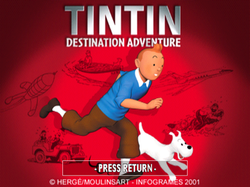
 Tintin: Destination Adventure on PlayStation
 DX Jinsei Game V on PlayStation
 Fantasy Life i: The Girl Who Steals Time – Nintendo Switch 2 Edition on Switch 2
 One Piece Grand Adventure on PS2










 Another SquareThought Site