

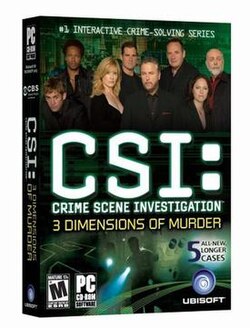

If you like murder mystery dinner parties where everyone pretends to be a forensic scientist and the plastic turkey is suddenly evidence, CSI: 3 Dimensions of Murder is your kind of awkward family reunion. Built on Telltale Games' then-new Telltale Tool and wearing a glossy coat of three-dimensional modeling, the title keeps the long-running structure of the CSI franchise - a sequence of individual cases culminating in a finale that ties threads together - while handing the player a different CSI partner for each puzzle. The PlayStation 2 build, ported by Ubisoft's Sofia studio, is a different animal compared to the PC original: free movement replaces the more guided camera of earlier PC CSI entries, and an extra, exclusive case pads the PS2 edition's docket. For those who live for fingerprints, dramatic reveals, and the quiet, oddly paternal air of Gil Grissom, this installment delivers a buffet of suspects and motives, even if it sometimes undercooks character depth in the service of puzzle boxes. As a character study wrapped in an adventure framework, 3 Dimensions of Murder operates like a procedural TV episode that occasionally remembers it's allowed to lean into character beats. Each case is practically its own short story with suspects who have a tidy arc, and the player - cast as an unnamed CSI collaborator - spends most of the game acting as a therapist-forensics hybrid, nudging the emotional arcs of suspects toward logical, often painfully human conclusions. The game's final case attempts to splice together the strands spun across the earlier episodes, rewarding players who paid attention to the quieter human details: petty grievances, financial anxieties, and the kind of petty cruelty that escalates into actual murder. Whether those arcs land depends on taste; some are tight and satisfying, others feel like cliff notes of much thicker novels.
The game's structure is reassuringly formulaic: five self-contained cases, with a fifth tying the first four together, and a sixth tacked on as PS2-exclusive. The pattern helps the narrative focus-each case zeroes in on a handful of human relationships and the small combustibles that turn them fatal. Case 1 (Pictures at an Execution) assigns you to Warrick Brown and stages a classic art-world meltdown: Rachel Maddox, an uptown bride-to-be with a talent for sharp criticism, is bludgeoned in an art gallery. The suspects are archetypal and deliciously performative: the hot-tempered fiancé Mark Stock; Nathan Ackerman, the gallery owner who lives in foyer-level anxiety; and Patrick Milton, the isolated artist whose portrait becomes an object of derision and the driver of his descent. Patrick's arc is the most textbook tragic-artist tale in the game: sensitive, withdrawn, repeatedly humiliated, and ultimately pushed past his breaking point. The game does a neat job of letting you witness the social violence of criticism-how a few careless words can grind a person down-without turning Patrick into a one-note caricature. You understand why he snapped, even if you don't forgive him. Case 2 (First Person Shooter) gets meta and slightly self-referential when it drops you into the trade-show chaos of the gaming industry and pairs you with Nick Stokes. The victim is a CEO at a flashpoint in his company's breakout release, and the suspects-Maya Nguyen, marketing and trigger-happy; Andy Penmore, the roommate with an eye for profit; and Craig Landers, the disgruntled ex-are painted with industry-aware strokes. Andy's arc is the blunt instrument of greed: his motivations are economic and unsexy, and the game uses him to demonstrate how ambition and the need to cash out can be as lethal as passion. The case also doubles as a wink from Telltale to its own history; the scenario is a dramatized nod to studio folklore about canceled projects, which gives the case a warm, inside-joke tone that contrasts with the colder personal tragedies elsewhere. Case 3 (Daddy's Girl) is where emotional duplicity takes center stage. Working with Sara Sidle, you investigate the apparent victimization of Carrie Canelli-though the body is missing and the scene is a smear of half-truths. The twist-that Carrie and Alex (a male nurse) staged Carrie's death so her twin sister Lucy could inherit their father's fortune-makes this arc a study in sibling bargaining. Lucy's subtle, long-game entitlement is played against Carrie's quiet resignation; they negotiate tragedy to change the balance of family power. The player's role is almost complicit-you're decoding a consented deception, deciding whether a crime born of familial pity counts as criminal. The moral ambiguity here is one of the game's stronger moments: the characters are more than motive and method; they're people trying to outmaneuver a paternal legacy. Case 4 (Rough Cut) teams you with Greg Sanders to investigate the son of a powerful real estate developer found dead in the desert. The suspects-wife, mother, and sleazy contractor-map onto the well-worn motifs of social expectation, dynastic pressure, and transactional intimacy. The arc here exists less in a single person and more in an ecosystem: the victim's death unravels the performative warmth of a family and the transactional nature of construction and favor. It's less interested in a single tragic hero and more in how class and influence can suffocate authenticity. Case 5 (The Big White Lie) is the game's narrative junction: a sleazy private investigator is shot and found by Doc Robbins, and you work with both Gil Grissom and Catherine Willows to trace a web of corruption. This is where the game leans into procedural payoff-connections discovered in earlier investigations surface here, and the emotional arcs of suspects from cases one and three ripple into fresh motive patterns. Thematically, this case posits that small deceptions and sycophantic acceptance of status accumulate into structural rot, occasionally erupting in violence. Doc Robbins' discovery of the body gives the whole affair a personal sting: it's no longer an abstract crime, it's one that touches the team, and that helps humanize the CSIs who, through the rest of the game, mostly serve as anchors rather than full protagonists. The PS2-exclusive Case 6 (Rich Mom, Poor Mom) further explores class collisions: a casino waitress, pregnancy, a Texas oilman, his young wife, and a live-in boyfriend form a tight triangle of motive, desire, and social aspiration. Its inclusion on PS2 gives that version a slightly meatier emotional palate, though it does not dramatically alter the game's core mechanics. Mechanically the game casts you as an investigative fulcrum: collect evidence, interrogate suspects, and assemble a coherent narrative from forensics. The PC version iterated this with a guided view, whereas the PS2 port's free movement changes the pace and the way you experience scenes, sometimes enriching characterization because you can linger on a suspect's posture or an object that suggests private ritual. The demo's availability of a chunk of Case 2 is evidence the developers knew which scenes carried tonal weight and could sell the game's mixture of forensic detail and human drama.
The '3 Dimensions' part of the title is no marketing swoon; the game was a turning point for the CSI series' visuals. Telltale's foray into full 3D on PC changed both the look and the feel of scenes-the sterile glow of lab lights, the cramped intimacy of interrogation rooms, and the echoing hollowness of an art gallery where a body lies. The move to a 3D engine grants the game a cinematic sense of space and occasionally a gratifyingly voyeuristic quality: you can study a suspect from angles that imply judgment or sympathy. On the PS2, Ubisoft Sofia's port had to satisfy Sony's mandate for free movement, which altered the player-suspect dynamic. That freedom sometimes improves characterization because it allows players to choose what to observe-someone's jittery hands, the vacant stare of someone in denial-but it also introduced technical strain. The PS2 visuals show their age compared to modern standards: polygonal faces and stiff animations at times betray the limits of mid-2000s hardware. Voice acting, where present, helps sell the performances; the cast list (for example James Monroe as Nathan Ackerman, David Collins in multiple roles, Sumalee Montano as Maya Nguyen and Lucy Canelli) indicates a respectable vocal backbone. The art direction favors practical realism over stylization, which fits the show's procedural DNA but can leave the game's emotional high points looking understated rather than operatic. Overall, the presentation is competent and serviceable, and the 3D engine marks a clear evolution from earlier CSI titles even if it doesn't push the PS2's visual envelope.
CSI: 3 Dimensions of Murder is a competent, occasionally touching procedural that excels most when it treats its suspects as people rather than puzzles. The case structure gives each episode a clear arc, and the game frequently rewards attention to small social gestures-an offhand comment, an overheard resentment-that illuminate motive as much as a DNA result. Some arcs are tightly written and satisfying (Patrick Milton's slow burn, the twisted tenderness of the Canelli twins), while others feel flatter, serving the mechanics more than the psychology. The PS2 port's free-movement tweak offers a different way to engage with characters and environments, and the extra case is a nice bonus, but the port also underlines the compromises required when adapting a mid-decade PC adventure to older console hardware. If you played the TV show and found yourself wanting to sit in Grissom's lab and ask uncomfortable questions, this game is worth a rent or cheap purchase. It isn't a masterpiece, and its technical wrinkles keep it from being essential, but as a study of motives-how vanity, greed, family, and quiet collusion escalate into violence-it does a more thoughtful job than its occasionally clumsy presentation would suggest. For players who value character beats and enjoy parsing human behavior as evidence, 3 Dimensions of Murder will scratch that sleuthing itch. For players looking for high-octane thrills or revolutionary gameplay, this is a hushed, methodical procedural where the real drama is always in people's small, avoidable cruelties. Score: 5.8/10 - a middling but human mystery, with enough personality to make you care about the people the game asks you to judge.
 Again on DS
 Serial Cleaners on PS5
 Tintin: Destination Adventure on PlayStation
 One Piece Grand Adventure on PS2
 Taiko no Tatsujin: Dokodon! Mystery Adventure on Switch
 Taiko no Tatsujin: Don to Katsu no Jikū Daibōken on Switch












 Another SquareThought Site