

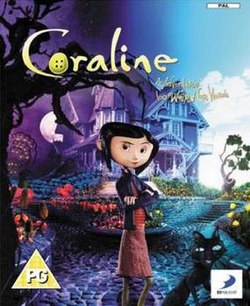

When a movie tie-in lands on your doorstep in the hopes that you'll buy the poster, the soundtrack and, if you squint, the game as well, a certain algebra of expectation begins to take shape. Coraline for PlayStation 2 arrives with all the trappings of a modern licensed project: a recent film to piggyback on, a studio with reasonable pedigree (Papaya Studio on the PS2/Wii builds), a publisher used to moving licensed boxes (D3 Publisher), and a marketing calendar synchronized to the movie's release. The game is faithful to the film's bare bones - Coraline Jones, bored and curious, discovers an Other World that seems perfect until it turns cold and hungry - but fidelity is a low bar. What matters is what the game does with that setting, whether it expands on the film's mood or simply repackages it into chores and token puzzles. As someone who still remembers reading magazines under dim lights while waiting for review code to arrive, I approached Coraline like any 1990s reviewer: skeptical, slightly caffeinated, and eager to see whether licensed games had finally learned how to be more than glorified activity books. The short answer: not yet.
Call it what it is: Coraline on PS2 is a mini-game parade dressed up as an adventure. The structure is almost defiantly unambitious - progress your way through a sequence of short tasks and mini-puzzles that move you from scene to scene in service of the film's plot. You help Coraline move boxes for her parents, fetch apples for neighbors, and complete simple environmental riddles. If you've ever filled in a magazine's activity section for two hours and felt vaguely accomplished, the sensation is the same here. The backbone of the gameplay is a string of discrete goals, each one thin enough to fit comfortably into a five- to ten-minute play session. Papaya Studio uses these micro-assignments to gate narrative beats: finish this chore, and you get a cutscene; collect enough objects, and a door opens. Theoretically this structure can emulate the episodic nature of Coraline's journey: a mysterious discovery, a small triumph, a deeper mystery. In practice the odds of noticing any meaningful dramatic escalation are slim. The mini-games are not designed to teach you anything new or to build on previous mechanics; they are slightly different flavors of busywork, recycled until the economy of variety runs dry. Controls on the PS2 build are serviceable but rarely inspiring. Coraline runs, jumps and interacts with items in a manner that recalls the simpler 3D platform-adventures of the turn of the century - except without the charm or polish that carried those older titles. The camera is the game's other frequent antagonist. It slides and snaps as you move through rooms and corridors, sometimes providing a cinematic angle but often leaving you wrestling to align jumps or identify an interactable object. When a game's puzzles are tiny and its navigation awkward, frustration replaces curiosity in short order. The game uses the Havok engine for physics, which on paper suggests the possibility of dynamic interactions. In practice Havok here mainly shows up as the occasional jitter when props wobble or tumble; the engine's promise of emergent moments is rarely seized. Enemies are minimal and the threats are more environmental than antagonistic. The Cat, one of the film's memorable presences and voiced by Keith David in both mediums, appears with a similar aloofness but without the sly animation cues that made the movie's feline so compelling. The voice work is a mixed asset. Dakota Fanning reprises Coraline and lends her voice the film's weary curiosity, and Robert Bailey Jr. returns as Wybie; the presence of these original actors helps at moments to recover the game's mood. Most of the remaining cast are replaced by capable TV and animation actors who do what is required but rarely lift the words off the script. Mark Watters' score, recorded and mixed at reputable studios, tries to stitch atmosphere across the mini-game seams but sometimes feels like background wallpaper - pleasant, professionally produced, and ultimately forgettable. Where Coraline stumbles hardest is in its design philosophy. The film thrives on atmosphere - stop-motion textures, slow dread, sudden visual filigree. The game treats fear like a quantity you can meter into a level: sprinkle some shadows here, a button-eye there, and call it eerie. It underestimates pacing. A great adventure balances exploration, puzzle-solving and narrative reward; Coraline too often substitutes one for the other. The result is a short, repetitive experience that alternates between being trivially easy and oddly opaque. Common Sense Media's observation that the game can be too hard for adults while seeming incomplete is a fair shorthand for the unevenness. If you want satisfying brain-teasers or the sense of solving a cleverly stacked gauntlet, look elsewhere. If, however, you are a collector of licensed curios or a parent seeking a brief Coraline-flavored diversion for a younger player, there are worse ways to spend a long afternoon.
Graphically Coraline on the PS2 aims for a stylized echo of the film's aesthetic but arrives like an imitation with memory loss. Character models have the silhouette of the stop-motion originals but lack the tactile surface detail and subtle deformities that made the movie's visuals uncanny and alive. Textures are flat in close-up, and the PS2's limited palette shows in washed-out surfaces and occasionally muddy lighting. There are moments - a carefully framed bedroom or a doorway into the Other World - where the game hits the right tone; those are the shots where the art team has leaned on composition, color contrast, and careful camera work. More often, you'll find characters behaving like plastic toys under a desk lamp. Animation is competent but uninspired. Gestures are clipped and repetitive; Coraline's walk cycle, for instance, lacks the tiny personality ticks the film's animators used to tell us everything about the character without words. Cutscenes exist to bridge the main beats, but they feel like storyboards come to life at half-speed. The Cat and Wybie get better-than-average modeling, but the supporting NPCs drift into the uncanny valley of rigid smiles and slow blinks. Performance-wise, the PS2 struggles with frame-rate drops when several dynamic objects appear on screen at once, which runs counter to the game's minimal demands and leaves you wondering whether optimization was sacrificed for expediency. On the audio front, the score and the handful of original voice performances lift the atmosphere. The music is serviceable and, on a system where visual polish is limited, a strong soundtrack can do a lot of the heavy lifting. Dakota Fanning's Coraline gives the game credibility it would otherwise lack, and Keith David's cat voice is a welcome seasoning. Still, sound design is not a substitute for mechanical depth; good music can make a short walk feel cinematic, but it won't hide a paucity of meaningful interaction.
This is the kind of licensed experiment that, in the 1990s, might have earned a polite shrug and a 'try-before-you-buy' sticker on the magazine cover. Coraline for PlayStation 2 is neither a faithful expansion of the film's narrative world nor a strong, standalone adventure. It occupies an awkward middle ground: too simple for adults seeking a substantive puzzle-driven experience, too uneven and thematically thin to serve as a genuine introduction to the film's atmosphere for newcomers. The mini-games are competent at the level of 'I've seen this before,' the controls are serviceable but hampered by camera issues, and the graphics, while occasionally evocative, rarely convey the tactile beauty of the stop-motion original. There are redeeming qualities. The inclusion of Dakota Fanning, Keith David and Robert Bailey Jr. on the VO roster lends authenticity. Mark Watters' score and some well-composed scenes demonstrate that the developers had an eye for the film's palette. For parents looking for a short, licensed diversion for younger players or for completists who collect every piece of a movie's merchandise, Coraline is a tolerable rental or a cheap acquisition. For anyone expecting the game equivalent of the film's inventive darkness and character, it is a disappointment. As a reviewer who remembers the 90s habit of grading games with a mix of empathy and strictness, I find Coraline on PS2 deserving of the low marks reviewers and aggregators assigned at release. It is not a broken product; it is a cautious one - conservative in design, safe in its ambitions, and ultimately forgettable. Score: 3.9 out of 10. If you're curious about Coraline's world, go watch the film, then come back and play the game only if you need a PS2-era curiosity to round out a collection.
 One Piece Grand Adventure on PS2
 Taiko no Tatsujin: Dokodon! Mystery Adventure on Switch
 Taiko no Tatsujin: Don to Katsu no Jikū Daibōken on Switch












 Another SquareThought Site