

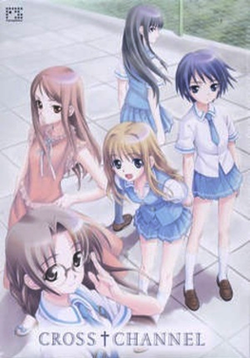

Cross Channel is the kind of visual novel that smiles politely, hands you a bicycle helmet, and then repeatedly runs you into a brick wall to teach you something about human connection. The PS2 subtitled 'To All People' is the console's embrace of Flying Shine's original 2003 Windows oddity: a darkly comic, emotionally abrasive study of a group of misfit teenagers trapped in a deserted city and, more crucially, trapped in themselves. At surface level it's a premise ripe for genre tropes - deserted town, repeating week, broadcasting club antenna to find survivors - but what lifts Cross Channel from weird curio to something like emotional therapy disguised as entertainment is its characters. This review focuses less on 'what you do' and more on 'who you are' while playing: Taichi Kurosu and the broadcasting club form a miniature sociology department of damaged people, each carrying a thesis statement on loneliness and adaptation. The PS2 port keeps the novel's core intact and delivers that thesis with Matsuryu's character art and Romeo Tanaka's script at its center.
Cross Channel is a visual novel in the most literal sense: you read, you choose, and you watch relationships rearrange themselves. Unlike action games where skills improve, the game's conceit is that the world resets - the same week loops over and over, and actions leave no permanent mark on the timeline. This is not just a mechanical quirk, it's a narrative hammer. The game forces you to confront the meaning of your choices in a setting where 'permanent consequences' are stripped away, exposing the raw human motives that remain: boredom, attachment, cruelty, love, and the desperate timesaving of self-preservation. From a systems perspective the PS2 'To All People' port presents branching narrative routes grounded in character routes typical of the visual-novel format. You steer Taichi's decisions and thus open or close doors to private conversations and route-specific confessions. But because of the repeating-week rule, the psychological payoff is richer: a single guess or misstep might lead Taichi to a scene of reconciliation one loop and to another loop's self-sabotage the next. The gameplay becomes a kind of psychiatric lab; the player is both observer and experimenter. Your choices feel weighty, paradoxically, precisely because the external world won't remember them. The weight is carried by people. The broadcast-antenna plot device gives the club a tangible objective - signal for survivors - but the real gameplay is in thawing frozen interpersonal dynamics. Taichi is formally introduced as a self-styled 'Love Aristocrat' and an outsized personality hiding a disturbing adaptation coefficient of 84 percent, which in Cross Channel's taxonomy means he's nearly beyond human boundaries. Playing as someone who calls himself a romantic while being flagged by the state as 'ill-adapted' is deliciously twisted: the player's task is to manage Taichi's performative bravado while peeling back his armor. The other club members are not merely romance options; they are mirrors that reflect Taichi's failures and, occasionally, his potential for repair. The routes explore how each character responds to isolation. With Miki you see a bright, sometimes cruel, form of attention-seeking; with Kiri you navigate fear and mistrust that must be coaxed into something resembling trust; with Misato the arc is about self-destruction and a fractured family history; with Touko the narrative pulses with pride, shame, and a samurai's attempt to hold onto her humanity; Youko's devotion to Taichi is at once affectionate and suffocating; Nanaka is the wildcard who crashes into scenes - literally - and forces other characters to react. The game encourages repeated playthroughs to chase the different emotional outcomes, and the lack of permanent progression is the point: Cross Channel wants you to witness how people change under scrutiny, not how a save file stacks up. For players who expect tidy 'fix the girl' storylines, Cross Channel can be unsettling. It's not a serviceable romance factory. Instead it offers arcs where 'healing' is ambiguous and sometimes cyclical. The PS2 port respects this by preserving route ambiguity and narrative cruelty. The antenna attempts, the repeated attempts to call the outside world - these are gameplay beats that function as punctuation marks in character arcs rather than as traditional quest completion markers. In short: the gameplay is brutal but brilliant in how it uses repetitive mechanics to highlight emotional consequence.
Art direction is by Matsuryu, and the PS2 faithfully transfers the character portraits and backgrounds in a style that is both mid-2000s anime and surprisingly personal. The character sprites are expressive without relying only on exaggerated faces; subtle shifts in eyes, posture, and clothing communicate the tiny betrayals and softening that the script asks of the characters. The deserted city backdrops lean into the uncanny: empty streets, silent plazas, and the broadcasting clubroom become stages for emotional monologues. On PS2 this looks like a game that knows its medium's limits and uses them: no realistic 3D spectacle, just composed 2D frames that let dialogue and expression do the heavy lifting. The muted color palette emphasizes loneliness and the occasional splash of color in Miki or Nanaka's appearances feels almost rude in how much it demands attention. If you play expecting high-resolution modern visual-novel polish, you'll find the PS2 presentation dated. But the art's strength isn't in technical fidelity, it's in intention. Matsuryu's designs give each character a silhouette and a shorthand. Touko's samurai austerity, Youko's watchful ninja posture, Misato's introverted precision behind glasses - those visual cues are used to enhance the arcs rather than to distract from them. The PS2 audio is competent; music and voice snippets (if present in your version) underline key moments more than they dictate mood. For a narrative so obsessed with repetition, the graphics and sound create a consistent emotional architecture you can inhabit across loops.
Cross Channel: To All People on PS2 is not an easy watch, and that's precisely why it sticks with you. The game uses a Groundhog-Day setup to ask a simple, terrifying question: if the world forgets, what keeps people from choosing loneliness? Taichi Kurosu starts as an irritating, cocky narrator who calls himself the 'Love Aristocrat' but is secretly flagged by the state as someone on the wrong side of adaptation. His arc is the backbone: we watch a man who performs humanity while being told by an objective metric that he's almost inhuman. That contradiction generates the novel's most powerful scenes - where the bravado slips and you see the scared, tired human underneath. Each supporting member of the broadcasting club functions as a facet of Taichi's own damaged reflection. Miki oscillates between charm and cruelty, a survivor who learned attention is a currency and spends it freely; her arc is about whether playfulness can cover a deeper emptiness. Kiri's arc is a slow, painful thaw from fear and distrust toward fragile reliance. Misato is the game's wound - her self-destructive behavior and fractured family history give her scenes that are both heartbreaking and raw; the antenna and the attempts to reach the outside world are as much about calling to her missing brother as they are about calling for rescue. Touko's samurai pride masks panic; her arc is about reconciling dignity with the necessity of dependence. Youko's stalking devotion challenges the player to question where protection ends and ownership begins. Nanaka is the narrative catalyst, a chaotic agent who forces everyone to move. The repeating week mechanic makes every attempt at connection both urgent and absurdly fragile, and the game refuses to hand you clean answers. If you like your character studies served with a side of existential black humor and a strong dose of ambiguity, Cross Channel is a masterclass. The PS2 port is a great way to experience this particular edition - it retains the game's core voice and character focus while delivering the art and presentation appropriate to the era. The game isn't for players seeking tidy resolutions or lighthearted dating-sim fluff. For those willing to sit in uncomfortable rooms with people who both hurt and need you, Cross Channel rewards with scenes that haunt. Final verdict: a challenging, darkly funny, and superbly written character study that uses repetitive mechanics to deepen emotional stakes. The PS2 'To All People' release is a fine entry point. Bring patience, empathy, and a willingness to replay painful decisions - you'll come away thinking about these people long after the week resets for the thousandth time.
 All-Star Baseball 2004 on PS2
 Sonic & Sega All-Stars Racing on DS
 Pachislot To Heart 2 on PS3
 Tomoyo After: It's a Wonderful Life on PS3
 Psycho-Pass: Mandatory Happiness on PS4
 Punch Line on PS4












 Another SquareThought Site