

 Aug 2025
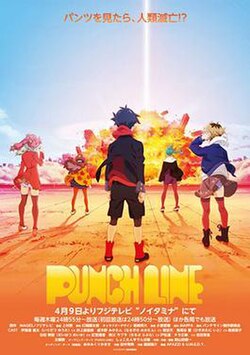

Reading the credits of Punch Line's anime felt a bit like finding an unlabelled VHS in a rental store's deep bin - you know something odd and bristling with personality is inside, and you are both intrigued and faintly worried for your sensibilities. The PlayStation 4 adaptation, developed by 5pb., dresses that same oddness in the relatively sober clothing of the visual novel: long stretches of text with fully voiced performances, branching choices, and just enough adventure elements to stop it being a static slideshow. If you remember the golden era of late-night console releases - where developers still felt free to marry oddball Japanese humor to convoluted sci-fi plot mechanics - Punch Line feels like a time capsule opened in a museum wing labelled 'Delightfully Unhinged.' Kotaro Uchikoshi, the writer responsible for the twist-happy Zero Escape series, returns to pen the game's scripts and the project's DNA: time loops, identity cross-dressing, and the world's fate hinging on whether a man sees panties twice in quick succession. It is both the game's greatest selling point and its most obvious gatekeeper.
Punch Line on PS4 plays exactly like a visual novel with occasional detours into light adventure-game mechanics. Expect long, carefully written scenes with character portraits and background art while a narrator or a cast member reads you through the grotesquely comic, occasionally sincere machinations of Yūta Iridatsu and his housemates. Yūta's premise - his soul has been popped out of his body after a bus hijacking, he can possess people, cinnamon grants possession bonuses, and panty-viewing causes an Über-fy surge that, if repeated, detonates a meteor into Earth - might be a sentence you would have bet the mid-1990s gaming press would never see printed next to 'family-friendly' and 'adventure.' The game leans heavily on this premise for jokes, stakes, and repeated time-loop set pieces. As with most Uchikoshi works, choices matter. The narrative branches and folds back on itself, and the game expands the anime's beaten path with new scenarios and alternative endings, offering both fan-service payoffs and explanatory beats for the anime's looser corners. Your choices steer which iterations of the time loop you inhabit, and slowly the knots in the story unwind - or retie themselves, depending on how stubborn you are about pressing the wrong dialogue option because you want to see the characters say something outrageous. Unlike pure kinetic novels, Punch Line occasionally asks you to explore small rooms, pick up items, and talk to characters to unlock different branches; these are light, serviceable diversions rather than puzzles that will make you send a letter to a strategy guide company. The game is fully voiced by much of the anime's original cast, which elevates otherwise indulgent exposition into full-blooded performances. Uchikoshi's fingerprints are all over the structure: reveals and rewinds are delivered at a clip that makes you admire, begrudgingly, the architect of the plot even while you're reaching for a cigarette that you do not smoke. For newcomers, the script can be dense and the premise squeamish; for those who loved the anime, the extra branches, alternate outcomes, and the chance to see characters' private moments again are the reason to invest. The biggest gameplay complaint from a conventional gamer's perspective is obvious: interaction is thin. Choices are meaningful but infrequent and the adventure bits never evolve into anything approaching a mechanical system. This is not a fault if you buy the game as a story-first experience, but it is a flaw if you expected the PS4 to be used as a vehicle for more dynamic play.
If you are buying Punch Line on PS4 for a graphical revolution, lower your expectations and raise your admiration for fidelity to source material. The game uses art assets faithful to the anime's character designs by Shōta Iwasaki and recycles background illustrations and CGs with care. On a big-screen television the sprites, CGs and event illustrations hold up well; they are clean, colourful and expressive in the way a 2D-dominated product of the mid-2010s ought to be. There is no attempt to pretend this is anything but a visual novel: you will not find real-time 3D traversal or dramatic boss screens rendered in engine. Instead what you receive is animation-friendly artwork, a heavy reliance on static poses, and a handful of animated sequences that feel like someone's nostalgia for the '90s OVA market. The presentation benefits enormously from the robust, studio-quality voice acting and the soundtrack; Tetsuya Komuro reprises his role as composer and provides cues that oscillate between pop flare and the slightly ominous synth undertone the premise requires. On PS4 the visual fidelity is clean and the interface is comfortably modern - large text boxes, save slots that respect the visual-novel player's compulsive need to save before choices, and fast-forward options that acknowledge you will be replaying the same scenes to chase alternate branches. The package is not indulgent in terms of environmental variety, and if you hoped the port would add galleries, art books, or an accompanying DLC novella to bulk up the experience feel, the base game is reasonably lean. Still, the art direction is accurate to the anime and the PS4 elevates fidelity over frills: smooth fonts, crisp character portraits and a UI designed for the couch rather than the handheld. That choice makes perfect sense for a title which is more interested in performance and reading comfort than in flexing polygons.
Punch Line for PS4 occupies a small, peculiar corner of the modern catalogue: it is a visual novel by taste and temperament, dressed up in the trappings of an adventure and powered by a writer whose favourite hobby is plotting locked rooms for emotions. For players who enjoyed the anime or who are already devotees of Uchikoshi's twist-crammed narratives, the game is a welcome expansion - a chance to revisit characters, catch previously skimmed-over details, and chase several satisfyingly bonkers alternative endings. The presence of the original voice cast, the return of Komuro's music and the commitment to the anime's tone make it a faithful and competent adaptation. If you judge games by how many systems they stack or how long they ask you to press a button for small victories, Punch Line will feel insubstantial. The gameplay is light, interactivity is limited, and the subject matter will close doors for players uncomfortable with broad sexual-comedy tropes. This is a title that asks you to buy into its joke - a man that seeing panties twice obliterates the planet - and then rewards you for staying to see how wildly the joke can bend into a serious emotional reveal. My final score of 7/10 sits with the kind of pragmatic, gradesheet-minded conclusion a reviewer from the 1990s would give a product that is not a universal recommendation but is undeniably interesting: it does exactly what it promises, better than some, worse than others, and with a flair that will leave a distinct memory. For fans: pick it up and savour the branching routes. For the merely curious: rent it, take it for a weekend, and brace yourself for one of the oddest, most author-driven visual novels you can buy on PS4.
 Punch Club on PS4
 Railfan: Chicago Transit Authority Brown Line on PS3
 Tintin: Destination Adventure on PlayStation
 One Piece Grand Adventure on PS2
 Taiko no Tatsujin: Don to Katsu no Jikū Daibōken on Switch
 Taiko no Tatsujin: Dokodon! Mystery Adventure on Switch
 Memories Off Historia Vol. 1 on PS4
 Memories Off 6: Next Relation on PS2
 Memories Off Historia Vol. 2 on PS4
 Robotics;Notes Elite on Switch
 Dunamis 15 on PS3










 Another SquareThought Site