

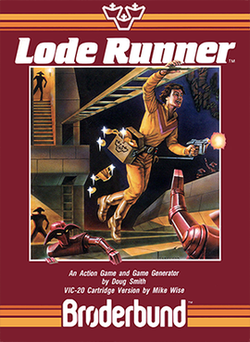

There is a particular gravity to certain game names; they arrive complete with a history, a patent groove in the public imagination. Lode Runner is one of those names. First appearing in 1983 as a two-dimensional exercise in digging, timing and fiendishly polite enemy AI, it became the sort of title that turns up in feature boxes and margin notes of gaming history. Cubic Lode Runner is Hudson Soft's attempt to take that old, beloved pickaxe and poke it into the third dimension. The result is neither a revolution nor a betrayal; it is instead the work of a studio trying to translate a delicately balanced 2D puzzle engine into a cubist sandbox. For collectors, fans of the series and the patient puzzle-minded player, this PS2-only Japanese release performs a very specific, very respectable trick: it asks the old questions anew, and it expects you to provide the old answers with 3D spatial reasoning added for seasoning.
At its heart Cubic Lode Runner remains faithful to the Lode Runner doctrine: collect the loot, avoid the guards, and use the environment as your primary means of offense and defense. The classic rules are present in spirit if not always in exact phrasing. The player is still a runner, not a jumper; digging is the mechanic that both makes progress possible and invites disaster. Where the modern reinterpretation must work hardest is on the question that has tormented every designer who ever tried to lift a 2D puzzle game into 3D: how do you keep the cleverness of the original without letting the camera, perspective or extra axis turn every puzzle into a muddled mess? Cubic Lode Runner answers that question by reimagining the familiar brick-and-ladder motif as an arrangement of cubic volumes, staircases and ledges. The logic of holes and temporary traps carries over: traps are still temporary, holes still refill, and guards still pursue with the idiosyncratic, sometimes seemingly repellant AI that defined the original title. The Wikipedia account of Lode Runner explains how mastering the game involved learning the personalities of the guards, how they sometimes move away from the player depending on ladder positioning, and how you could use contact rules to stand on a guard's head while falling. Those oddities survive in Cubic, and they are welcome. They make for puzzles that are less about twitchy reflexes and more about prediction, timing and positional shenanigans. The transition to three dimensions forces a change in puzzle design. In the 2D original a single screen could be read at a glance; the routes, dead ends and one-way traversal orders were immediately legible. In the cubic world, rooms become multi-level mazes whose routes must be considered in three planes. This is where the remake earns its keep: several stages cleverly exploit verticality to force the player to think in depth rather than just width. Traversal orders remain crucial. There are sections where a misordered collection means a piece of gold becomes unreachable without coercing a guard into retrieving it and becoming trapped, a classic Lode Runner trick. There are also time-sensitive sequences where you must dig and re-dig, passing through tiles that repair themselves in a narrow window. The added dimension increases the cognitive load, but in the better levels that is precisely the point. Hudson Soft has a history of adding small flourishes to Lode Runner ports: the Famicom version, for example, introduced music, scrolling screens and a more cartoon-like look. Cubic follows that tradition with modest enhancements rather than radical changes. There is a strictness to the rules: the player cannot climb out of a hole by him or herself, the guards pick up gold and can carry at most one bar at a time, and holes still refill on a short timer. These constraints preserve the original game’s delicious cruelty. If anything, the 3D setting amplifies the sense of doing something clever and then immediately regretting it when the environment reasserts itself. Controls are serviceable. For those who cut their teeth on the haste-and-precision of the Apple II and Commodore variants, the PS2 pad is an accommodating interface, offering precise lateral movement, stair transitions and digging inputs. The camera, inevitably, is the weak spot of almost any 3D reinterpretation. There are moments when the camera insists on showing you a sculptural angle rather than a tactical one, and a few puzzles feel punishing not because they are unfair but because the view obscures the neat line that solves them. Still, these instances are more annoyance than fatal flaw. For a game that rewards mental maps more than muscle memory, an occasional opaque view is an irritant, not a death knell. Level design leans on the franchise’s strengths. Lode Runner has always been notable for its emphasis on strategy over violence and for the delight of the level editor, which allowed players to become creators. Cubic Lode Runner is presented as part of that legacy: the cube aesthetic is used to craft 3D puzzles that nod at the original 150 levels while offering new spatial riddles. The designers understand that the essence of a good Lode Runner level is in the forced choices â€" whether to trap a guard, use a falling enemy as a bridge, or coax an enemy into an otherwise sealed-off alcove. Those choices remain the core pleasures here. The difficulty curve is steady, occasionally abrupt, and generally fair. Veteran players will find familiar solutions in unfamiliar geometry; newcomers will need to learn how the 3D space changes the timing and tactics of digging and evasion. Where Cubic falters is in ambition and scope. It is not a comprehensive reimagining, and it does not attempt to fix the series’ old problem of self-inflicted dead ends. The game still allows traps that will doom you if you misjudge a refill, and while losing a life and restarting the level is part of the classic formula, it occasionally feels like the designers had a fondness for the old cruelty that borders on stubbornness. Multiplayer, if present in some versions of the series, is not the point here; this is a single-player workout, a meditation on level geometry and guard psychology.
Given Hudson Soft’s pedigree with earlier ports, Cubic Lode Runner takes a tasteful, conservative approach to visuals. The cube motif is literal and functional: levels are composed of blocky volumes that read clearly on a TV screen. This is not a game aiming to show off PS2 muscle; rather, it uses three-dimensional space to communicate puzzle information. The art direction favors utility over flash. Surfaces are clean, the color palette is readable, and enemies animate with the sort of slightly silly personality that carries over from the Famicom and later incarnations. Textures and lighting are unremarkable by console standards of the early 2000s, but they are entirely adequate for the job. What matters most in a Lode Runner game is legibility, and Cubic keeps the important things visible: ledges, ladders, refill timers and the position of gold. Animation is economical, and the guards retain that twitchy, semi-predictable gait that makes them useful puzzle pieces rather than mere nuisances. Sound and music follow a similar brief. There is background music that nods to the series’ arcade lineage, and simple sound cues underline digging and collection actions. These elements do not sing, but they keep good time with the puzzles. The occasional camera tilt and occlusion problem, mentioned earlier, is a graphics-adjacent issue. A more dynamic camera could have resulted in cinematic flair, but a camera that gets in the way of puzzle reading would be a worse sin. Overall, the aesthetic is pragmatic: it gives the player exactly what they need to solve a room, and nothing more. For players who expect glossy PS2 spectacle, this will feel modest. For purists and puzzle fans, the clarity of presentation is a virtue.
Cubic Lode Runner is the kind of game that will not be loudly celebrated in the pages of a trend-chasing magazine, but it will be quietly adored by the players who prize precise design and conceptual continuity. It does what so many modern remakes forget to do: it preserves the rules that made the original clever and then asks what those rules look like in a new spatial register. The result is a competent, occasionally brilliant 3D reworking that keeps the intellectual playfulness of the 1983 original intact. The PS2 release, limited to Japan, makes the title a gem for collectors and a curiosity for completionists. Its adherence to Lode Runner’s original mechanics, its readable cube-based presentation and its array of puzzles mean that buying this game is buying a particular experience, not the latest audiovisual parade. The score reflects that focus: a solid 7.5 out of 10. This is a game for people who like to sit with a puzzle, trace the guard’s likely route with their eyes, dig a hole with cold intent and then hold their breath while the level mends itself. If that sounds like your idea of a good evening, Cubic Lode Runner is worth the import fee and the patience; if you crave spectacle, you will find this decidedly old-fashioned, and deliberately so. In either case, it is an honest homage to a small masterpiece of game design.
 Lode Runner 2 on PlayStation
 Lode Runner: The Legend Returns on PlayStation
 Puzzle by Nikoli 4: on PS4
 Professor Layton and the Last Specter on DS
 Puzzle Kingdoms on DS
 Puzzle de Harvest Moon on DS
 Bloody Roar on PlayStation
 Bomberman Wars on PlayStation
 Bomberman World on PlayStation
 Lode Runner on DS
 Lost in Blue on DS












 Another SquareThought Site