



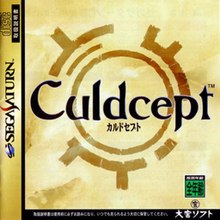
For the uninitiated, Culdcept arrives looking like a stern brief to the strategic part of your brain, wrapped in card sleeves and delivered with the polite but inexorable thump of a dice cup. It is not a role‑playing game, nor a straight collectible card sim, nor even a board game in the conventional family‑room sense. It is, rather, a blend - a careful and occasionally maddening alloy of Monopoly's property jockeying and Magic: The Gathering's deck‑woven temperament. Originating in the late 1990s and refined through several ports and expansions, the PlayStation 2 incarnation is essentially the western introduction to the material: a PS2 release built on Culdcept Second's balance and content, packaged for markets that had largely forgotten how much fun economics and RNG can be when dressed up in dragons and arcane law. The tone of evaluation here will be old school: measured, a little pedantic, and entirely unforgiving of games that promise depth and then skimp on clarity. Culdcept keeps its promises. It offers layers of strategy that reward patience and a penurious fondness for spreadsheets of magical power. It is also an indulgence: games are long, luck barges through the door whenever dice are rolled, and there are times when your well‑constructed strategy is rendered moot by a single poorly timed card draw. For the serious strategist with a tolerance for caprice, this is an odd, intoxicating treat; for the casual player seeking instant gratification, it will feel like being asked to read an encyclopedia while someone keeps moving the page numbers.
The central conceit of Culdcept is one that rewards both foresight and improvisation. You construct a deck of 50 cards - monsters, items, and spells - and then you traverse a modular board whose squares host elemental affiliations and special effects. Each turn begins with a dice roll that propels your Cepter across the map; what follows is a sequence of decisions that feels less like playing a video game and more like adjudicating a small, discreet war of possessions. Land on an unoccupied square and you can summon a monster to claim it, thereby converting raw land into revenue - or, in the game's preferred terminology, magical power. That power is the currency of upgrades: level a square up and its magical income increases, much as building houses and hotels multiplies rent on Boardwalk and Park Place. Land already occupied? You may challenge the occupying monster to battle; win and you seize control, lose and pay the toll. Alternatively, if you prefer to avoid the dicey business of combat, you can pay the toll directly as a kind of economic surrender. Battles are not the paper‑scissors routine of simpler board games. They are fought by summoning creatures and deploying spells that modify, buff, or outright sabotage opponents' fighters. The strength of a monster comes from its base stats, the reinforcement of items, and the strategic timing of spells; this is where the card game DNA becomes unmistakable. Deck construction matters. A deck built around heavy, slow beasts will dominate once they land and begin to collect power, but getting them to their desired square across several dice rolls is an exercise in patience and luck. Conversely, decks rich in miniatures, removal spells, and movement manipulation are more fleet of foot and can react to the board state faster - at the cost of the crushing endgame presence. Story Mode hands out new cards as rewards, encouraging a sense of progression and the temptation to chase the perfect synergy. There is also a multiplayer component: PvP is a natural fit, and Culdcept's longest and best matches are those played against another human being who understands the small cruelties the game affords. The developers have attempted to balance accessibility with depth. Players are given tutorials and an in‑game economy to master card acquisition, but the learning curve is steep. Newcomers will find themselves bewildered by the strategic vocabulary - elemental affinities, power thresholds for upgrades, the significance of particular items - and will then be humbled by how a single lucky roll can upend a carefully planned turn. Luck is an explicit design choice rather than an oversight. Dice rolls determine movement; card draw decides options; and match length allows fortune to swing. Veteran players will tell you that Culdcept is a study in risk management: mitigate bad rolls by diversifying income sources, hedge against devastating spells by including counters, and never allow a single territory to become so valuable that its loss ends the game. Still, the specter of randomness cannot be entirely banished, and the game's critics - especially in Western press - have called this both frustrating and exhilarating. The experience can feel cruel when skill is rendered impotent by a low roll or an unlucky draw. It can feel sublime when a narrow gambit comes to fruition and you watch an opponent's empire collapse with the solemn dignity of falling dominos. Culdcept's AI is serviceable, sometimes pleasantly aggressive, and often inclined towards dramatic, last‑ditch plays that test the player's nerves. The card pool is deep for those who invest the time; the meta - when players begin to iterate and counteriteration becomes routine - is satisfying in a way that few hybrid titles manage. Matches are long; they reward concentration and punishingly reward mistakes. There are few instant thrills here, but a great many slow burns. If you enjoy plotting across dozens of turns and savor the small victories that compound into a final, decisive blow, Culdcept will repay you.
Graphically, the PlayStation 2 version is pragmatic rather than ostentatious. Culdcept wears its aesthetic like a well‑pressed suit: functional, tidy, and considerate of the player's attention span. The boards are clear and readable, with elemental tiles and iconography that communicate game state without forcing the player to squint at a manual. Monster art, whether rendered in sprite or low‑polygon 3D (the game moves between representational and illustrative during combat), is colorful and appropriately dramatic; the designs owe as much to classic trading‑card art as to the brighter, more whimsical JRPG creature galleries of the era. The game's UI is where the developers deserve particular praise. In a project with this many systems, information overload is a real hazard; Culdcept's menus, card descriptions, and combat overlays mostly avoid that fate. Important numbers are emphasized, costs are shown in context, and the distinctions between elemental effects are, by and large, explained. The presentation will not win any awards for pushing the PS2's hardware - particle effects are modest and animations are functional - but it also never lies to you. Everything on screen is there to facilitate the strategy, not to distract from it. On the audio front, the soundtrack is workmanlike and occasionally stirring. The series' broader history names composers like Yuzo Koshiro and Kenji Ito, the latter of whom became a recurring musical presence starting with Culdcept Second; for those who appreciate melodically driven JRPG scores, the themes here add a respectable gravitas. Sound effects are serviceable and help punctuate combat without becoming irritating. In short, the package is coherent: it looks like a board game, feels like a card game, and sounds like the sort of soundtrack you might find accompanying a mid‑length, strategy‑heavy console release of the early 2000s.
Culdcept on the PlayStation 2 is not an apology for its ambitions. It is a confident, sometimes forbidding hybrid that will delight those who habitually rearrange metaphorical furniture in search of more elegant strategies. It demands patience and a tolerance for the whims of dice and card draws; in return it offers a strategic richness rare in console releases of its period and a multiplayer experience that can become obsessively engaging. The criticisms leveled at the series - a steep learning curve, occasional frustrations born of luck, and a niche appeal - are not incorrect. They are, however, part of the bargain. For an audience that remembers reading strategy guides by candlelight or who prefers a slow, carefully constructed victory over immediate spectacle, Culdcept is a small masterpiece of design ethics: systems first, spectacle second. For those who want instant gratification, flashy graphics, and the soothing certainty of deterministic outcomes, it is likely to be maddening. I award it an 8 out of 10 because it accomplishes precisely what it sets out to do, with a clarity and integrity that are increasingly uncommon. It is a thinking player's board game, a collector's card game, and, if you will permit a remainder of old‑school hyperbole, a minor miracle that managed to squeeze a fully grown strategy title into the generous chassis of the PlayStation 2.
 Culdcept Expansion Plus on PlayStation
 Coloball 2002 on PS2
 Press Your Luck on PS3
 Trivial Pursuit on PS3
 One Piece: Pirates' Carnival on PS2












 Another SquareThought Site