

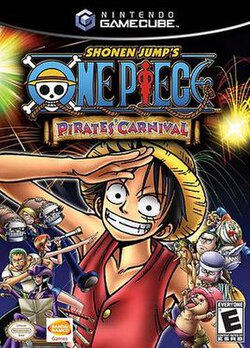

One Piece: Pirates' Carnival is a party-game spin of Eiichiro Oda's pirate epic that dresses up the Straw Hats and their rogues' gallery in minigames, board-game shenanigans, and enough personality to make a mermaid spit out her pearls. Developed by h.a.n.d. and released for PlayStation 2 (and GameCube), it stitches together over 30 minigames around a Reversi-like board mode where taking squares equals recruiting crew and supplementing your cash pile. The result is less an epic retelling of the manga and more a collection of character vignettes - bite-sized theatricalities where Luffy can gum-up a rhythm mini-game and Crocodile can act like a sandstorm with a vendetta. If you come expecting a narrative-driven One Piece campaign you will be disappointed; if you come for a party romp where each character gets a little spotlight to act like their anime selves in miniature, Pirates' Carnival mostly delivers. This review will examine how the playable micro-arcs and villain captain games translate the personalities and beats of One Piece into ludic moments, and whether those moments add up to anything resembling a proper carnival or a chaotic flea market.
Pirates' Carnival has two big mechanical ideas: the board-game mode and the Versus / minigame collection. The board itself is the game's clever connective tissue: dozens of panels laid out across five boards based on familiar One Piece locales - East Blue, Calm Belt to Alabasta, Skypiea, Water 7 and Longring Longland. Each panel is a promise. Event panels hand you properties, Mini-Game panels force a contest, and Captain panels set up the moment where the game's guest stars get to be dramatic. Win enough contests and your color spreads across the board, flipping tiles between rival colors like a pirate-themed game of Othello where the stakes are berries and bragging rights. Where this review wants to dig in is how characters are translated into gameplay beats. The game uses its mini and captain games to condense each character's temperament and key story motifs into a single task. Luffy, for example, is less a serialized hero and more a tornado of comedic chaos in Gum Gum Carnival. The rhythm-based game makes players listen for beats while avoiding Luffy's errant gumming attacks; the mechanic underlines his carefree unpredictability and the way everything around him becomes elastic under his will. It's not a chapter of adventure so much as a Luffy-flavored carnival ride - no depth, but unmistakably him. Zoro's representation in Thundering Swordplay leans into his stoic, bruiser persona. The slippery ring and the objective of knocking Zoro out of the ring turn his swordsmanship into a test of spatial dominance and resilience. He can defeat players and still remain a threat; the minigame captures the sense that facing Zoro is about endurance and tactics more than speed. Nami's Loguetown Treasure Chase is pure trickster: she is chased through streets and the prize is repeatedly stolen. The cat-and-mouse dynamic mirrors her resourcefulness and her tendency to be both foil and prize for those around her. Usopp's Defend Usopp Factory! turns his bluff-and-protect archetype into asymmetrical play: he's the central defender choosing doors to guard, relying on deception and timing. Sanji's Cooking Fighter plays like an absurd culinary duel that communicates his culinary pride and protective streak; players steal plates while Sanji's attempts to feed Patty act as a ticking-pressure objective, which mirrors his tendency to serve and defend with flair. Tony Tony Chopper's Wave the Pirate Flag! models his cuteness and innocence as a gameplay mechanic where the creature must place flags on seven castle sections while players try to steal them - it is adorable, it is strategic, and it uses his non-threatening presence to create tension. Robin's Ancient Ruin Mystery reduces her cryptic intellect into a competition of treasure hauling versus deciphering poneglyphs, a clever abstraction of the manga's long-running tension between archaeology and acquisitiveness. Each Straw Hat game is an encapsulated character beat: delightful for the fan who wants to see the crew distilled into a single joke or mechanical motif. The captain games are where the villains show their teeth and the game stretches into spectacle. These minigames often turn the antagonist into environmental hazard and antagonist-in-chief at once: Buggy's Chop-Chop Festival has players stepping on different parts of his enormous body while cannonballs rain - he can berserk and the stage becomes a slapstick battlefield that conveys his clownish, destructive threat. Kuro's Cat Out of the Bag becomes a yard where illusions and hypnosis are threats; Don Krieg's Beware the MH5! turns seamanship into a survival test under poison gas with spears and bombs - it captures Krieg's militaristic menace as a hazardous platforming gauntlet. Crocodile's Sand Trap literally weaponizes his signature motif, with water guns and sandstorms making his presence feel unavoidable and thematic. Wapol turns his greed into a monstrous, revolving hazard where hitting his heart is a focal point; when he devours players the game telegraphs his gluttony as a resource-driven threat. Even Enel, with his Light the Shandorian Fire! minigame, becomes a storm of literal lightning attacks, the game's designers wisely mapping his devastating god complex into telegraphed but unavoidable attacks. What this means for fans: the game rarely has the patience for long, winding arcs, but it often nails the emotional shorthand. A fight with Crocodile does not replay Alabasta's politics, but the sandbox of his minigame feels tonally correct. The Davy Back Fight-inspired contests, the Straw Hat members' games, and the captain panels act like skits - each one is a micro-episode with a beginning, a mechanical middle, and a punchline. That format is well-suited to party play: you do not need to follow a complex plot to cheer when Luffy knocks someone off the stage or sigh when Robin solves a poneglyph puzzle faster than you can steal 100,000 berries. Mechanically, the board game gives context and progression. Winning minigames grants money and panels, and owning panels yields passive income. The interplay - uncover panel, risk a minigame, possibly recruit a square - creates enough strategy to keep matches engaging. However, the document notes that the American release trimmed content beyond Skypiea and altered the soundtrack because the western anime had not progressed as far and the American localization used different theme songs; these decisions truncate the game's potential as a complete One Piece experience for Western players, effectively cutting a few later-character beats from the carnival lineup. All told, the gameplay is best consumed in short bursts with friends. Solo players can play, but the charm is social: so many of these mini-arcs land purely because other humans cheer at the chaos.
The Wikipedia-sourced documentation does not dive deep into polygon counts or texture budgets, so any comments here are about style and faithfulness rather than technical minutiae. Pirates' Carnival deliberately leans on the anime's recognizable silhouettes: the Going Merry, Drum Island snows, and the grandiosity of Skypiea function as backdrops more than photoreal setpieces. The minigames are designed to foreground readable, colorful stages where each character's presence is immediately legible. This is a moral choice as much as an aesthetic one: clear visuals mean players can quickly parse threats and targets in frantic four-player minigames. One notable localization quirk that affects presentation is the soundtrack. The Japanese version uses the opening Map of the Heart during the introduction; North American versions replaced some elements because the western anime localization did not use the original themes. That switch affects the emotive kick some players feel when the game starts - you either get the anime theme that pumps nostalgia or you get a replacement that still does the job but with slightly less soul. In short, the game's visual language is serviceable and faithful to the source material, trading fidelity for readability and cartoony charm. For a party game whose goal is quick recognition and frantic fun, that is mostly the right call, even if the package feels more like a fan product than a production designed to win awards for graphics.
One Piece: Pirates' Carnival is a swarm of character vignettes wearing a party-game costume. It rarely aspires to be a narrative retelling and instead offers micro-arcs - Luffy's chaotic gumming, Zoro's endurance, Nami's trickery, Crocodile's sandstorm tyranny - that capture personality rather than plot. For fans who love seeing the Straw Hats compressed into a dozen clever minigame premises, the title is a warm, silly buffet of recognition. For players seeking a cohesive story or polished competitive systems, the game can feel shallow and a little scattershot. Critics' scores reflect that split: mixed-to-negative reception overall, with Metacritic hovering in the high 40s for the console versions. My score lands in the middle of that range: this is a competent, occasionally delightful party game that works best in a noisy living room full of friends and ramen. If you own a PS2, a few controllers, and a soft spot for One Piece's cast, Pirates' Carnival is worth a rental or a cheap purchase - just don't expect to relive Longring Longland's long-form drama here. Instead, enjoy the condensed, candy-colored snapshots of characters you already love, and let the carnival's chaos remind you why you became a fan in the first place.
 Microsoft Xbox One
 From TV Animation - One Piece: Grand Battle! 2 on PlayStation
 Super Mario Party Jamboree – Nintendo Switch 2 Edition + Jamboree TV on Switch 2
 Trivial Pursuit on PS3
 Rabbids: Party of Legends on Switch
 The Jackbox Party Starter on Switch
 Kingdom Hearts 358/2 Days on DS
 Disney Magical World 2: Enchanted Edition on Switch
 Active Life: Outdoor Challenge on Switch
 Kingdom Hearts Re:coded on DS












 Another SquareThought Site