

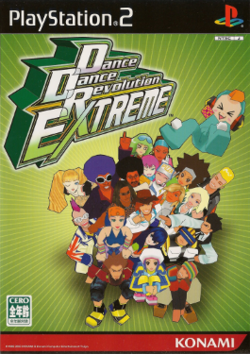

If you grew up in the era when arcades smelled like sticky quarters and fluorescent trainers, the Dance Dance Revolution series felt like a law of nature: step on arrows, not on social decorum. The PlayStation 2 era of DDR is where the series tightened its engineering and packed weird, ambitious features into two-button-to-the-left, two-button-to-the-right gameplay. Dance Dance Revolution Party Collection is often remembered as the outgoing party animal - it featured a hefty roster (58 unlockable characters is a ridiculous flex for a rhythm game) and set the stage for the more technically ambitious DDR Extreme ports that followed on PS2. This review looks under the rubberised tiles: input timing, mode plumbing, peripheral integration, and how the PS2 handles a game whose soul came from a Bemani System 573 arcade board. Consider this the kind of review a rhythm-game nerd writes while taping a dance-pad to their living-room carpet and blaming latency for every failed full combo.
At its mechanical core, Party Collection - and the PS2-era DDR lineage it lives in - is deceptively simple: a stream of timed notes scroll toward fixed receptors; you step when they align. Where things get interesting is in the plumbing behind that simplicity. The engine inherited from the Bemani lineage supports multiple timing windows, graded scoring, several play modes, and dynamic life-gauge behaviors that all interact to produce a very different player experience depending on difficulty and mode. Timing windows and judgments are the first place engineers and competitive players focus. The PS2-era titles refined the judgment set beyond Good/Perfect/fail: there is an explicit Perfect window, and subsequent titles introduced an even stricter "Marvelous" timing for pinpoint accuracy. On arcade hardware Marvelous was gated to certain modes, but fan projects later back-ported it across modes on the same engine by adjusting internal timing thresholds. On PS2, the way these windows are exposed in the UI and how lenient the default calibration is will make or break a player who cares about consistent timing. Practically speaking: if your TV introduces frame-delay or your dance pad has input debounce longer than a few milliseconds, the game's tighter windows will punish you. The game lets beginners circumvent this with Beginner mode, which replaces flashy backgrounds with an on-screen dancer that mirrors steps - a clever, low-latency visual cue for human learning. Modes are where the system's state machine shows its maturity. Nonstop mode chains four songs and tweaks the life-gauge drain curve so that missed steps cost progressively more as the course advances. This is implemented as a multiplicative penalty on the existing gauge decay function rather than a separate health pool, which is elegant because it reuses the same scoring and recovery code path across modes. Challenge mode flips the paradigm: in the arcade this mode gives you a small number of lives and enforces combo integrity - a "Good" judgment can cost a life. On PS2, Challenge translates to a set of specific objectives tied to a goal system: hitting thresholds, playing with modifiers, or clearing sections with a certain grade. That difference reflects a classic console-vs-arcade design choice: arcades are about one-credit, high-stakes skill checks; consoles are about progression and play goals that keep you returning. From a systems perspective, reusing the same step parser but routing the outcomes to either an objective-tracking subsystem (PS2) or a life-pool decrement (arcade/Bemani) is a smart reuse of code. Extra Stage logic is a compact piece of game design that exposes the engine's modifier pipeline. Earning the Extra Stage requires a rating threshold (AA or better) and then layers forced modifiers like 1.5x speed, Reverse scrolling, Heavy step density, and a No-Recover life meter. The engine composes these modifiers at the moment of stage instantiation: speed slider modifies arrow scroll velocity, Reverse inverts the spawn-to-receptor mapping, and No Recovery overlays a stricter life-gauge reducer. Because these are applied at instantiation rather than being baked into the step charts, the same song asset can be stress-tested at wildly different mechanical loads - a compact way to multiply content difficulty without additional authoring overhead. Party Mode is the playful engineering sprint of the PS2 release and a showcase for peripheral integration. The EyeToy mini-games are clever from an input-design standpoint: they demonstrate how a rhythm engine can be repurposed for mixed input types (feet + hands). "Watch Me Dance" composites live camera input as a background layer, while "Clean the Screen" maps lateral hand sweeps to a wiping animation that clears visual obstruction layers. "Hands and Feet" adds two top-of-screen targets so the input pipeline must handle simultaneous pad presses and positional hand-targeting events. Those events are sampled at camera frame rate, converted into on-screen hit detections, and then merged with the precise pad-based timing stream. From a software architecture viewpoint, handling two asynchronous input domains - low jitter pad signals and higher-jitter vision-based signals - and still producing a coherent scoring judgment is non-trivial. The PS2 ports accomplished this with modest hardware by using separate polling loops and synchronizing to the main render/tick loop. There are also ludic mechanical ideas like Hyper Dash (a racing minigame using pad input and power-ups) and Feeding Time (arrow-based matching for animals). These are mini state machines that reuse the same note-detection core but reroute results into separate UI and progression models; that reuse reduces code duplication and keeps the entire product footprint compact - important on a console with limited disc space and a need to run well on a variety of TV setups. On the subject of calibration and real-world performance: the PS2 release choices - how it exposes audio latency offsets, whether it offers frame-based visual adjustment, and how it handles input bounce - are the things that technically-minded players will obsess over. The era's best practice was to allow players to tune audio offset for their specific AV chain (especially necessary for composite/S-Video/HDMI converters), and the PS2-era DDRs generally respected that requirement. If you're diagnosing missed notes, check three things: audio offset calibration, pad wiring (ground bounce and false positives), and TV display lag. Fix one or two and your timing windows suddenly feel generous again.
Graphically Party Collection sat in that sweet-spot between arcade dazzle and console practicality. The series' visual language by this point had standardized: the song wheel with banners, foot-rating icons, and a foreground HUD that prioritized timing information over spectacle. DDR Extreme - the follow-up and more documented cousin to Party Collection - moved the song wheel to the centre and shifted banner display to the top-of-screen, a UI tweak that improved readability on TVs where overscan obscured HUD elements. Removing the Groove Radar simplified the mid-play information load and moved the interface toward a minimal, timing-first presentation. Technically, the PS2 ports had to contend with two challenges: maintaining consistent sprite and particle budgets to keep the frame rate steady, and ensuring arrow-scroll smoothness regardless of background complexity. The engine uses a fixed-tick update for arrow positions and then lerps render positions to cope with frame rate variance; this decoupling reduces perceived jitter. Background animations and EyeToy compositing are layered at the shader/renderer level, but the PS2's limited fill-rate meant Konami often used pre-baked loops and low-overdraw particle systems to preserve CPU/GPU headroom. The net result is a clean, readable playfield with the occasional background strobe - a deliberate tradeoff favoring input clarity over background fidelity.
Dance Dance Revolution Party Collection on PlayStation 2 exists at the intersection of arcade pedigree and console iteration. Technically it is a compact, efficient system: a flexible timing engine, composable modifiers, multi-domain input support (dance pad + EyeToy), and a set of modes that reuse core systems in clever ways. If you're the sort of player who enjoys tuning latency, optimizing a living-room rig, and squeezing every millisecond of timing consistency from a pad, this era of DDR rewards that attention. For parties and casual play it's forgiving and inventive (58 characters? unlockable flair for days). For competitive players the architecture supports tight timing and the community's mods only prove how robust the underlying engine is. On a scale that balances design, technical achievement, and longevity, an 8/10 feels right: the game is not a generational graphical showpiece, but it is rock-solid rhythm engineering with surprising breadth. It's a great example of a console port that respected the mechanical heart of the arcade original while adding features (Party Mode, EyeToy mini-games, and nuanced console goals) that made it feel at home in a living room. Bring a cushioned mat, calibrate your audio offset, and don't blame the developers when your neighbor shows up and steals your high score - blame the Marvelous timing window, which is unforgiving by design.
 Just Dance 2020 on PS4
 Just Dance 2017 on Switch
 PixelJunk 4am on PS3
 Pop'n Music 5 on PlayStation
 Pop'n Music 6 on PlayStation
 Dancing Stage Fever on PS2












 Another SquareThought Site