

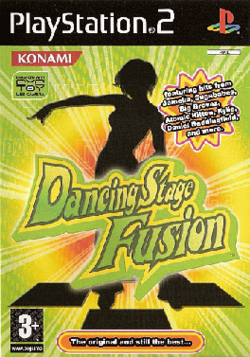

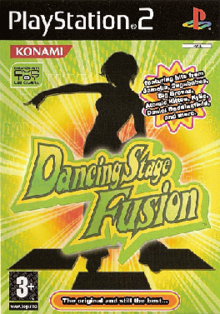
Dancing Stage Fusion is Konami's European-branded DDR entry that arrived on PlayStation and PlayStation 2 in November 2004, with an arcade outing following in April 2005. It wears its Dance Dance Revolution lineage like a sequined tracksuit: familiar arrows, the same ruthless timing, and a songlist that is deliberately less cuddly than earlier Dancing Stage releases. This is not a lazy couch rhythm title where you nod along to the beat while scrolling social media. Fusion asks you to move, to think ahead, and to occasionally accept that your coordination is not the myth you hoped it was. If you want a quick party trick, it has that. If you want a sustained challenge that will chisel your footwork and punish carelessness, it delivers.
At its heart Fusion sticks to DDR's simple premise: arrows scroll up the screen, you step on corresponding panels in time, and the game rewards good timing with points, poor timing with disappointment and exploding combos. What makes Fusion interesting from a challenge perspective is how many levers it hands you to turn the difficulty up or down, and how those levers interact with inherent demands of the better songs on the tracklist. Game Mode supports up to two players, each choosing their own difficulty and settings across up to five songs. This is important: opposing players can pick wildly different challenges, so a novice can tiptoe through a gentle three-arrow waltz while their mate chains together Paranoia-level insanity. The fact that each player configures their experience separately means Fusion becomes a negotiation of pain thresholds during local multiplayer. Versus mode and two-mat support amplify the challenge. Using two dance mats at once is not a novelty you fake for a YouTube clip; it multiplies the required foot independence, turning the floor into a choreography puzzle where left- and right-leg patterns must be juggled like angry puppies. Difficulty tuning is one of Fusion's biggest strengths for players who love to chase mastery. The game exposes a 'substantial number of tweaks and settings' that let you alter scroll speed, judgment windows, and other modifiers that shape how a step chart plays. These options are the difference between a practiceable chart and a punishing gauntlet; speed mods force you to read denser patterns at pace, while narrow timing windows punish sloppy habits. If you're training for precision and want to sharpen rhythm execution, crank up the judgment strictness and watch your life bar file a restraining order. Fusion also includes Workout and Endless modes, each of which reframes difficulty in useful ways. Workout mode converts the game into an endurance trainer: score isn't the only metric, calories and stamina come into play. This is where rhythm gaming crosses over into actual exercise, making the difficulty less about complex chord patterns and more about sustaining motion without sobbing lightly. Endless Mode removes the respite of song breaks and forces you to keep a rhythm through track after track; stamina, mental focus, and step economy become the primary skills under test. Song selection in Fusion is intentionally spicier than some earlier Dancing Stage offerings. The PS2 edition boasts 54 tracks, the arcade 49, and the base PlayStation release a leaner 20. Packed into those lists are several tracks that demand both speed and pattern-reading ability. Classics from the DDR lineage such as Paranoia Survivor and Xenon sit alongside licensed pop and club tracks. The variety matters for challenge: some songs test raw speed and ankle dexterity with rapid singles and jumps, while others test memory and pattern anticipation with complex, repeating sequences. Locked songs on the PS2 add a light progression challenge; unlocking them feels like getting the key to the training dojo. EyeToy support on PS2 is a quirky wrinkle that influences how you approach the game as a challenge. The camera doesn't replace the mat in any meaningful mechanical way, but it adds a layer of performative feedback and forces players to be aware of space and movement in front of the TV. In practice, this means you must manage not only precise foot placement, but also body position and presence - useful if you're training to be spectacle-ready, less helpful if you just wanted a quiet accuracy session at midnight. The player skillset Fusion punishes or rewards includes: precise timing, of course, but also pattern recognition at speed; peripheral awareness when playing with another human; stamina and breath control for long or fast songs; and tactical choice-making when customizing modifiers. Learning to read step charts means recognizing signature shapes - bursts, triplets, crossovers - and letting your feet become reflexive. A good session with Fusion trains fast visual-to-motor translation: see an arrow sequence, execute before your brain asks permission. That's the sweet spot where score-streaks happen and your ego inflates by a degree or two. Multiplayer escalates the psychological difficulty. Competitive modes are not just about executing steps; they're about maintaining composure as someone next to you squeals every time they hit a 1.000-million combo. The adjustable difficulty options mean players of different skill levels can still share the same floor, which is great for party scenes but also invites friendly sabotage when someone purposefully ramps up the speed mods to watch you flail. From a coach's perspective, Fusion is excellent: it lets you calibrate sessions for drills that improve specific weaknesses - timing windows, jump accuracy, or endurance. Finally, the songlist balance is crafted to push you. Fusion is not content to hold your hand through the easy stuff and then randomly drop you into nonsense; the progression from accessible tracks to the more brutal licensed or DDR-heritage songs is deliberate. The inclusion of both arcade and console-only songs on the PS2 gives experienced players fresh puzzles to master while still providing enough familiar material to keep newcomers from being embarrassed in front of their roommates. If the game's challenge has a downside, it's that Fusion's variety exposes hardware weaknesses. Poorly calibrated home mats or a laggy TV can turn a sharp chart into an exercise in frustration. The game trusts your setup to be honest; if it isn't, the difficulty feels unfair. Still, when everything lines up, Fusion rewards practice with consistent, measurable improvement - and that is the purest kind of game difficulty.
Graphically Fusion is not trying to sell you on a visual revolution; its focus is arrows, avatars, and a clean interface that lets your eyes find patterns quickly. The PS2 version tucks in extra flair with EyeToy camera effects and additional licensed song visuals, but the core graphics are functional rather than flashy. This is actually a feature for challenge-driven players: minimal visual clutter means less distraction, which helps you read dense step charts at speed. Avatars and backgrounds provide enough contrast so that arrows don't get lost, but you're never treated to a spectacle that masks the patterns you need to react to. If you want pretty lights and confetti to hide your mistakes, Fusion gives you modest glitter; if you want clean visual feedback to grind skills, it gives you precisely that.
Dancing Stage Fusion is a disciplined, slightly cheeky DDR cousin that prioritizes challenge and training as much as it does party fun. With robust settings, workout and endless modes, EyeToy camera support, two-mat options and a songlist that leans toward the demanding, Fusion is less a casual time-waster and more a gym for your feet and reflexes. It's forgiving where it needs to be for local multiplayer parties, but it refuses to let veterans coast. The main caveat is hardware: your mat, TV, and living room calibration directly affect whether the game feels fair. If you're prepared to treat it like practice - to tinker with modifiers, to work on timing windows and endurance - Fusion will teach you to read patterns faster, step cleaner, and, occasionally, to stop looking ridiculous while doing it. If you're after a shallow 'press-the-pad-occasionally' rhythm distraction, this game will judge you with cold perfection. Recommended for anyone who enjoys a physical, skill-based challenge in their rhythm games, or for friends who like to watch their mates slowly learn humility on a dance mat.
 Dancing Stage Max on PS2
 Dancing Stage Fever on PlayStation
 Dance Dance Revolution SuperNova on PS2
 PixelJunk 4am on PS3
 Pop'n Music 5 on PlayStation
 Pop'n Music 6 on PlayStation
 Dancing Stage Fever on PS2












 Another SquareThought Site